
What Changes in a Public Organization Are Subject to State Registration in 2026
Cost of services:
Reviews of our Clients
Managing a public organization involves not only pursuing its statutory goals, but also carefully complying with the law. In addition to implementing social or charitable projects, it is important to constantly ensure that the organization’s actual status matches the data recorded in the Unified State Register. That is why the state must be informed in a timely manner about changes in the activities of a public organization.
Not all changes in a public organization are subject to state registration. However, those that are cannot be safely ignored. Mistakes or delays may lead to blocked bank accounts, loss of non-profit status, and problems with state authorities.
In this article, we will examine which changes in a public organization are subject to state registration and which are not, what happens if they are not submitted to the register, and how to properly complete the registration of changes in a public organization.
What Changes in a Public Organization Are Subject to State Registration
Any public organization with legal entity status exists for the state not “in practice,” but through the data recorded in the Unified State Register. It is this information that confirms who has the right to act on behalf of the organization, where it is located, what its purposes are, and how its management system is structured.
Therefore, all changes that affect the organization’s identification, governance, or representation are subject to mandatory state registration. Such changes include, in particular:
- Changes in the composition of governing bodies, including the election or replacement of the head, deputy head, members of the highest governing body, or other governing bodies of the public organization.
- Changes to the charter of the public association, including its name, purpose or purposes of activity, decision-making procedures, and the rights and obligations of members.
- Changes in the persons authorized to represent the public organization, both in legal relations with the state and for registration actions.
- A change in the location of the public organization, meaning its legal address.
- A change in the name of the public organization or its abbreviated name.
- The establishment of separate subdivisions of the public association with legal entity status, if this is provided for by the charter.
Thus, any changes concerning the organizational structure, governance, charter provisions, or legal representation of a public organization are subject to mandatory state registration in order to preserve its legal entity status and its ability to operate lawfully in Ukraine.
You might also like: Amendments and signing of the Charter: who has the right to sign and what key legal aspects to consider
Time Limits for Notifying Authorities of Changes in a Public Organization
According to the law, any public organization operating with legal entity status must notify the state register of amendments to its charter and changes in the structure of its governing bodies within 60 days from the date the relevant decision is adopted.
Which Changes in a Public Organization Are Not Subject to State Registration
Ukrainian legislation clearly distinguishes between changes that must be reflected in the Unified State Register and those that relate solely to the internal activities of a public organization.
If the changes do not affect the organization’s governance, representation, charter provisions, or identifying information, they do not require state registration and may be formalized through the organization’s internal decisions. Such changes include:
- Internal organizational decisions that do not concern the governing bodies or the organization’s representation before the state, such as approval of the annual work plan, internal rules for holding meetings, or the distribution of responsibilities among members of the governing bodies.
- Internal regulations of separate subdivisions, provided they do not acquire legal entity status.
- Internal personnel changes among ordinary members of the public organization that do not involve the election or replacement of the head, deputy head, or members of the highest governing body, such as changes in the composition of working groups, commissions, or temporary committees.
- Changes relating to internal documentation or record-keeping, such as meeting logs, internal minutes, or internal financial allocations, provided they do not affect the charter provisions or the organization’s rights of representation.
- Financial and operational activities carried out within the scope of the charter, including:
- receiving grants or donations;
- entering into contracts;
- using funds in accordance with the statutory purpose
(provided that such activities do not change the information entered in the Unified State Register).
Consequences of Failing to Register Changes in a Public Organization
Ukraine’s registry system is based on the principle of formal compliance. If mandatory changes are not entered into the Unified State Register within the prescribed time limit, the consequences arise automatically, without warnings or any “human factor.”
The main risks for a public organization in the event of failure to register changes include:
- Blocking of bank accounts. Banks regularly verify an organization’s data against state registers. If information about its managers, location, or charter does not correspond to reality, transactions may be suspended.
- Loss of non-profit status. Non-profit status allows an organization to reduce its tax burden and receive grants. Failure to update the register in time may result in the cancellation of that status.
- Fines and claims from state authorities. Discrepancies in the Unified State Register, or violations of requirements relating to the charter or governing bodies, may lead to administrative sanctions, including fines ranging from UAH 17,000 to UAH 340,000.
- Loss of the legal validity of the organization’s decisions. If the documents do not reflect the current composition of the leadership, transactions and agreements may be challenged as invalid.
All of these consequences can seriously complicate the activities of a public organization and may even put its continued existence at risk.
How to Register Changes in a Public Organization
Registering changes in the public organization register is a formal process, but it is quite manageable if you follow a clear procedure:
- Adoption of a decision by the highest governing body. The changes must be approved by the body authorized under the charter, such as a congress, conference, or general meeting.
- Preparation of the minutes and supporting documents. The minutes must contain information about the type of changes, the date of the decision, the list of participants, and the signatures of the organization’s leadership.
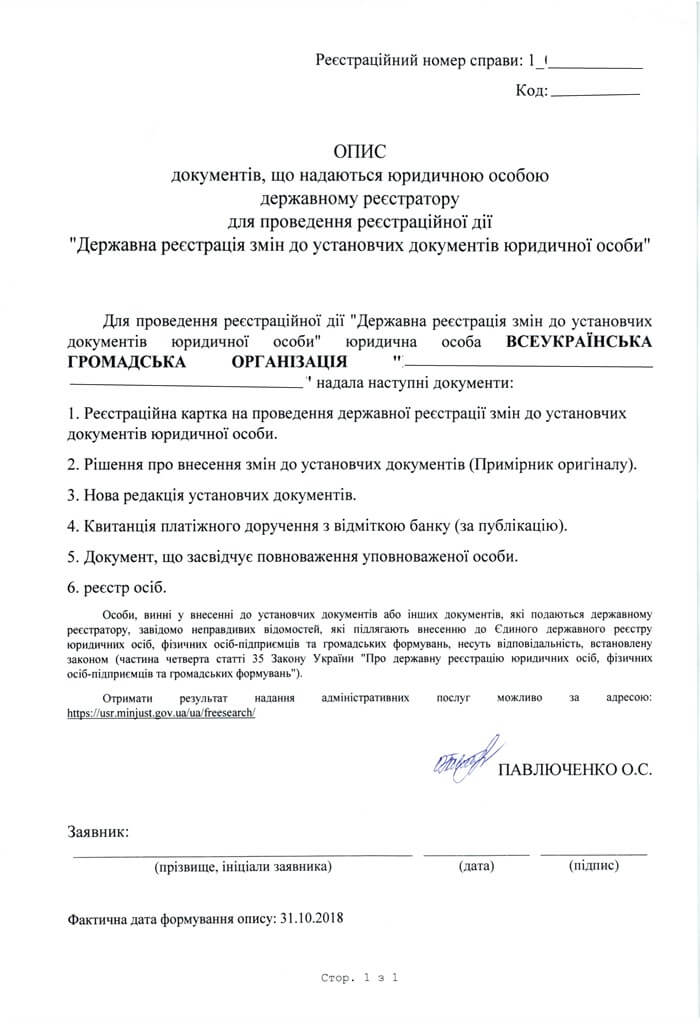
- Preparation and submission of documents to the state register. This can be done through the Administrative Services Center or the Ministry of Justice. To register changes in a public organization, it is necessary to submit an application for state registration of changes to the information in the Unified State Register, the decision of the authorized governing body on such changes (in the original or a notarized copy), proof of payment of the administrative fee, if required, as well as the constituent documents in a new edition if the changes affect them.
Depending on the nature of the changes, additional documents may also be required, including a register of participants in the meeting, information on the governing bodies, documents confirming termination or suspension of membership, a transfer act or division balance sheet, and, in the case of changes concerning ultimate beneficial owners, documents confirming identity, ownership structure, and, where applicable, registration of a non-resident founder. - Receipt of confirmation of registration of the changes. After registration, you will receive updated information in the Unified State Register, which formally legalizes the changes.
Benefits of Professional Legal Support When Registering Changes in a Public Organization
At first glance, amending the charter or changing the composition of a public organization’s governing bodies may seem like a simple formality. In reality, however, this process involves a number of legal pitfalls, and overlooking even a single detail can have serious consequences. Engaging an experienced lawyer helps avoid such risks.
Compliance Review
Every change must comply with the requirements of the Law of Ukraine “On Public Associations” and other regulations governing the activities of non-profit organizations. A lawyer will verify whether the rules regarding managers, membership, property, and non-profit status are being observed.
This is especially important for organizations that receive grants or funding, since even minor violations may become grounds for the cancellation of benefits.
Proper Preparation of Documents
Whether the minutes of the meeting, the decision of the highest governing body, and the charter amendments are accepted by the state register depends on how they are drafted. Even a small mistake, such as using different names for the governing body in different documents, for example, “board” in the charter and “commission” in the decision, may lead to a refusal.
A lawyer reviews all documents for compliance with formal requirements and helps prepare them in the correct wording, minimizing the risk of resubmission and delays.
Minimizing the Risk of Losing Non-Profit Status
Non-profit status gives an organization the right to tax benefits and access to grants. A lawyer develops a step-by-step approach to implementing the changes so that all documents comply with the law and preserve the organization’s status without additional inspections or risks.
Advice on Complex Cases
Situations involving changes in leadership, reorganization, or the establishment of separate subdivisions require special attention. A lawyer assesses potential conflicts among members of the organization, recommends the most effective course of action, and helps prepare the documents in a way that avoids problems with the state register. This allows the organization to implement changes as safely and efficiently as possible.
Saving Time and Resources
Incorrectly prepared documents lead to repeated refusals, delays in registration, and additional costs. With professional legal support, you can significantly reduce the time and effort involved.
Proper legal assistance ensures not only compliance with the law, but also the stability and security of the organization’s operations, creating a solid foundation for its future development.
Successful case: Updating NGO Founding Documents: A Case from Legal Practice
Legal Support for Changes in a Public Organization: Protection Against Mistakes
Every change within an organization has strategic importance. That is why the approach to implementing it must be precise and well thought out, taking into account the unique needs and specific features of your public organization.
Our lawyers have deep knowledge of the law and extensive experience in supporting public organizations, which allows us to prevent mistakes and ensure the legal soundness of every step.
We offer tailored solutions that align with your development strategy rather than relying on standard templates. Our advantages include:
- Deep expertise and practical experience. We help prevent common mistakes and risks that may lead to blocked accounts, fines, or loss of non-profit status.
- Comprehensive support from preparing documents to submitting them to the Unified State Register, so that your changes take legal effect without delays.
- Clarity and simplicity. We speak your language, without complicated legal terms, and provide clear steps that allow you to act with confidence.
Do not put off until tomorrow what can make your public organization stronger today. Contact us, and we will help you take every step with confidence and reliability.
Learn more about registering changes in a public organization with our support here.
Our clients