

Reserving Beneficiaries of Critically Important Enterprises: Key Aspects
Cost of services:
Reviews of our Clients
... our work on joint projects assured us of your high level of professionalism
For business owners, retaining a key management team is a top priority during wartime. However, the greatest risk to a company’s stability arises when mobilization directly threatens the beneficiary, the person who makes strategic decisions and controls financial flows. The loss of the actual leader can paralyze the operations of even a critically important enterprise.
This is where many entrepreneurs face a practical dilemma. Is it possible to reserve the ultimate beneficial owner if they are not formally employed under a labor contract? Legal uncertainty and common myths around this issue often prevent businesses from using lawful mechanisms to protect their leaders, exposing them to unnecessary risks.
In this article, we clarify all the key aspects of reserving beneficiaries. You will learn how to legally arrange a reservation for an owner without a labor contract, what requirements the state sets for such individuals, and how to avoid critical documentation errors that may lead to rejection.
You might also like: Employee Reservation Quotas: How to Calculate Them and Increase the Limit to 100%
Who Is a Beneficial Owner?
Under the law, the ultimate beneficial owner is an individual who exercises decisive control over an enterprise, regardless of whether they hold a formal ownership stake in its authorized capital. Such decisive influence may be exercised directly, through ownership rights to the company’s assets, or indirectly, through other financial and legal mechanisms.
In the context of reservation from mobilization, the beneficiary is a key figure in ensuring business continuity. This person may be responsible for strategic management, financing, and making critical decisions. For this reason, the state allows such individuals to be granted a reservation.
Can a Beneficiary Who Is Not an Employee Be Reserved?
Yes, reserving business owners is possible even under these conditions. Ukrainian legislation, in particular Cabinet of Ministers Resolution No. 76, allows for the reservation of ultimate beneficial owners regardless of whether they are in an employment relationship with the company. Having an employment contract, receiving a salary, or holding a position in the official staff list is not a mandatory requirement.
This means that a company does not need to formally appoint the owner to its staff, for example as a director or advisor, solely for the purpose of reservation.
Three conditions under which a beneficiary can be reserved:
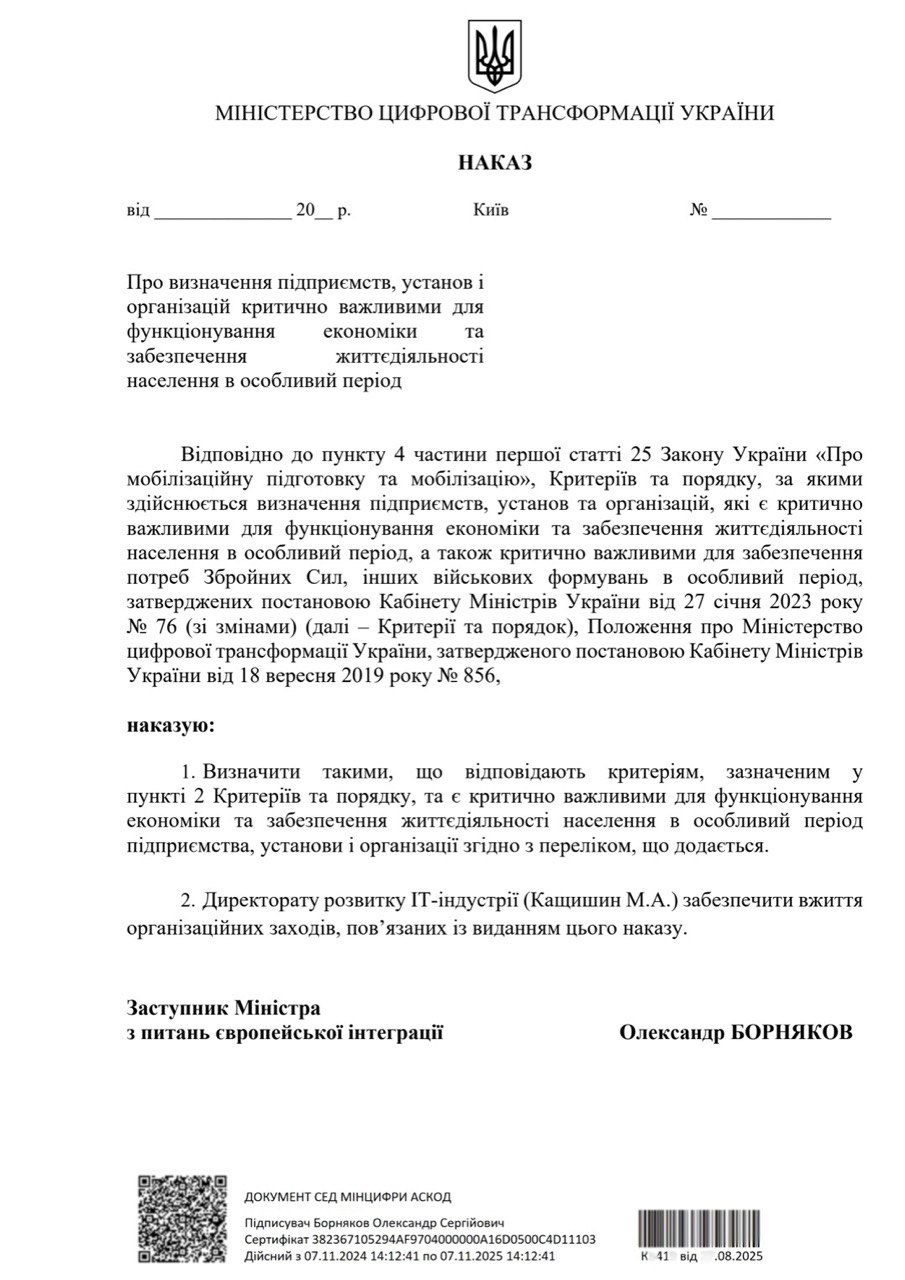
- Company status. The company must have a valid status as critically important to the economy or to the needs of the Defense Forces, confirmed by an order of the relevant ministry or regional military administration.
- Registration in the Unified State Register. Information about the individual must be clearly recorded in the Unified State Register under the Ultimate Beneficial Owner section. The reservation system verifies the person based on this specific entry.
- Military registration. The beneficiary must be registered for military service, possess a military registration document, and have up to date personal data in the Oberih register.
How does this work in practice? The inclusion of a beneficiary in reservation lists follows the standard procedure through the Diia portal or the relevant authorized body. However, instead of employment details such as position and salary, the basis for reservation is confirmation of ownership rights and control over a critically important enterprise, as reflected in the Unified State Register.
You might also like: Military Registration Checks by Territorial Recruitment Centers: Common Violations and How to Avoid Them
What Can Lead to a Refusal or Cancellation of a Reservation for an Ultimate Beneficial Owner?
The procedure for reserving military liable beneficiaries is highly formalized and regulated by Cabinet of Ministers of Ukraine Resolution No. 76 dated January 27, 2023. Errors in documentation, inaccurate information, or procedural violations may result in either a refusal to grant a reservation or the cancellation of an already approved one.
It is also important to note that the reservation process has been further digitalized. As mentioned above, beneficiaries can now be reserved through the Diia portal. This means that decisions are made by an automated system that cross checks data across multiple state registers. As a result, even minor discrepancies can lead to an immediate refusal.
The most common mistakes that leave ultimate beneficial owners of critically important enterprises without protection:
- Outdated military registration data
Reservation is possible only if the beneficiary is registered for military service, holds a valid military registration document, and has updated their personal data through Reserve+ or a Territorial Recruitment Center. If a beneficiary has an old Soviet era military ID or failed to update their data in time, the system will block the application. - Incorrect status in the Unified State Register
In some cases, an owner effectively manages the business, but information about the Ultimate Beneficial Owner in the Unified State Register is missing, incomplete, or outdated. The Diia portal pulls data exclusively from this register. If the register does not list the person as a beneficial owner, the system will not recognize them as eligible for reservation. - Loss of critically important enterprise status
A reservation remains valid only as long as the company retains its critically important enterprise status, which is typically granted for one year.
Correcting errors after a refusal is both time consuming and risky, as mobilization may occur while documentation issues are being resolved. The most effective solution is a preliminary audit.
Legal support during the reservation process, combined with a full data review across all relevant state registers before submission, helps identify and eliminate discrepancies in advance so your application passes verification on the first attempt.
You might also like: How Not to Lose the Status of a Critical Enterprise
Legal Assistance With Reserving a Beneficial Owner
Today, the reservation of ultimate beneficial owners is carried out in accordance with the applicable procedure, and with professional support this process can be completed as efficiently as possible. We provide comprehensive reservation services and have already helped many companies successfully complete this procedure while avoiding bureaucratic delays and unnecessary complications.
We can help you with the following:
- Clarifying all procedural details. We explain who is eligible for reservation, how to complete applications correctly, and which documents are required.
- Preparing and submitting documents. We draft all necessary applications, certificates, and cover letters for the relevant authorities and verify their compliance with the established procedure.
- Reserving beneficiaries. We support the reservation process through the Diia portal and through state authorities.
- Updating records. We verify that beneficiary information in state registers is up to date and make corrections where necessary.
With our support, your company can secure beneficiary reservations quickly and safely, avoid errors and delays, and ensure full compliance with current legislation.
Does your company have critically important enterprise status? Do not delay protecting the owner. Contact us to review your documents and submit a reservation application for the ultimate beneficial owner as soon as possible.
Our clients