

Critical Enterprise Status for Small and Medium-Sized Businesses
Cost of services:
Reviews of our Clients
... our work on joint projects assured us of your high level of professionalism
For Ukrainian small and medium-sized businesses, hereinafter referred to as SMBs, the status of a critical enterprise has turned from an administrative option into a condition for survival. In teams of 10 to 50 people, the mobilization of even two or three key specialists, such as a chief engineer, lead developer, or logistics manager, can paralyze operational processes.
Unlike giant corporations, SMBs do not have a personnel reserve that allows them to quickly replace highly specialized specialists. Obtaining critical status is the only way to reserve employees, allowing business owners to move from “putting out fires” to strategic planning.
So, let us look at how this process works and how a small company can become critical and reserve its team so that it can continue operating instead of shutting down because of staff shortages.
Economic Role Criterion: Why a Small Company Can Be Critical
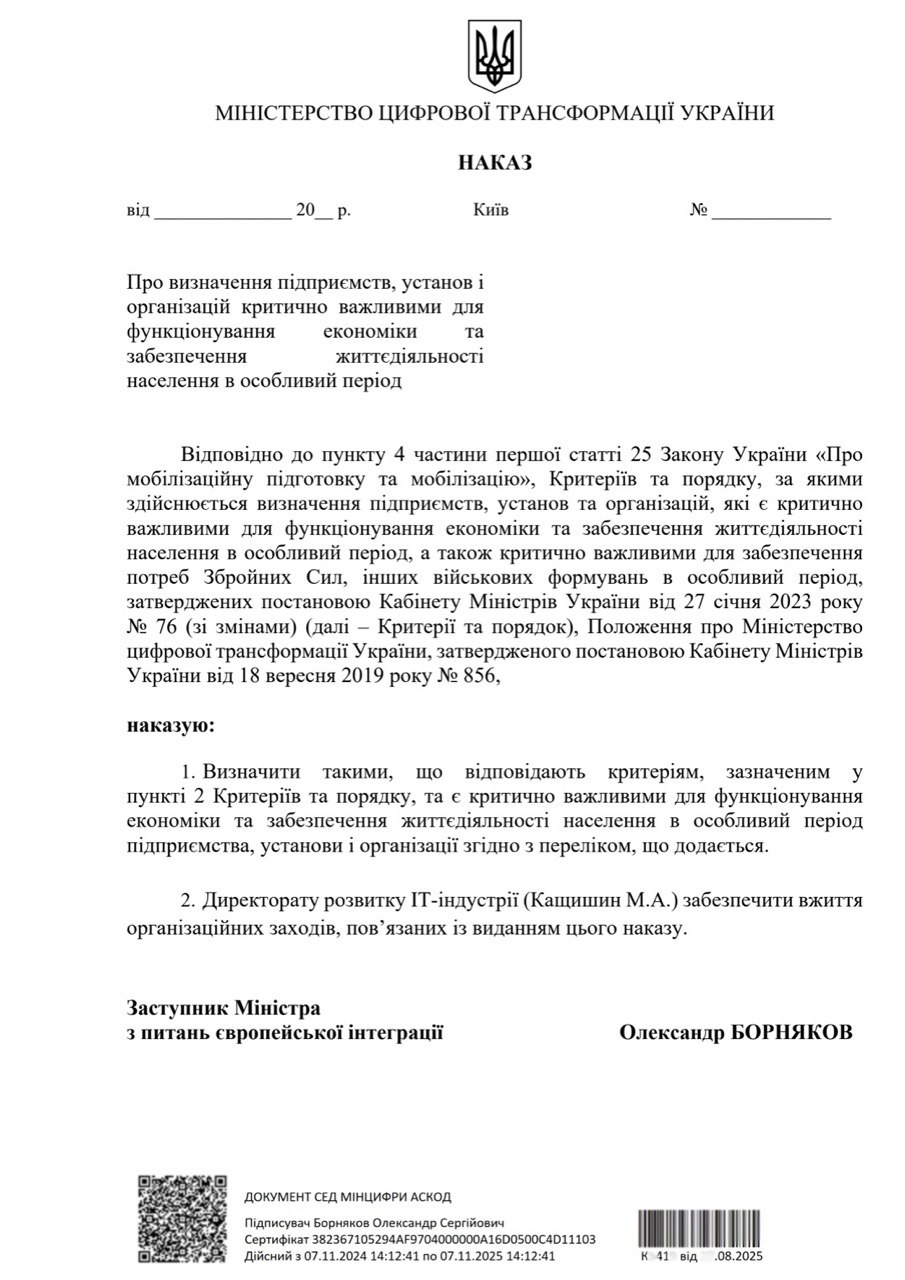
The regulatory basis for recognizing enterprises as critical is Resolution No. 76 of the Cabinet of Ministers of Ukraine. It establishes the criteria for classifying a business as one that is important for the functioning of the economy and for ensuring the vital needs of the population during a special period.
More on the topic: Which businesses can reserve employees?
In practice, this status is a state policy tool aimed at maintaining economic stability during wartime. Obtaining the status allows an enterprise to:
- reserve employees;
- reduce the risk of operational shutdown;
- ensure the performance of contractual and production obligations;
- maintain stable work processes.
It is important to understand that the state evaluates not the size of the enterprise, but its functional role in the economy, industry, or region. Even a small company can be “critical” if it is a link in a chain, for example, supplying a large defense plant or ensuring the vital needs of an entire community.
Myths and Realities: Can SMBs Actually Obtain Critical Status?
The most common mistake business owners make is believing that only large companies with thousands of employees or significant turnover can obtain critical enterprise status. In reality, the size of the enterprise is not a disqualifying criterion. Small and medium-sized businesses can successfully complete the procedure if they meet the established requirements.
Relevant for founders: Can a Startup Obtain Critical Enterprise Status
Moreover, in many cases, it is small and medium-sized businesses that find it easier to obtain critical enterprise status due to:
- Regional and sectoral criteria. Your company may be a key bread supplier for a district, the only service station for agricultural machinery in a region, or an IT team that supports software for local hospitals. Where large corporations do not see major profits, you may be sustaining the life of an entire region.
- Confirmation of the importance for the local economy. For a small town, you may be a major employer whose taxes support street lighting and the operation of kindergartens. When you employ 30 to 40 people, you are no longer just a “business,” but the foundation of well-being for dozens of local families, and the authorities understand this.
It is worth saying that, in practice, the key role is not played by the scale of the business, but by the correct legal strategy for preparing documents to obtain critical status. A mistake in a single word of the justification can lead to refusal, while thorough preparation turns the process into a predictable result.

General Requirements for Obtaining Critical Status
To obtain the status of a critical enterprise, a company must meet three or more criteria defined by Resolution No. 76 of the Cabinet of Ministers of Ukraine. At the same time, two criteria are mandatory.
1. Salary level. The average salary of the enterprise’s employees must be no lower than 2.5 times the minimum wage.
This criterion is under constant state control. After the introduction of monthly employer reporting, tax authorities can quickly verify compliance with this requirement. Violation of the salary criterion may lead to:
- loss of critical enterprise status, if it has already been obtained;
- cancellation of employee reservation if non-compliance is identified during an inspection;
- inability to reapply for the status for a certain period, which puts the entire reservation process at risk.
This criterion is usually confirmed by:
- a certificate of average salary;
- tax reporting on income and the Unified Social Contribution.
2. No debt for the payment of:
- taxes;
- fees;
- the Unified Social Contribution.
This is confirmed by a certificate from the State Tax Service showing the absence of debt. The certificate has a limited validity period of 10 calendar days and must be valid at the time the documents are submitted to the relevant ministry or regional military administration.
Without meeting these two criteria, obtaining critical status is impossible, regardless of how significant your other indicators may be.
Regional and Sectoral Criteria: A Strategic Path to Employee Reservation for Small and Medium-Sized Businesses
For SMBs, sectoral and regional criticality criteria approved by regional military administrations or the relevant ministry are especially important. These criteria often allow an enterprise to:
- confirm its role in ensuring the vital needs of the community;
- justify its economic importance;
- prove the need to reserve employees.
These criteria may take into account:
- participation in supporting critical infrastructure, such as energy, water supply, communications, and similar areas;
- provision of socially important services, such as food production, logistics, or healthcare;
- the importance of the enterprise for the regional economy, including export volume, number of jobs, and other indicators;
- performance of state or defense orders, including direct contracts, subcontracting, and similar arrangements.
For small and medium-sized businesses, this mechanism is often the most realistic path to obtaining critical enterprise status.
You might also like: Employee Reservation Quotas: How to Calculate and Increase the Limit to 100%
Legal Strategy: How to Avoid Refusal When Submitting Documents
Obtaining critical enterprise status is not only about preparing a standard package of documents. It is a process that involves:
- Analysis of compliance with the criteria. This means not just looking at the figures, but also understanding how to confirm them.
- Determining the optimal authority for submission. It is important to understand where it is better to apply, either to the relevant ministry or to a regional military administration, since the strategy depends on the specifics of your business activity.
- Building the evidence base. Critical status is not granted automatically. It must be “earned” through proper justification of each criterion.
- Proper legal justification of the enterprise’s importance. This includes preparing a cover letter that clearly explains to state authorities why your company is indispensable.
The most common problems SMBs face when apply:
- a formal approach to document preparation, including copying someone else’s justifications that do not reflect the real specifics of the business;
- incorrect selection of criteria, such as applying under criteria that the business only partially meets;
- insufficient justification of the enterprise’s role, with no clear emphasis on what would happen to the industry or region if the company stopped operating;
- errors in supporting documents, including mismatched dates, missing stamps, or outdated certificates.
These are the factors that most often lead to refusal, creating the risk of losing both time and key personnel.
Legal Assistance in Obtaining Critical Status for Small and Medium-Sized Businesses
As a law firm, we take on the full burden of the bureaucratic procedure and support clients at every stage of obtaining critical enterprise status:
- audit of compliance with the criteria;
- determination of the optimal strategy for obtaining the status;
- preparation of documents;
- formation of the evidence base;
- communication with authorized bodies;
- support until the decision is obtained.
Our practical experience shows that obtaining critical status is a fully realistic goal for small and medium-sized businesses, provided that the legal preparation is done correctly.
Get legal support for the procedure of recognizing your enterprise as critically important. Book a consultation for a detailed analysis of your chances and preparation of a reservation strategy.
Services on the topic of this material
Our publications on this matter


Our clients