

Legal business support of veterinary clinics
Cost of services
Reviews of our Clients
... our work on joint projects assured us of your high level of professionalism
What we offer
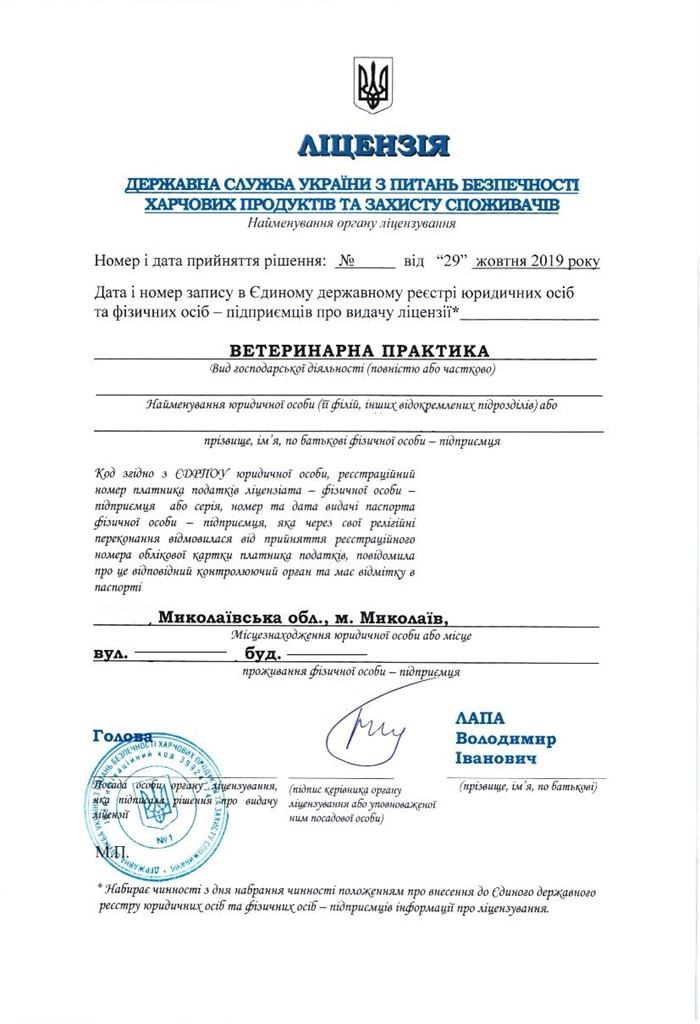
- Obtain a veterinary practice license, extend its scope and update its details, and provide legal support for opening new places of business (branches).
- Obtain a license for activities involving narcotic drugs, psychotropic substances and precursors for pain management and surgery, where needed.
- Review and draft leases for premises, contracts for the supply of veterinary drugs and equipment, and agreements with other business partners, including waste disposal providers.
- Develop HR documentation, including orders on hiring, dismissal and transfer, employment contracts, and job descriptions.
- Prepare documents for patient care, including veterinary service agreements, informed consent to surgery / anesthesia, and the clinic’s internal rules.
- Provide advice and written explanations on legal issues that arise in the day-to-day operation of a veterinary business.
Documents Needed to Begin Legal Support for a Veterinary Practice

A monthly retainer allows you to entrust your veterinary clinic’s ongoing legal matters to one team, from licensing and staffing to contracts, claims, and new locations. You do not have to find a separate lawyer each time and explain how your business works all over again.
How Legal Support for a Veterinary Clinic Begins
At the outset, we agree on how we will work together and the approximate scope of legal work. To do this, we need to understand both your business’s legal structure and how your clinic actually operates each day. We therefore ask about the following:
- Formation and authorization documents: an extract from the USR, the current charter, a copy of the veterinary practice license, if available, or current authorization documents.
- Premises and equipment: the lease or proof of ownership of the premises, information on X-ray equipment, and the use of narcotic drugs or preparations containing precursors.
- Organizational structure: the staffing schedule and information on staff numbers.
- Areas of veterinary practice: small companion animals, exotic species, farm animals, inpatient care, mobile services, and so on.
- Supplier details: suppliers of veterinary drugs, equipment, and other goods and services critical to the clinic’s operations.
- Waste management: information on the specialist company that disposes of biological and medical waste, including whether a contract is in place and its terms.
We need this information for more than a routine collection of documents. It allows us to identify immediately where the clinic’s actual operations match its documentation and where gaps could create risks during an inspection, an employee dispute, or a client claim. This helps us determine which legal issues take priority for your clinic and how much support you actually need.
Initial Legal Audit of an Existing Veterinary Clinic
Legal services on a monthly retainer are available both to new veterinary practices and to clinics that are already operating.
At the outset, we can check:
- whether actual places of business match the information on record and the authorization documents;
- whether staff employment is properly documented;
- whether the necessary contracts, job descriptions, and internal documents are in place;
- whether dealings with pet owners are properly documented;
- how surgery, anesthesia, and other procedures involving risk are addressed;
- whether the documentation reflects the actual handling of drugs, equipment, and waste;
- whether there are any critical gaps in contracts with suppliers and the landlord.
The initial audit does not result in a list of every possible shortcoming or a proposal to redo all the documentation at once.
We prioritize the issues: first, those that may affect the clinic’s ability to operate and its current financial interests; then, those that can be addressed on a planned basis.
This ensures that legal hours are spent on your business’s actual needs.
Licensing and Changes in the Clinic’s Operations
Veterinary practice is a licensed business activity in Ukraine. In 2026, it is no longer possible to begin this activity solely on the basis of a declaration. Licensing follows the established procedure of the State Service of Ukraine on Food Safety and Consumer Protection (State Food and Consumer Service).
For a client on a monthly retainer, obtaining a license once is only part of the process. It is also important to assess the legal implications of changes in the veterinary business in good time. For example, a lawyer should be involved before, rather than after:
- opening a new veterinary office or clinic;
- moving to different premises;
- expanding the range of services;
- installing new equipment;
- making significant staffing changes;
- starting to use controlled drugs.
You do not have to determine on your own whether a particular change requires an update to the license, a new document, or another legal step. You tell us about the planned change, and we review its legal implications before it is implemented.
This allows you to put the legal arrangements in place first, before investing in new premises, equipment, or an area of practice.
Narcotic Drugs, Psychotropic Substances and Precursors
If a veterinary clinic uses drugs subject to the rules governing narcotic drugs, psychotropic substances or precursors, authorization to practice veterinary medicine alone is insufficient.
These activities are subject to separate licensing conditions and are overseen by the State Medicines Service. The relevant licensing requirements continue to apply in 2026.
As part of ongoing legal support, we can help assess whether your operating model requires this license, review the documentation before you begin using the drugs, and guide you through the necessary licensing process.
Documents for Working with Pet Owners
A clinic needs both to provide quality veterinary care and to properly document its communication with the pet owner: what was explained, the scope of the procedure agreed to, and the recommendations provided. Depending on the practice’s operations, the following documents may be used:
- a veterinary service agreement;
- informed consent to surgery;
- consent to anesthesia;
- hospitalization and inpatient care documents;
- a record of refusal of a recommended examination or treatment;
- internal rules;
- other forms for the clinic’s specific procedures.
These documents should reflect how the veterinarian actually works. We adapt them to the clinic’s processes so that staff understand exactly when each document is needed and what it must record.
Employment Matters in a Veterinary Business
A veterinary clinic is also an employer, so some legal issues concern the team rather than animal treatment.
Issues that may arise during operations include:
- hiring and dismissing employees;
- transfers and changes in duties;
- documenting work schedules;
- employment disputes;
- employee liability for financial loss or property damage;
- confidentiality and the use of the clinic’s internal information.
With retainer-based legal support, you can involve a lawyer before making a staffing decision: have an order reviewed, check a contract, prepare a job description, or determine the correct procedure for a specific situation. This allows you to document staffing decisions properly from the start instead of correcting the paperwork afterward.
How Long It Takes to Begin Legal Support
The time needed for the initial review depends on the number of clinics, employees, documents, and issues that have already accumulated.
For a small veterinary office, reviewing key documents and setting priorities may be sufficient. A network of clinics with multiple premises, a large staff, inpatient facilities, X-ray equipment, or controlled drugs will require a broader initial audit.
Before the main work begins, we agree on what to review first and the outcome the client should receive, so that legal support hours are spent on the clinic’s current needs.
Service packages offers

- Oral and written legal advice on veterinary legislation and client relations (up to 2 hours per month).
- Documentation of employee hiring and dismissal, and preparation of standard employment contracts and job descriptions.
- Provision of pet owner informed consent forms for medical procedures and anesthesia.

- Oral and written legal advice on veterinary legislation and client relations (up to 3 hours per month).
- Drafting and legal review of contracts with drug and equipment suppliers, contractors, and biological waste disposal providers.
- Comprehensive HR recordkeeping and implementation of employee liability agreements and non-disclosure agreements (NDAs).

- Oral and written legal advice on veterinary legislation and client relations (up to 3 hours per month).
- Legal support during scheduled and unscheduled inspections by the State Food and Consumer Service and the State Labor Service.
- Review and updating of veterinary practice license details when equipment or staff changes.
- Legal resolution of disputes with pet owners and preparation of responses to complaints and claims.
Cost of Legal Services for Veterinary Clinics on a Retainer
The cost depends on the package you choose and the actual scope of your clinic’s operations. Packages differ in the number of consultation hours and, above all, in the range of legal matters we handle on an ongoing basis.
The choice of package and the final scope of work depend on the number of clinics or veterinary offices, staff numbers, the nature of current legal issues, and the processes that require regular involvement from a lawyer.
For example, a clinic that needs advice, HR documentation, and basic forms for working with pet owners does not need the same level of support as a network opening new locations, undergoing inspections, and handling claims.
What the Package Includes
For each package, we define the scope of work and any consultation limits in advance. You know which tasks you can assign to our team as part of your monthly service.
If the clinic’s needs change during our work together, the package can be revised to reflect the actual legal workload.
When a Task Falls Outside the Package
We do not automatically begin separate projects that fall outside your chosen package or require significantly more work. We first determine the scope of the task and agree with you on how it will be handled and what it will cost.
This is particularly important for separate licensing projects, litigation, large-scale openings of new facilities, or other tasks beyond routine support.
Additional Expenses
Government payments, licensing fees, notary fees, and other third-party expenses should not come as a surprise once work is underway. If they are necessary for a particular task, we identify them separately and inform you before taking the relevant action.
Before we begin working together, you know which service package you have chosen, which tasks it covers, which limits apply, and which work will require separate agreement.
Why us


Our clients
When Involving a Lawyer Is Especially Important
Your License Must Reflect the Clinic’s Actual Operations
The absence of a license is not the only source of legal risk. Problems may also arise when documents were prepared for one operating model, but the clinic has since changed how it works. For example, its premises, staff, equipment, or range of services may have changed, or it may have introduced new drugs.
As part of ongoing legal support, it is therefore important to notify your lawyer before making significant operational changes so that their legal implications can be assessed first.
If the Clinic Still Relies on a Martial-Law Declaration
Since January 31, 2026, it has no longer been possible to begin veterinary practice by filing a declaration. Businesses that had previously operated under a declaration were required to move to the licensing procedure.
If the clinic’s documentation still contains only the old declaration, this issue should be reviewed as a priority. In this situation, it is inadvisable to postpone the review until a future inspection.
If an Inspection Is Planned or Has Already Begun
During an inspection, what matters is both whether individual documents are in place and how accurately they reflect your veterinary practice’s actual operations.
Before an inspection, it is advisable to review authorization documents, HR documentation, contracts, and documents relating to the premises, drugs, equipment, and other processes relevant to the particular practice.
If an inspection has already begun, our lawyer can assess the regulatory authority’s requests, prepare documents, analyze the findings, and help determine the next steps.
If You Receive a Claim from a Pet Owner
A dispute with a client can arise even when the veterinarian has acted professionally. The treatment outcome is often only part of the issue; what was explained to the owner, what they agreed to, and which recommendations they received also matter. This is why contracts, informed consent forms, records of refusal to follow recommendations, and medical records must work together as a single system.
Once a claim has been received, we first analyze the documents and the facts, then help determine the appropriate response: provide a reasoned explanation, negotiate, or prepare to take further steps to defend the clinic’s interests.
X-Ray Equipment, Waste, and Specialized Processes
X-ray equipment, the use of certain drugs, inpatient care, and the disposal of biological and other waste may require separate legal preparations.
When you engage our services, we therefore do not assume that every veterinary practice needs the same set of documents. We first identify the particular clinic’s activities and then determine which matters require legal oversight.
Answers to frequently asked questions
If the monthly retainer fee has been paid but the funds have not been used, can they be refunded or carried over to the next month?
As a rule, if the client has had no legal questions at all during the current month, the service payment is carried over to the next month. Funds are refunded only if our engagement ends. However, this happens very rarely—for example, when a client decides to cease operations.
Can the legal services package be changed during the engagement?
Yes. If the agreed number of legal hours no longer meets the clinic’s needs, the terms of our engagement can be changed. We document the new package terms in an addendum or another manner agreed by the parties. An early adjustment to the package should not, in itself, result in a penalty for the client.
Can an existing veterinary clinic engage you for ongoing legal support?
Yes. In this case, it makes sense to begin with an initial audit of key documents and processes. We identify the issues that need urgent correction and those that can be updated on a planned basis as part of retainer-based legal support.
Can you support a veterinary clinic during an inspection?
Yes, if this is included in the agreed scope of work. A lawyer can help prepare documents, assess the regulatory authority’s requirements, analyze inspection materials, and determine the clinic’s position going forward.
When a Monthly Legal Retainer Offers a Veterinary Clinic More Value Than a One-Time Engagement
A one-time engagement with a lawyer works well when there is a single, specific task.
Legal services on a monthly retainer are more appropriate when legal issues arise regularly: the clinic hires staff, enters into contracts, works with suppliers, opens new locations, updates documents, receives claims, or plans new areas of practice.
The main advantage is that the lawyer does not start each task from scratch. They already understand the structure of the veterinary business, have access to previous documents, and can assess a new decision in the context of the entire clinic.
Opening a Second Clinic or a New Veterinary Office
Scaling a veterinary business involves more than finding premises and staff.
Before launching a new location, you need to assess its implications for authorization documents, the lease, staffing arrangements, equipment, suppliers, and documents for pet owners.
If we already support your veterinary business, there is no need to analyze the basic operating model from scratch. We adapt it to the new location and the new scope of operations.
If an Urgent Situation Arises at the Clinic
Not every legal task can be planned a month in advance. An employee may resign unexpectedly, a client may file a claim, a regulatory authority may request documents, or the landlord may propose new contract terms.
With a monthly retainer, you already have a team that knows your business. When a new issue arises, less time is spent collecting basic information again, leaving more time to work directly on a solution.
How We Work with You
At the start of our engagement, we collect key documents, examine the clinic’s operating model, and establish legal priorities. You then assign tasks as they arise. Before carrying them out, we agree on what needs to be done, which documents will be required, and how much time we expect to use.
If a task goes beyond routine support—for example, if it requires a separate licensing project, litigation, or substantial work with a regulator—we inform you before starting that work and agree on the arrangements separately.
This allows you to control legal expenses while having support with issues that arise in the day-to-day operation of your veterinary clinic.
If you would like to entrust your veterinary practice’s legal matters to an ongoing support team, contact Pravova Dopomoga. We will identify the initial risks, recommend priorities, and tailor the scope of legal services to your clinic’s actual workload.
We are ready to help you!
Contact us by mail [email protected] or by filling out the form:Our publications on this matter



Our team