

How to Launch a Private Ambulance Service: Licensing Requirements in Ukraine
Cost of services:
Reviews of our Clients
…we can confidently recommend the lawyers of Law firm «Pravova dopomoga» as reliable legal partners on the matters of medical practice licensing and other procedures related to the Ministry of Health of Ukraine.
... Having used the services of the Law Firm "Pravova dopomoga", we managed to solve our problems, as well as found a qualified and reliable partner.
The idea of opening a private ambulance service seems logical: there is demand, the market is growing, and the state system does not always cover existing needs. Indeed, in recent years, demand for private hospitalization and interhospital transportation has grown significantly. In practice, however, this area is one of the most complex in the medical business. In addition, creating an emergency medical services business in Ukraine requires not only significant investment, but also flawless knowledge of the regulatory framework.
The approach of “let’s open a clinic and figure it out later” does not work here. Ambulance service means real readiness to respond to a call, which means people, vehicles, equipment, and documents that must be brought together into a single system before applying for a medical practice license from the Ministry of Health.
The most common scenario clients come with is this: there is an idea, sometimes even a vehicle or a team, but no understanding of how to structure it legally. As a rule, this is exactly where mistakes arise: incorrectly declared types of activity, the wrong staff composition, an “unprepared” facility, and similar issues.
In this article, we will look at what exactly is needed to obtain a medical practice license for an ambulance service, what this process actually looks like, and at which stages problems most often occur.
Who Can Obtain a Medical Practice License for an Ambulance Service
Let’s start with the main point: an ambulance service can be opened not only by a doctor. This is good news for investors and entrepreneurs who want to enter this field as a business, rather than purely as a medical practice. The law allows both individual entrepreneurs and LLCs to obtain a medical license. However, it is important to look not only at what is “allowed,” but also at what actually suits your format.
If you are planning a small medical project, for example, one team serving a specific district or route, you may consider the individual entrepreneur option. In this case, it is worth studying in advance how a doctor operating as an individual entrepreneur can open a private medical practice and what restrictions apply to this form of ownership.
However, when it comes specifically to ambulance services, where there are vehicles, teams, schedules, staff, and potentially several ambulances, it is almost always more logical to work through an LLC from the start.
Why is an LLC the priority choice for this business? Because this is no longer a “doctor’s office,” but a full-fledged medical structure where it is important to:
- properly register the staff;
- organize the work of ambulance teams;
- settle liability issues;
- have the ability to scale.
Is Medical Education Mandatory for the Business Owner?
A separate important point that often comes up is whether the owner of an on-site medical care business must have medical education. No, this is not mandatory.
In other words, an investor, entrepreneur, or clinic owner can launch this area of activity even without a medical degree. However, the activity itself is possible only if the structure includes medical workers with the proper education and qualifications who will provide the care. In particular, it is mandatory to appoint a medical director with the relevant certificate in “Healthcare Organization and Management.”
Licensing Features for Mobile Medical Care: Which License Is Required
It is important to correctly understand the licensing logic from the very beginning. There is no separate “ambulance license.” For this area, a license is issued for carrying out business activities in medical practice. However, within this license, the relevant type of medical care must be declared: emergency medical care.
At the same time, the institution must be staffed with medical workers who meet the requirements for this area. In particular, the key medical specialty here is “emergency medicine.”
In practice, this means the following: it is not “ambulance service” that is licensed separately as a business name, but medical practice with the right to provide emergency medical care, which must be supported by the appropriate staff, vehicles, equipment, and work organization.
This is what fundamentally distinguishes this format from opening an ordinary medical office or outpatient practice. For many other medical areas, it is enough to properly arrange the premises and the doctor. In the case of ambulance services, however, it is necessary to confirm readiness for a real mobile work format, including the availability of:
- a team;
- a vehicle;
- equipment;
- medical workers who can work specifically within the emergency care system.
Therefore, if you are planning to open a private ambulance service, the license should not be prepared simply “for medical practice in general,” but specifically for the type of activity “emergency medical care,” with the proper staffing and organizational structure.
Please note! We recommend reading the material: Obtaining a License for Urgent Medical Care: Requirements and Specifics. There, we analyze in detail the licensing conditions for conducting medical practice in this niche, including the difference between emergency and urgent care.
Qualification Requirements for Mobile Medical Care Staff
In short, when it comes to ambulance services, the staff is the key element. It is also the staff that most often causes problems during licensing. This is because it is not enough simply to “have a doctor.” You need to show that you have a full team that can actually provide emergency medical care.
Who Should Be Part of the Medical Care Team
As a rule, a medical care crew consists of specialists capable of stabilizing a patient at the prehospital stage. In practice, this includes:
- An emergency medicine physician. This is the key person who makes decisions on hospitalization and performs resuscitation measures, intensive care, and diagnosis of emergency conditions.
- A paramedic and a nurse. This is the mid-level medical staff responsible for carrying out medical procedures.
In other words, the team does not necessarily have to be physician-led. Mid-level medical staff may also be allowed, but everything depends on the format of work and the declared level of care.
It is important to understand that an ambulance doctor is not just any general practitioner, but a specialist trained specifically for emergency situations. For a doctor to be listed in the license, they must have:
- complete higher medical education;
- specialization in “emergency medicine,” through internship or courses;
- a specialist doctor certificate;
- continuous professional development, CPD.
Work experience depends on the category, but a doctor may work even without a category. The main requirement is having the relevant specialization.
Can an Ambulance Service Operate Without a Doctor on Staff?
This is one of the most common questions. Formally, yes, the structure may include not only doctors, but also paramedics or nurses, as mentioned above. However, it is important to understand that this significantly changes the nature of the care you will be able to provide.
A paramedic team has limited functions. It does not have the right to certify death or make decisions on administering certain potent medications without communication with a physician dispatcher. This narrows your market to the level of a “medical taxi.”
If you position yourself as a full-fledged private ambulance service that businesses or critically ill patients can rely on, your model should be built around a doctor. This is not only a matter of quality requirements, but also a matter of market competitiveness and the cost of providing medical services.

Requirements for Specialized Vehicles, Facilities, and the Material and Technical Base of an Ambulance Service
Opening a private ambulance service often starts with the thought: “We have a vehicle, so we can launch.” In reality, however, this is not enough. For medical care licensing, it is important to show not just that you have a vehicle, but that you have a fully organized service that is genuinely ready to respond to calls.
Why Is Having a Vehicle Not Enough to Obtain a License?
Yes, an ambulance service cannot operate without transport. But for a license, it is important not only to have a vehicle, but also to confirm that it is used specifically for medical activities and corresponds to your operating format.
In practice, the assessment is quite straightforward: can medical care actually be provided to the patient in this vehicle, rather than simply transporting them? This means the following matters:
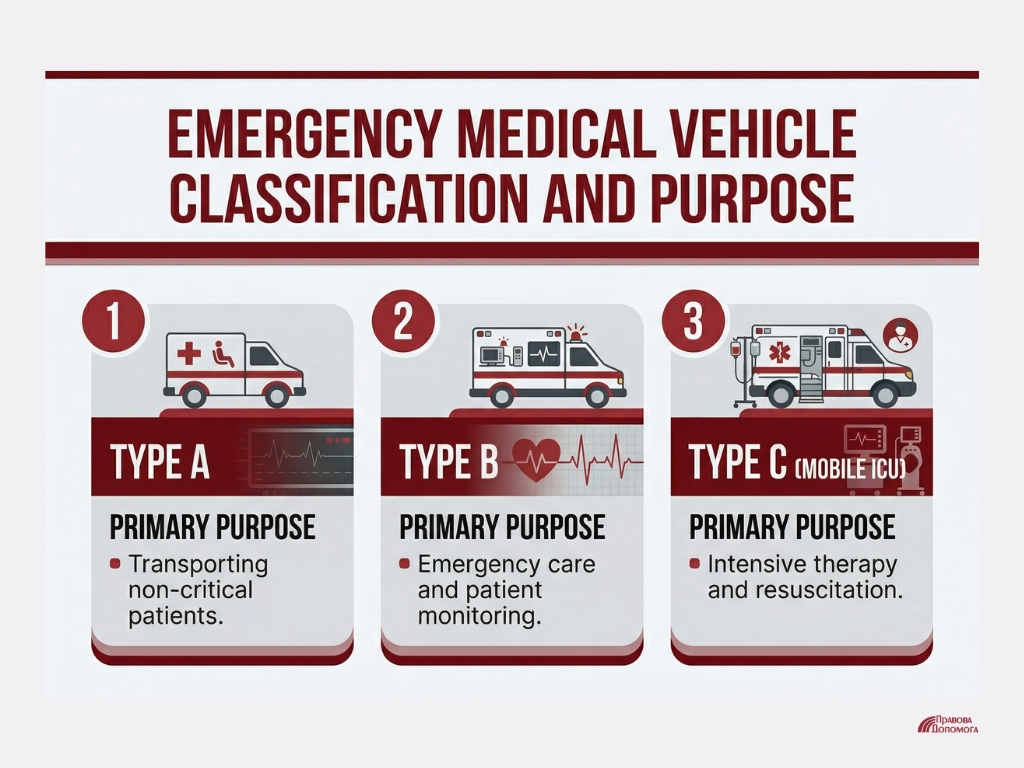
- what class of vehicle it is, type A, B, or C;
- how it is equipped;
- whether there is space inside for the team to work;
- whether it allows operation as an ambulance vehicle.
In this context, we also recommend reading our material: Registration and Licensing of a Mobile Intensive Care Unit: Requirements for Equipment and Personnel
Requirements for the Stationary Base and Consultation Room
Launching an emergency medical service is not only about specialized transport. An important condition is the availability of a stationary facility. Moreover, this should not be an ordinary office, but a specialized base that will officially appear in the documents as the location of your medical activity.
Even if care is provided on-site, you still need to have a separate premises where:
- documentation is maintained;
- the work of the service is organized;
- medical staff can work;
- part of the equipment and medical supplies is stored.
We have described these nuances in detail in the article: Address of Activity of a Mobile Medical Team: Ministry of Health Requirements.
Simply put, a private ambulance service is not just a vehicle on wheels, but also a stationary point from which the system actually operates. This is exactly the point that is very often missed by those who try to launch the business independently.
Equipment for the Mobile Team: Preparing Equipment for Real Work
Another mistaken approach is purchasing the minimum required inventory solely to obtain a positive decision from the regulator. In ambulance services, this is one of the riskiest approaches. Equipment here is not a formality, but a question of whether your mobile medical team will actually be able to work during a call.
In practice, the assessment focuses on whether you have:
- means for monitoring the patient’s condition;
- basic resuscitation equipment;
- oxygen support;
- stretchers and transportation equipment;
- consumables and medical kits.
Pay attention to environmental requirements: starting in 2026, having a contract for medical waste treatment will become a mandatory condition for medical institutions. This also applies to ambulance services, since hazardous waste is generated during calls, such as used syringes, infusion systems, and biological materials.
Document Package for Obtaining an Emergency Medical Care License
Formally, the package of documents for obtaining a medical practice license for an ambulance service is standard, the same as for other medical areas. The following are submitted to the Ministry of Health:
- Application for obtaining a license.
- Information on the condition of the material and technical base and the availability of personnel.
- List of submitted documents.
The difficulty is not in the names of the documents themselves, but in how their content is completed so that it actually corresponds to the format of a private ambulance service.
This is where the most important part begins. For a typical dermatologist’s office, it may be enough to show the doctor, premises, and office equipment. In the case of an ambulance service, however, the information must correctly reflect a much more complex operating model.
In particular, the documents must correctly show that:
- the activity is carried out specifically under the type of medical care “emergency medical care”;
- the structure includes the relevant medical staff;
- there is a consultation room or base as the place where the activity is carried out;
- a vehicle is used in the work and is, in fact, part of the medical service;
- the available equipment corresponds to the emergency care format.
In other words, the documents are standard, but their content is far from “standard.”
Legal Assistance in Obtaining a Medical Practice License for an Ambulance Service
Obtaining a medical practice license for an ambulance service is not a case where it is enough to simply “submit template documents” and rely on luck. Here, it is important to properly build the entire operating model before launch: from staff and premises to transport and the content of the submitted information. Otherwise, you risk lost time, idle expensive vehicle fleets, and a delayed business launch.
The law firm “Pravova Dopomoha” has been supporting the licensing of medical projects in Ukraine for more than 15 years, ensuring a confident entry into the medical services market.
Our team works as your internal compliance department, taking over the most complex stages. We can help you:
- assess whether your model is properly structured for emergency medical care;
- check whether your staff, base, transport, and equipment are suitable for licensing;
- prepare and correctly complete the document package;
- support the process of obtaining a medical practice license;
- help avoid typical mistakes before the documents are submitted.
With us, you avoid the typical mistakes of launching independently and receive a business that is ready to operate within the legal framework. We create conditions under which you can calmly plan development in the direction of patient care quality, while we take over all paperwork and bureaucracy.
Planning to launch a private ambulance service? Do it reliably: leave a request for a consultation and receive professional legal support.
More about medical activity licensing with us is available here.Services on the topic of this material
Our publications on this matter


Our clients