

How to Open a Veterinary Clinic: From Sole Proprietorship (FOP) Registration to the First Patient
Reviews of our Clients
... our work on joint projects assured us of your high level of professionalism
Planning your own veterinary practice often runs into bureaucracy and building code requirements that seem to be written in a completely foreign language. For a veterinarian, opening a clinic is a difficult transition from treating patients to managing a business. Here, every miscalculated square meter of space or missing record-keeping journal can cost you your license, and an inspector from the State Service of Ukraine on Food Safety and Consumer Protection can easily identify a weak point in an unprepared clinic.
In this article, we will cover not just the theoretical steps, but also the hidden pitfalls that people usually discover only during the pre-licensing inspection. We have been supporting this process since 2006, so we know exactly where the system sets its traps and how to avoid them.
You might also like: How to Correctly Fill Out Documents for a Veterinary Practice License
Sole Proprietorship or LLC for a Veterinary Practice: Choosing the Optimal Business Structure
The first question most often asked by doctors planning to open their own veterinary clinic is: “Can I simply operate as a sole proprietor?” Yes, you can, and for the clinic format, meaning an individual practice run by one doctor without partners or a complex management structure, this is usually the most practical option.
A sole proprietorship offers a simplified taxation system, minimal reporting requirements, and lower accounting costs. At the same time, however, the entrepreneur is personally liable with all of their assets, which requires a thoughtful approach to financial planning.
As for choosing an LLC, this makes sense only when the business is created by two or more partners, when expansion is planned, or when investment is expected. An LLC allows clear allocation of ownership shares, protects each participant's interests, and limits liability. However, it also requires more complex administration and accounting.
Although choosing an LLC may be justified in certain cases, most veterinarians who open their own clinic start as sole proprietors. That is why below we will look in detail at the process of registering as a sole proprietor, choosing a taxation system, selecting business activity codes (KVEDs), and preparing the necessary documentation so that your clinic is ready to operate without the risk of violations.
Registration of a Veterinary Business: Step-by-Step Process
So, once the business structure has been chosen, the next step is the state registration of the business entity. Today, you can register a sole proprietorship in several ways:
- Online through the Diia portal, which is the fastest option, with registration usually completed within one business day after the application is submitted.
- Through an Administrative Services Center or a state registrar, which may take from one to three business days, depending on workload.
- Through a notary, which is convenient if the doctor also wants to submit an application for the simplified tax system at the same time.
To complete the registration, the following are required: an application for state registration, a passport, an RNOKPP (tax identification number), the selected KVED activity codes, and the chosen taxation system.
Choosing a Taxation System
For small veterinary facilities, the simplified taxation system is usually the most suitable option. The specific single tax group depends on:
- the amount of income;
- the number of employees;
- the format of the activity.
Sole proprietors of Group 2 provide services to the public or to other single taxpayers and may also engage in the production or sale of goods. They may employ up to 10 workers. Annual income is limited to UAH 7,211,598 as of 2026.
Sole proprietors of Group 3 are not subject to any limit on the number of hired employees. Their annual income may not exceed UAH 10,091,049 as of January 1, 2026.
Choosing KVED Codes for a Veterinary Clinic
To register the business properly, the relevant economic activity codes must be specified:
- KVED 75.00, which covers veterinary activities.
If you also plan to sell products, the following codes may be relevant:
- 47.73 Retail sale of pharmaceutical goods in specialized stores, including the sale of veterinary medicines.
- 47.75 Retail sale of cosmetic and toilet goods in specialized stores, including products such as combs, brushes, hair accessories, and care products.
- 47.76 Retail sale of flowers, plants, seeds, fertilizers, pets, and pet food in specialized stores, including the sale of pets and pet food, and so on.
Please note! Mistakes in choosing KVED codes or the taxation system may later lead to tax risks or the need to amend the registration data.

Obtaining a License for Veterinary Practice
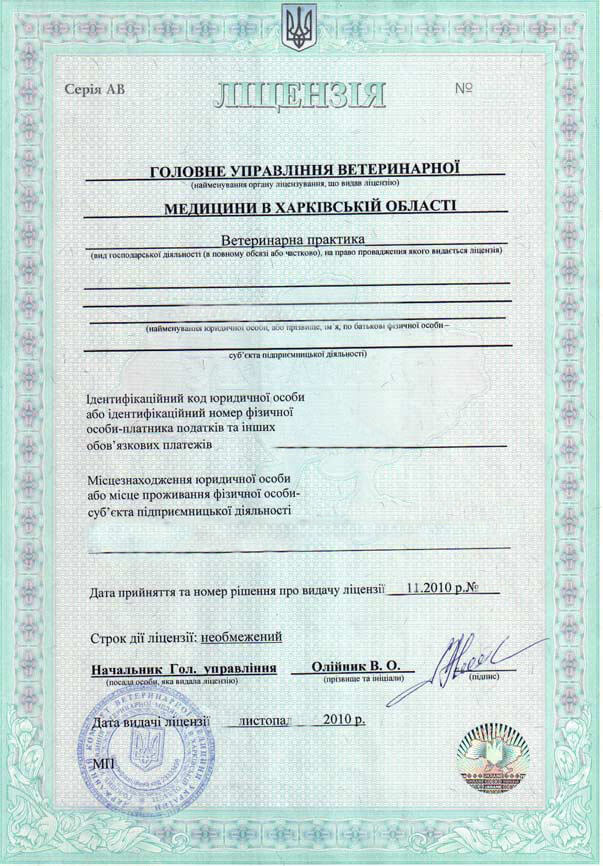
Registering as a sole proprietor or an LLC is only the legal framework. The real foundation and your “entry ticket” into professional practice is the license for veterinary practice itself. Without it, you have no right to conduct even a single consultation or procedure, and any attempt to treat patients will be considered unlawful activity.
A license is your confirmation to the state and to animal owners that you operate within the legal framework, have the appropriate education, and maintain proper conditions for practice. That is why obtaining a license for a veterinarian is the starting point from which private practice becomes lawful.
To obtain a license for a private veterinary clinic, it is necessary to:
- Confirm that the material and technical base complies with the established requirements.
- Have lawful grounds for using the premises, whether through ownership or lease.
- Ensure proper conditions for the storage of medicinal products.
- Have qualified personnel with specialized education.
Please note! Persons who directly provide veterinary services must have the appropriate education in the specialty of Veterinary Medicine, whether junior specialist, bachelor’s, or master’s level, confirmed by an educational document. Advanced training is mandatory at least once every five years.
When completing the section on the material and technical base, keep several points in mind: when specifying the details of a lease agreement, you must indicate not only the contract number and date, but also the party with whom it was concluded, as well as the RNOKPP of the sole proprietor or the EDRPOU code of the legal entity from whom the premises are being leased.
The next step is to describe the premises in accordance with the licensing conditions. In practice, it is advisable to use wording without alteration by directly reproducing the requirements set out in the licensing conditions.
It is important that for a veterinary clinic, the premises must be designated as non-residential, built-in, isolated, located on the ground floor of a non-residential building, and have a separate independent entrance. In other words, you cannot simply rent an ordinary apartment and put up a sign. The premises must be legally transferred into non-residential use before the licensing documents are submitted.
Next, it is necessary to indicate the area of each room separately. It is important to remember that there are no minimum area requirements for premises used for veterinary practice, only zoning requirements.
License for Precursors and Narcotic Drugs Used in Animal Anesthesia
If you plan to use anesthesia with substances classified as precursors, psychotropic substances, or narcotic drugs, you must obtain a separate license, namely a License for Precursors, Narcotic Drugs, and Psychotropic Substances.
Under the Law of Ukraine On Narcotic Drugs, Psychotropic Substances and Precursors, any activity involving the circulation of narcotic drugs, psychotropic substances, and precursors included in the relevant official lists is subject to licensing. At the same time, it is important to note that not all veterinary medicines fall within these categories.
It should also be noted that the license for precursors is issued by the State Service of Ukraine on Medicines and Drugs Control, which is a different regulatory authority with its own licensing requirements. In addition, obtaining this license requires a specially equipped room or safe, bars on the windows, an alarm system, and an agreement with a security company. You can learn more about the requirements and practical pitfalls of this license here: How to Obtain a License for Precursors.
Please note! It is prohibited to begin treating patients without a valid license, and violation of this requirement may result in financial and administrative liability.
Preparing Premises for Veterinary Practice
Veterinarians sometimes choose a location based on the idea that it is simply “a good spot,” forgetting that for licensing purposes, engineering systems and proper zoning matter more. That is why special attention must be given to preparing the premises. They must comply with sanitary, anti-epidemic, and fire safety standards and must provide for:
- zoning, including a reception area, a treatment room, a place for storing medicines, and other necessary sections;
- proper lighting, ventilation, and water supply.
Every detail matters here. For example, the treatment room cannot be a walk-through room, and the wall and floor surfaces must be resistant to regular disinfection with aggressive cleaning agents. Ventilation must prevent stagnant air and the mixing of odors between waiting areas and procedure rooms.
More details in our article: Requirements for Personnel and Premises for Obtaining a License for Veterinary Practice
What Agreements Must Be Concluded Before Opening
To minimize risks during inspections, it is necessary to conclude agreements for:
- the removal of solid household waste;
- the disposal of biological and medical waste;
- disinfection, disinsection, and related services.
It should be noted that having an agreement for the disposal of medical waste is one of the critical points. Used syringes, systems, and remnants of biological material cannot be placed in general waste containers. The absence of official proof showing how such waste is disposed of is a direct path to a violation report and refusal to issue a license.
Also, where special equipment is used, such as X-ray machines for veterinary services, or where fire alarm systems are installed, the relevant maintenance agreements for such equipment and systems must also be concluded.
Please note! The use of X-ray equipment requires a separate and highly complex license from the State Nuclear Regulatory Inspectorate of Ukraine, as well as special design of the premises, including lead-lined doors, barite plaster, and similar protective measures. Therefore, if you plan to add X-ray equipment to the clinic, you must take into account the serious risks of delays and the increased cost of opening a veterinary clinic due to the need to obtain this license.
Internal Documentation for a Veterinary Clinic
It is equally important to prepare the internal documentation correctly. A veterinary clinic typically maintains the following records:
- An animal admission log records the owner’s details, identifying information about the animal, the date of the visit, complaints, diagnosis, procedures performed, and prescribed treatment. It is the primary medical record that ensures proper documentation of the care provided.
- The veterinary medicines register contains information on the receipt, storage, and use of medicinal products, including their name, quantity, batch number, and expiration date. Particular attention is given to medicines subject to special control.
- The instrument sterilization log reflects the date and method of instrument processing, the list of sterilized items, and the responsible person. Maintaining it confirms compliance with sanitary requirements.
In addition, forms of informed consent from the animal’s owner must be prepared separately. These forms should include information about the diagnosis, the proposed treatment, possible risks, and confirmation that the owner has voluntarily consented to the intervention.
Common Mistakes When Opening a Veterinary Business
Many veterinarians approach the idea of opening their own clinic with the thought: “Everything is clear, I will register as a sole proprietor, buy the equipment, and start seeing patients.” In practice, however, reality looks very different.
Even at the inspection stage, an inspector from the State Service of Ukraine on Food Safety and Consumer Protection may ask about seemingly minor details: why the landlord’s tax identification number is not stated in the lease agreement, why the area of the treatment room is not described in the same way as in the licensing conditions, or why batch numbers of medicines have not been entered in the animal register. For an inspector, each such detail is a sign that the system has not been properly organized.
The most common mistakes encountered when opening and operating a veterinary practice include:
- submission of an incomplete set of documents for obtaining the license or inconsistency between the material and technical base and the declared type of activity;
- improper arrangement of the premises, for example where the treatment room is designed as a walk-through room or the walls of the veterinary clinic are covered with a material that cannot withstand daily disinfection;
- absence of documentary proof of staff qualifications or expired advanced training;
- improper maintenance of internal documentation and record-keeping logs, which creates risks during inspections;
- violation of isolation and infection control requirements, which may become grounds for sanctions by regulatory authorities.
Each individual mistake may seem minor, but together they accumulate and create a real risk for the operation of the clinic. Quite often, veterinarians who tried to do everything on their own simply ended up wasting time and money, going in circles between documents, inspections, and clarifications.
Knowing the rules is only the beginning. What matters is understanding how they work in practice, which documents are required, how to prepare them correctly, and what inspectors actually pay attention to. In this situation, the solution is simple: delegate the process to a lawyer who knows all the nuances. Such a specialist will anticipate the risks, prepare the documents in a way that avoids questions from regulatory authorities, and help prevent unnecessary expenditure of the veterinarian’s time and resources.
Successful case: How to Amend a Veterinary Practice License: Legal Support Case
Legal Support for Licensing a Veterinary Clinic
Opening your own veterinary clinic is a stage where every decision matters: where to submit documents, how to properly prepare the premises, which KVED codes to choose, and how to organize the material and technical base.
We help ensure that the right decisions are made from the very beginning so that the clinic complies with all legal requirements and licensing conditions. Our lawyer, with many years of practical experience, knows where the hidden pitfalls are and how to avoid them before they become real problems.
Our services include:
- preparing the document package for obtaining a license for veterinary practice;
- support in communication with regulatory authorities, including preparation of the necessary applications and notifications;
- review of the material and technical base and assistance with proper zoning of the premises;
- preparation of the internal documentation of the veterinary clinic and veterinary record-keeping logs;
- advice on the circulation of medicines subject to special control.
Separately, we can also arrange the registration of a sole proprietorship or an LLC for a veterinary business. We will help you choose the optimal business structure, taking into account the number of partners, expected income, and the scale of the business. This way, you receive not just a set of documents, but a well-structured legal model for your future clinic.
Are you planning to open a veterinary clinic and want to do everything in full compliance with licensing requirements from the start? Contact us, and we will help you complete the entire process, from registration to obtaining the license and seeing your first patient, without mistakes.
Services on the topic of this material
Our publications on this matter


Our clients