
How to Open a Veterinary Clinic in 2026: A Step-by-Step Guide
Reviews of our Clients
... our work on joint projects assured us of your high level of professionalism
The veterinary business in Ukraine is experiencing a real boom. Pet owners are ready to invest in quality service for their animals, while demand for modern clinics is growing faster than supply. However, in 2026, the entry threshold for this business has become higher than ever.
The era when a veterinary office could be opened quickly and informally by simply submitting a declaration is officially over. Today, the state imposes significantly higher requirements on veterinary centers, which is actually a positive development. This is a challenge that will filter out amateurs, but it also opens a major window of opportunity for those who do everything correctly from day one.
You are here because you want to save animals’ lives and build a profitable business. Our goal is to make sure that legal labyrinths do not stand in the way of your dream. In this article, we will break down the step-by-step algorithm for opening a veterinary clinic in 2026, explain how to go through this process without stress or fines, and help you preserve your most valuable resource: your time.
Legal Framework for Veterinary Practice: What Changed in 2026?
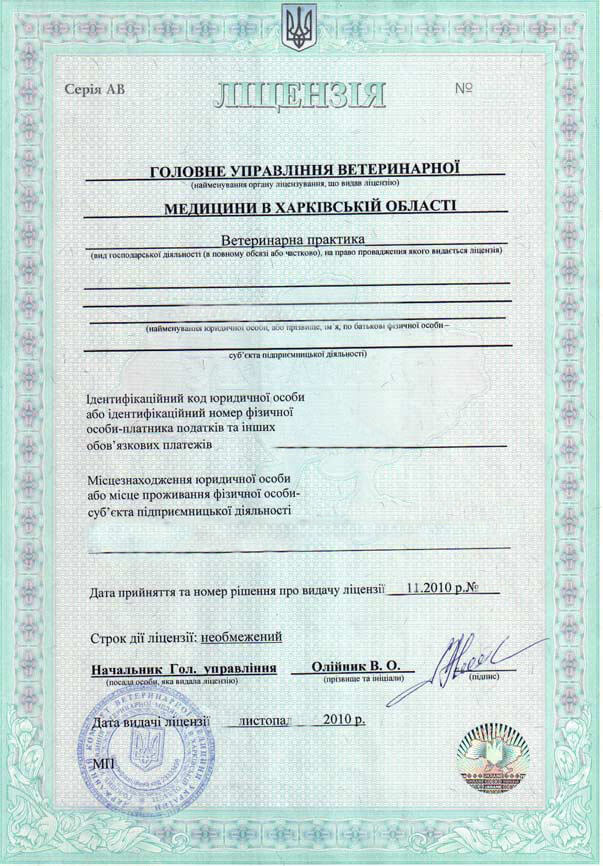
If you planned to open a clinic “the old way”, forget it. The time of grey schemes and quick declarations is over. Today, a veterinary practice license is your entry ticket into a legal business. And you need to obtain it before inspectors come to you, especially if you are already seeing patients.
The End of the “Declarative Principle” in Veterinary Medicine
From January 31, 2026, the Government cancelled the possibility of working on the basis of a veterinary practice declaration, which was the simplified procedure available during martial law. We have already covered this in our article: Veterinary Practice License: How to Switch from a Declaration Without Stopping Your Business.
But let us briefly explain what this means. For newcomers, you do not have the right to see your first patient until your license number appears in the official register. In other words, you must first obtain a veterinary license.
For those who were already operating under a declaration, the state set a deadline for obtaining a full license: April 30, 2026. After this date, the veterinary practice declaration becomes nothing more than a “nice piece of paper” that will not protect you from fines or the shutdown of your activity.
The New Law of Ukraine “On Veterinary Medicine and Animal Welfare”
On March 2, 2026, this law became the main legal framework for your veterinary business. The key changes are as follows:
- Responsibility for animal welfare. You are now responsible not only for the “treatment result”, but also for compliance with animal housing standards in inpatient care. The size of animal boxes, lighting levels, and even noise levels may now be subject to inspection.
- State certificate for staff. Having a veterinary diploma is no longer enough. Personnel working with animals must have confirmation of their knowledge of animal welfare standards. Allowing a veterinarian to perform procedures without such a certificate may become grounds for cancellation of your license.
Digitalization Through Diia
The good news is that it has also become possible to submit documents and obtain a veterinary practice license through Diia. The bad news is that the system is automated, and any error, typo, or mismatch between the premises area and the applicable standards may lead to an automatic refusal.
Unified State Information System in the Field of Veterinary Medicine
Since 2026, veterinary medicine has finally become part of the “state in a smartphone” concept. This refers to the introduction and use of digital record keeping through the Unified State Information System in the Field of Veterinary Medicine, as well as the issuance of veterinary documents in electronic form. This requires a clinic to have not only medical competence, but also IT competence.
It is important to note that digital record-keeping is not universally mandatory for every veterinary clinic, but it becomes mandatory depending on the type of activity carried out.
Choosing the Organizational Form for a Veterinary Clinic in Ukraine
The decision whether to register as an individual entrepreneur or an LLC in 2026 determines your ability to attract investment and the level of your personal legal protection.
This model is ideal for small clinics, veterinary offices, or private veterinarians. If this matches your format, you can find more information here: How to Open a Veterinary Office: From Sole Proprietorship Registration to the First Patient. But briefly:
- Main requirement: you must personally have a veterinary degree. In 2026, a license for a sole proprietorship is issued only if the owner has specialized veterinary education.
- Advantages: the simplest accounting, with the possibility of using the simplified taxation system, group 2 or group 3.
- Risks: a sole proprietor is liable for obligations and lawsuits with all personal property, including an apartment, car, and bank accounts.
An LLC is the optimal choice for medium and large clinics, as well as for investors who are not veterinarians.
- Qualification requirement: the owner does not have to hold a veterinary degree, but the company must have a veterinary doctor with the relevant education on staff.
- Advantages: scalability. You can bring in partners and sell shares in the business. Liability is limited to the company’s authorized capital, while your personal property is protected.
- Nuance: accounting is more complex, and dividend withdrawal requires additional planning.
Comparative characteristics of ownership forms:
|
Criterion |
Sole Proprietorship |
LLC |
|
Who can open it |
Only a veterinarian |
Anyone (investor) |
|
Liability |
Personal liability (all personal property)0 |
Limited liability (company’s capital) |
|
Taxation |
Simplified taxation (single tax) |
General taxation system or single tax |
Which KVED Codes to Choose for a Veterinary Clinic: From Treatment to a Pet Store
For the full operation of a veterinary clinic with inpatient care, pet boarding, grooming, and retail sales, you need to choose one main KVED code and several additional ones.
Main KVED Code:
- 75.00 Veterinary activities. This is your foundation. It covers diagnostics, treatment, surgery, prevention, and vaccination.
Additional KVED Codes:
For pet boarding, inpatient care, and grooming:
- 96.09 Provision of other personal services not elsewhere classified. (This is usually where pet care services are included, including temporary care and pet boarding).
For retail sales, including food, accessories, and care products:
- 47.76 Retail sale of flowers, plants, seeds, fertilizers, pet animals, and pet food in specialized stores. (This is your main code for selling everything except medicines).
For the sale of veterinary medicines:
- 47.73 Retail sale of pharmaceutical goods in specialized stores. This is critically important if you plan to open a veterinary pharmacy.
Lawyer’s advice: do not be afraid to indicate 5 to 7 KVED codes during registration. This is free and does not create any obligations, but gives you a “license to expand” in the future. When you decide to add grooming services in a year, you will not have to go back to the registrar, because the code will already be in the register.
Premises Requirements for a Veterinary Clinic: Sanitary and Veterinary Standards
Have you found the perfect location with panoramic windows in the center of a residential complex? As practice shows, 80% of license refusals today are related to premises non-compliance. The requirements of state building standards and sanitary regulations have become so detailed that a mistake at the lease stage can bury the entire project.
Therefore, do not rush to sign the lease agreement. Premises for veterinary practice must not only be convenient, but also “sterile correct”.
Location and Entrance Area: Why a Regular Residential Entrance Will Not Work
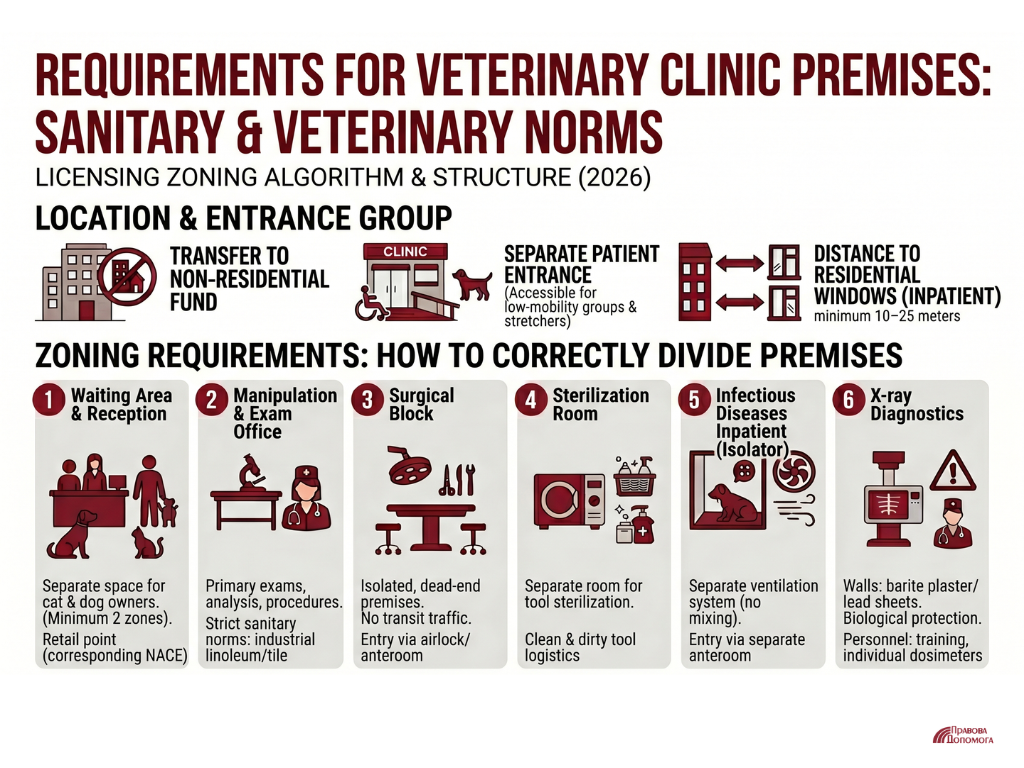
A clinic cannot be located in residential premises unless they have been converted into non-residential premises. This is the basic rule. But there are also important nuances. For example, your clinic cannot share an entrance with a residential building entrance, since shared use of entrances with residents is prohibited. The entrance for patients must be separate and convenient for people with limited mobility, as well as for animals on stretchers.
If you plan to have inpatient care or pet boarding, keep in mind that there are requirements for sound insulation and distance from residential windows (at least 10 to 25 meters). Incorrect measurement of this distance at the design stage may result in the State Service of Ukraine on Food Safety and Consumer Protection never approving your activity.
Zoning Requirements for a Veterinary Clinic: How to Divide the Premises Correctly
Forget about universal rooms “for everything”. Under the new 2026 rules, you cannot conduct an examination and perform surgery in the same room. The premises must be clearly divided into zones:
- Waiting area and reception: This is your first marketing touchpoint. The space must be organized so that clients with animals do not come into direct contact unnecessarily. There should be a separate space (at least 2 zones)0 for owners with cats and dogs in order to reduce animal stress. In addition to comfort, the reception area is also a point of sale for related goods and medicines, which must be reflected in your KVED codes.
- Treatment room and examination room: This is where initial examinations, sample collection, and simple procedures are carried out. Important: the floor and wall coverings must meet strict sanitary standards so that quick disinfection between appointments is possible, for example, industrial linoleum with welded seams or special medical tiles.
- Operating block: The operating room must be a separate dead-end room. There must be no transit movement of staff or visitors. Entry without an airlock or an anteroom for changing clothes and shoes is prohibited. Such a layout is not only a licensing requirement, but also a guarantee of infection safety. Surfaces must withstand daily treatment with strong antiseptics.
- Sterilization room: A separate room is required for sterilization processing and autoclaving of instruments. If you try to “fit” sterilization into a corner of the treatment room, you risk receiving a license refusal due to a violation of the clean and dirty instrument flow.
- Infectious disease inpatient unit: This room must have a separate ventilation system that does not mix with the clinic’s general ventilation system, so that viruses do not spread throughout the building. Entry must be through a separate vestibule.
X-Ray Diagnostics: A Separate License
If you plan to install an X-ray machine, you will need a license from the State Nuclear Regulatory Inspectorate of Ukraine.
- The walls of the room must be protected with barium plaster or lead sheets.
- A biological protection calculation prepared by a licensed organization is required.
- Personnel must have individual dosimeters and undergo special radiation safety training.

Working with Narcotic Drugs and Precursors: Anesthesia in Veterinary Medicine
This is a section that is often overlooked at the planning stage, including by general practice lawyers. Modern veterinary medicine is impossible without quality pain relief and anesthesia. However, most such drugs, including ketamine, fentanyl, and others, or their precursors, are subject to strict licensing.
What is required for legal anesthesia in veterinary medicine:
- License for activities involving narcotic drugs, psychotropic substances, and precursors: This is the official name of the permit issued by the State Service of Ukraine on Medicines and Drugs Control. Without it, the use of most veterinary anesthetics is illegal.
- Premises requirements. The premises must have solid walls, windows with bars, a certified safe fixed to the floor, and an alarm system connected to the centralized monitoring panel of the State Security Service.
- Police certificates. Every employee who has access to such drugs must undergo a criminal record check and obtain the relevant medical certificates.
Working unofficially with ketamine type drugs in 2026 is a direct path to criminal proceedings. When working with our clients, we help prepare the premises for the police inspection so that they can obtain the permit on the first attempt.
Read more about obtaining a license for precursors, narcotic drugs, and psychotropic substances here.
Material and Technical Base and Staff of a Veterinary Clinic
Today, simply hiring a person with veterinary education is no longer enough. The 2026 requirements create a strict filter:
- Qualification confirmation. Each veterinarian must have a valid certificate of professional development, completed within the last 5 years.
- Employment relations. No “freelance interns” without proper formalization. For licensing purposes, a clear order appointing the person responsible for veterinary medicine is required.
- Person responsible for animal welfare. This is a new mandatory position. Under the new EU-aligned rules, the clinic must have a specialist responsible for animal welfare, either on staff or part-time.
As for the material and technical base of the veterinary clinic, there are also important nuances. The information on the condition of the material and technical base must include:
- Measuring instruments. Thermometers, scales, and microscopes. Important: all measuring equipment must be properly verified.
- Surgical and diagnostic unit. Even if you specialize in therapy, the documents must record a minimum set of instruments for emergency care.
- Refrigeration equipment. Veterinary medicines and vaccines must be stored in separate refrigerators with temperature sensors recording indicators 24/7.
You might also like: Requirements for Staff and Premises to Obtain a Veterinary Practice License
Waste Disposal: A Trap for Beginners
You cannot simply throw a used syringe or biological waste into the garbage bin outside the building. You are required to have an agreement for the disposal of hazardous waste. The premises must also include a designated place for the temporary storage of such waste, inaccessible to unauthorized persons.
Procedure for Obtaining a Veterinary Activity License
Obtaining a license for a veterinary clinic requires maximum precision. The State Service of Ukraine on Food Safety and Consumer Protection checks not only whether the documents are actually available, but also whether they comply with the licensing conditions. Any discrepancy in the data creates a risk of receiving a request for clarification or a refusal.
Preparing the Document Package
Your document package must be complete and legally flawless. It includes:
- Application for obtaining a license in the prescribed form. You can download a sample completed application for obtaining a license to carry out business activities in veterinary practice here.
- Information on the condition of the material and technical base. This document confirms the availability of the premises, their characteristics, equipment, and instruments required for veterinary practice.
- Information on personnel. This includes the list of employees involved in veterinary practice and their qualification documents.
- Inventory of documents. This is attached to the package in two copies, one of which remains with you as confirmation of acceptance.
Please note: the package must include certified copies of documents confirming higher veterinary education, including diplomas and professional development certificates, for all specialized personnel.
Submitting the Documents
Documents are submitted to the State Service of Ukraine on Food Safety and Consumer Protection. You can choose the submission format that is most convenient for you:
- In person. Documents may be submitted through a territorial office of the State Service of Ukraine on Food Safety and Consumer Protection or through the nearest administrative services center.
- By post. Documents may be sent by registered mail with an inventory of enclosures and delivery confirmation. This is a reliable method that leaves you with proof of submission.
- Through the Diia portal. You can submit the application electronically through Diia using a qualified electronic signature. The system automatically pulls data from the registers, which simplifies completion of the application. However, if you choose this route, all documents, including copies of diplomas, must be converted into electronic form as scanned copies signed with a qualified electronic signature.
Review Terms and Process
By law, the application is reviewed within 10 business days.
It is important to understand that during the review, the State Service of Ukraine on Food Safety and Consumer Protection has the right to request additional documents if there are doubts regarding the compliance of the premises or the qualifications of the staff. Each such pause for collecting certificates or clarifications increases the overall waiting period. In practice, the process often takes up to one month.
You might also like: Accessibility Report for People with Reduced Mobility: Why Is It Essential?
Professional Legal Assistance in Opening a Veterinary Clinic
Obtaining a license independently and opening a veterinary institution is possible. Doing it on the first attempt without legal support is a real challenge that usually costs 3 times more than professional assistance. Every mistake in the documents is not just a refusal. It means months of downtime for your premises, rent payments for an unused space, and lost doctors who are not willing to wait.
The lawyers of Pravova Dopomoha, thanks to many years of experience, know the internal practice of the State Service of Ukraine on Food Safety and Consumer Protection and the State Service of Ukraine on Medicines and Drugs Control. We offer you the opportunity to enter the market confidently by delegating all bureaucratic processes and communication with the regulator to our team. When you choose our support, you buy time and peace of mind.
What does our comprehensive approach include?
- Premises audit before signing the lease: We analyze the property for compliance with state building standards and sanitary rules. This protects you from renting a “beautiful but unsuitable” space where obtaining a license is impossible.
- Development of information on the material and technical base from scratch: We structure the description of your material base ourselves so that the regulatory authority has no additional questions. We know which wording passes review and which does not.
- HR consulting: We check your doctors’ documents for compliance with licensing conditions. If someone lacks professional development hours, we tell you in advance, not after a license refusal.
- Turnkey support: We accompany you at all stages, from registering a sole proprietorship or LLC and choosing KVED codes to obtaining the license, including a precursor license.
Are you ready to open the doors of your clinic as early as next month? Do not wait until the rules change again.
Get legal support for a veterinary practice. Book an introductory legal consultation.
Everything about obtaining a veterinary practice license is available here.
More information on obtaining a precursor license is available here.
Services on the topic of this material
Our publications on this matter


Our clients