

Occupational Health Doctor at a Company: Why You Need One and How to Set Up an Office
Cost of services:
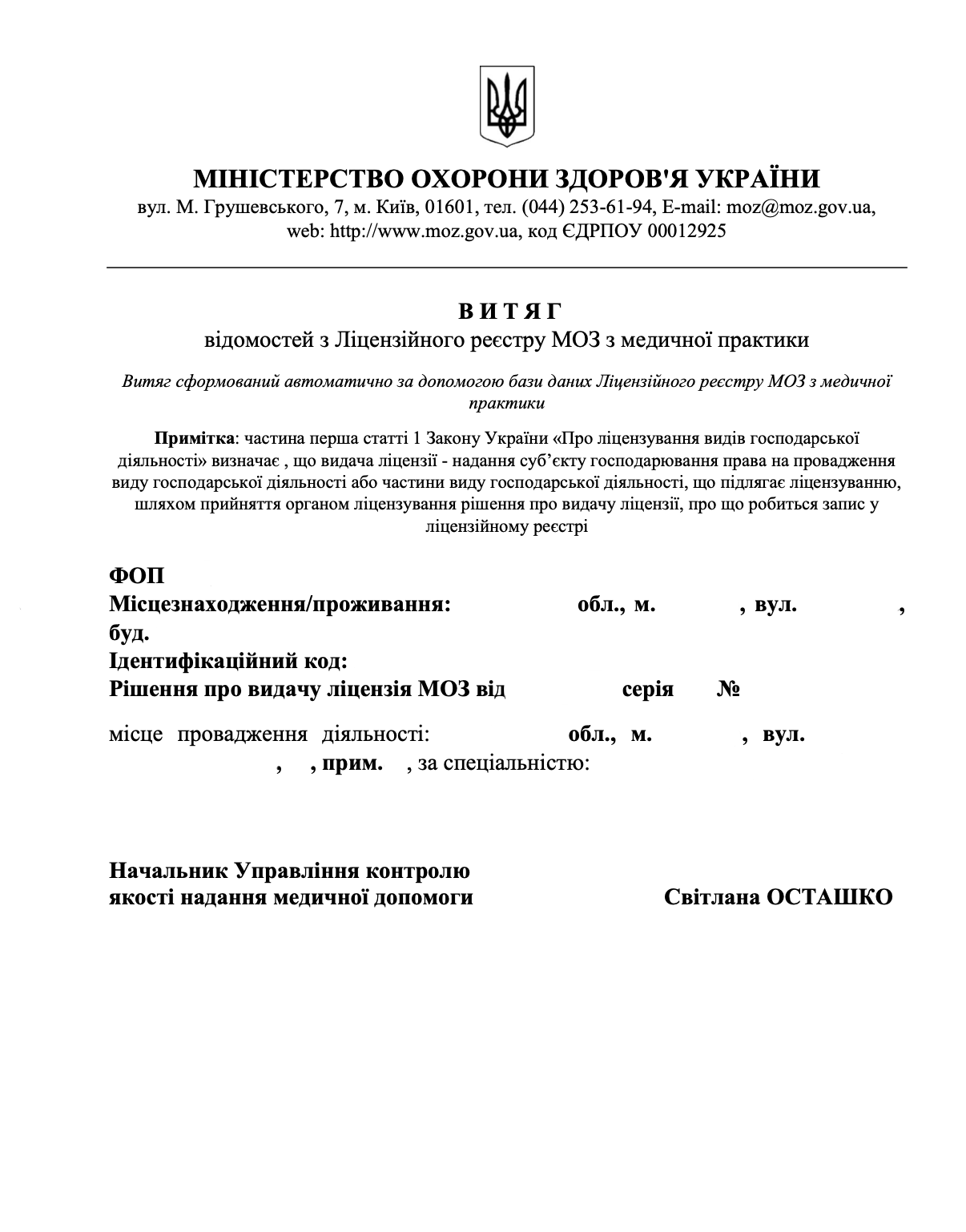
Reviews of our Clients
…we can confidently recommend the lawyers of Law firm «Pravova dopomoga» as reliable legal partners on the matters of medical practice licensing and other procedures related to the Ministry of Health of Ukraine.
... Having used the services of the Law Firm "Pravova dopomoga", we managed to solve our problems, as well as found a qualified and reliable partner.
For many types of businesses, including industrial, construction, agricultural, and chemical enterprises, regular employee medical examinations are not merely a bureaucratic formality—they are an effective way to protect the business from fines, lawsuits, and production shutdowns.
At the center of this system is an occupational medicine physician—a specialist who identifies health risks at an early stage and assesses whether employees are fit to perform hazardous work.
If your company has a large workforce, hazardous working conditions, constant employee turnover requiring medical examinations, or operations that require daily or rapid medical oversight, you should seriously consider opening your own occupational medicine office. This also means that you will need to obtain a medical practice license. And even then, many questions arise:
- Does the company obtain the license, or does the physician obtain it personally?
- What should such an office look like, and how should it operate?
- What physician should you hire as an occupational medicine physician, and on what terms?
In this article, we explain what functions an occupational medicine physician performs at an industrial workplace, why the physician’s conclusions are critical for the employer, and how to open an occupational medicine office on a turnkey basis without risking a licensing refusal.
Why a Company May Need Its Own Occupational Medicine Physician
Unlike a general practitioner or family physician, an occupational medicine physician specializes specifically in how workplace factors—chemicals, noise, vibration, and heavy physical labor—affect the human body.
Key functions of an occupational medicine physician at an enterprise include:
- Required medical examinations: Organizing and coordinating pre-employment medical examinations and periodic employee medical examinations.
- Fitness-for-work assessment: Issuing an official conclusion on whether an employee’s health allows them to perform specific duties without risk to life.
- Early diagnosis and prevention: Identifying the initial signs of occupational diseases long before they result in loss of working capacity.
- Investigation of occupational diseases: Participating in commissions that determine the causal link between a disease and working conditions.
For an employer, an in-house occupational medicine office is primarily a reliable legal and financial buffer. Having a specialist on staff removes much of the ongoing concern about inspections by the State Labor Service, because allowing an employee to work without the required medical examination can expose the company not only to substantial fines but also to the mandatory removal of employees from work.
The occupational medicine physician also becomes a key safeguard for the company in employment disputes. If a worker later develops a chronic illness and seeks compensation through litigation, properly completed medical records and initial medical conclusions can provide an evidentiary basis in court.
In addition to legal protection, this approach can produce a tangible economic benefit and help prevent emergencies. Regular occupational health screening makes it possible to identify in time employees for whom working at height or with high voltage is contraindicated, directly reducing the risk of sudden accidents, workplace injuries, and production-line shutdowns.
The company also stops losing money to forced downtime: instead of sending employees to municipal clinics for entire days and having them wait in long lines, all required examinations are carried out on site, quickly and without disrupting production schedules.
The absence of an in-house occupational medicine office does not relieve the employer of the obligation to arrange medical examinations. If the company does not have its own physician, it will need to consider entering into an annual agreement with an accredited private or public medical center. In that case, the company must adapt to the schedule of an outside clinic, pay commercial rates for each examination, and absorb the working hours employees spend traveling to and waiting at the medical facility.
Important! For companies with a large workforce or high employee turnover, keeping an in-house occupational medicine physician on payroll is much more cost-effective than regularly paying outside medical organizations. An in-house physician can offset the cost of maintaining the office by eliminating private-clinic markups and, most importantly, can work around the company’s needs by arranging examinations promptly without taking employees away from the production process.
Worth reading: How a Company Can Open a Pre-Trip Driver Examination Office

Licensing an Occupational Medicine Office: Step-by-Step Process
Before moving to the procedural steps, it is important to understand the basic legal model: the medical practice license is obtained by the company itself, not personally by the physician it hires. To do this, the company creates a separate medical unit within its structure—for example, an occupational medicine office—makes the corresponding changes to its staffing schedule, and formally employs an occupational medicine physician. Only after the premises are prepared, the equipment is purchased, and employment orders are issued for the medical staff does the company submit the licensing package to the Ministry of Health of Ukraine.
To complete the licensing procedure successfully on the first attempt, it is important to account for the legal and technical details of each of the three stages.
Step 1. Premises and Equipment
To open an occupational medicine office, a legal entity or individual entrepreneur (FOP) must comply with the Licensing Conditions for Medical Practice approved by Resolution No. 285 of the Cabinet of Ministers of Ukraine. Preparing the premises and the material and technical resources is the first and most important stage.
Premises Requirements
The premises must be removed from the housing stock and comply with applicable state building and sanitary standards, including DBN V.2.2-10:2022 “Healthcare Facilities.”
- Area and layout: The physician’s consultation office must have an area of at least 12 sq. m. If an examination area or procedural manipulations are planned, it is recommended to design premises with an area of at least 18 sq. m.
- Finishes: Wall, ceiling, and floor surfaces must be smooth and suitable for wet cleaning and disinfection, such as ceramic tile, linoleum with welded seams, or water-based paint.
- Accessibility: Conditions for persons with reduced mobility are mandatory, including ramps, lifts, widened door openings, and an accessible restroom, in accordance with DBN V.2.2-40:2018. Compliance is confirmed by a report issued by a technical building inspection expert.
- Engineering systems: The workplace must have centralized or autonomous water supply, sewerage, supply-and-exhaust ventilation, and adequate lighting.
Material and Technical Equipment
The office must be equipped in accordance with the Sample Equipment List for the relevant type of medical care. Several categories of equipment will need to be provided.
Medical furniture: Physician’s desk, chairs, a medical examination couch with a hygienic covering, a cabinet for medical records, a cabinet for medicines and instruments, and a privacy screen.
Diagnostic and examination equipment:
- Blood pressure monitor with cuffs of different sizes and a stethoscope.
- Medical scale and stadiometer.
- Neurological reflex hammer.
- Hand dynamometer for assessing muscle strength during examinations of workers in hazardous industries.
- Basic examination kit, including tongue depressors, a thermometer, and a pulse oximeter.
Safety and sanitation equipment: Germicidal irradiator or air recirculator, containers for disinfecting instruments, medical waste containers, and an emergency first-aid kit.
Lawyer’s tip: All medical devices and instruments must have documents confirming their lawful placing on the market in Ukraine, such as declarations of conformity with technical regulations and certificates of conformity. Measuring equipment, including blood pressure monitors and scales, must have valid verification where required.
Worth reading: Leasing Premises for Medical Practice: Ministry of Health Requirements and the Lease Agreement
Step 2. Personnel
A common misconception among employers is that opening the office requires only a civil-law services agreement with a physician acting as an individual entrepreneur (FOP). For a company seeking a medical practice license, this is legally unacceptable. The physician must be employed by the company, even if the company operates in a field completely unrelated to healthcare.
How This Works in Practice:
Consider a large construction company or a metal-fabrication plant. It is not a hospital or clinic, but an ordinary commercial enterprise. To hire a physician and lawfully apply for a medical license, its HR and legal teams should follow this sequence in the company’s internal documentation:
- Creating a medical unit within the company structure: The head of the company issues an order amending the organizational structure. A new internal unit is added, for example, a “Medical and Sanitary Unit,” “Medical Office,” or “Medical Surveillance Service.”
- Amending the staffing schedule: The head of the company approves a new staffing schedule, or amendments to it, that includes medical positions. Important: job titles must strictly comply with the National Classification of Occupations DK 003:2010 and the Ministry of Health qualification directories.
- Formal employment of medical personnel: Employment agreements are entered into with the medical professionals. Employment may be either their primary employment or secondary employment if the physician also works at another clinic.
- Issuing appointment orders: Employment orders are issued for the newly created positions, and job descriptions are approved, clearly setting out duties related to medical examinations and medical recordkeeping.
Qualification Requirements for an Occupational Medicine Physician
A physician appointed to the occupational medicine position must meet the requirements of the Directory of Qualification Characteristics for Healthcare Professions, Issue 78 “Healthcare.”
- Education: A master’s degree in the specialty “Medicine.”
- Specialization: A physician-specialist certificate in “Occupational Pathology,” obtained through internship, secondary specialization, or retraining courses.
- Certification and CPD: A qualification category certificate, if applicable, and compliance with continuing professional development (CPD) requirements, including the required annual CPD points.
Supporting Medical Personnel
If the occupational medicine office operates as a separate unit or performs procedures such as blood sampling or functional diagnostics, a nurse is added to the staff:
- Education: Incomplete higher education or a bachelor’s degree in the field of “Medicine,” with a specialty in “Nursing” or “Midwifery.”
- Documents: Medical education diploma and a valid certificate confirming advanced training or specialization.
Legal Formalization of Personnel
The Ministry of Health carefully reviews the legality of staffing arrangements. When completing the licensing information, the company should have the following documents in place:
- Staffing schedule: Approved by company management by order and clearly stating the positions, such as “occupational medicine physician” and “nurse.”
- Employment agreements / employment orders: Employees may be hired either for their primary employment or on a secondary-employment basis.
- Job descriptions: Approved descriptions of duties signed by the employees.
Important for legal and HR teams: The job title in the staffing schedule and employment record must exactly match the National Classification of Occupations DK 003:2010—for example, “Occupational Medicine Physician,” occupational classification code 2221.2. Any discrepancy in job titles may result in the Ministry of Health refusing to grant the license.
Step 3. Preparing the Information and Submitting It to the Ministry of Health
You may submit the medical license application only after the premises for the office have been allocated and equipped and the physician has been formally employed.
The difficulty at this stage is that the Ministry of Health assesses the company’s readiness solely on the basis of the submitted documents—the Information Form—so any formal error or inconsistency in the data may lead to refusal.
Preparing the Licensing Package
Under the Licensing Conditions approved by Resolution No. 285 of the Cabinet of Ministers of Ukraine, the following documents are prepared and submitted to obtain the license:
- Application for a license in the prescribed form, completed by the head of the company or an authorized person.
- Information on the state of the material and technical resources and the availability of personnel, including their educational and qualification levels.
- List of documents attached to the application, in two copies when filing on paper.
Please note: Diplomas, equipment passports, and lease agreements themselves are not submitted to the Ministry of Health. The relevant information is entered in tables in the Information Form. However, all underlying documentation must physically be kept at the office because it may be reviewed during a scheduled or unscheduled inspection.
Methods and Procedure for Submitting Documents
A license applicant may choose one of the available methods for submitting the document package to the Licensing Department of the Ministry of Health of Ukraine:
- Electronically: Through a personal electronic account or the government services portal using a Qualified Electronic Signature (QES).
- By mail: By registered mail with an inventory of enclosures through the national postal operator.
- In person or through a representative: By submitting the materials to the Ministry of Health.
The Ministry of Health licensing commission reviews the application within 10 business days from the date of its registration.
Worth reading: Accessibility of Healthcare Facilities and Pharmacies for Persons with Disabilities
Common Pitfalls and Risks of Handling the Licensing Process Yourself
Attempting to complete the medical office licensing procedure without specialized medical-law counsel leads, in 60% of cases, to a Ministry of Health decision to leave the application without further action or to refuse the license. This can cost the company one to three months and delay the launch of workplace medical surveillance.
So many errors occur that we have grouped them into several categories.
Errors in Premises Documentation and Calculations:
- Noncompliance with DBN V.2.2-10:2022: Errors in calculating the required area—for example, stating 12 sq. m for an office where examinations are actually performed on an examination couch instead of the required 18 sq. m—or the absence of mechanical ventilation.
- Accessibility issues (DBN V.2.2-40:2018): The Ministry of Health closely reviews the report issued by the technical building inspection expert. If the report does not clearly confirm barrier-free access for persons with reduced mobility—for example, there is no ramp, door openings are too narrow, or the restroom description is unclear—the documents may be left without further action.
- Incorrect designated use of the premises: Filing documents for an office that is legally part of the housing stock or does not have the status of premises intended for medical use.
Personnel “Traps” and Document Discrepancies:
- Job titles inconsistent with the nomenclature and DK 003:2010: For example, the Information Form may state “general practitioner–occupational medicine physician” or “shop-floor physician,” while the Licensing Conditions require the specific title “Occupational Medicine Physician.”
- Confusion over specialization and CPD: Listing a physician whose specialist certificate has expired or who did not earn the required number of CPD points during the previous year.
- Incorrect employment documentation: Failure to issue an employment or secondary-employment order, or inconsistencies in the physician’s work schedule—for example, where the physician is shown as working full-time at three different facilities simultaneously, which the Ministry of Health can readily identify.
Technical Errors When Completing the Information Form:
- Medical equipment without certificates: Listing devices such as blood pressure monitors, dynamometers, and scales that do not have valid declarations of conformity or have not undergone the required periodic verification on time.
- Formal inconsistencies in the tables: Any discrepancy between the data—for example, different premises area figures in the lease agreement and in the relevant section of the Information Form—may be treated by the commission as submission of inaccurate information.
Important: If the company decides not to wait for the license and begins operating the occupational medicine office—conducting medical examinations and issuing conclusions—before the license is entered in the Ministry of Health register, it may face serious liability for unlicensed medical practice.
How We Can Help
Our law firm handles the entire process, minimizing your risks and guaranteeing that the license will be obtained. Our services include:
- Initial audit and consultation: Assessing your premises, equipment, and available personnel documents for compliance with the State Building Standards and the Ministry of Health Licensing Conditions.
- Premises review and preparation: Coordinating with technical building inspection experts to obtain a proper accessibility report for persons with reduced mobility under DBN V.2.2-40:2018.
- Personnel audit: Reviewing diplomas, certificates, CPD records, and HR orders for the occupational medicine physician and nurses.
- Preparation of the full document package: Preparing the complete filing package for the licensing authority without formal errors.
- Representation before the Ministry of Health: Filing documents, monitoring the review of the case, and providing support until the Order granting the license is issued.
- Comprehensive occupational safety audit: Advising on the subsequent organization of required employee medical examinations at the enterprise to help avoid fines from the State Labor Service.
Our firm obtains licenses for a wide range of applicants, including medical centers, individual entrepreneurs (FOPs), state and municipal institutions, and rehabilitation facilities. With us, you can complete the entire process in one place, including issues such as obtaining an accessibility report for the building.
Do not risk fines or a shutdown of workplace medical surveillance. Contact our lawyers and order turnkey support for opening an occupational medicine office.
You can find the cost of obtaining a license here or ask our specialists.
Services on the topic of this material
Our publications on this matter


Our clients

We are ready to help you!
Contact us by mail [email protected] or by filling out the form:
Other publications by the author

School psychologists, speech therapists, rehabilitation specialists, and massage therapists do not always require medical licensing. The key issue is whether their actual work is educational or corrective, or amounts to medical care or rehabilitation.

Adding a new medical specialty does not always require another accessibility assessment, while a new location usually does. The key questions are which premises the existing report covers and whether the property has changed.

Two independent private doctors may use the same medical office, but one practitioner’s license does not cover the other. Each must properly document the premises, equipment, schedule, and licensing basis for their own practice.

Own locations and franchising create different licensing, control, and liability structures for a veterinary network. Before expanding, the owner should define who will hold each clinic’s license and how brand and service standards will be controlled.
Our other authors