

Medical Office Sublease Between Private Doctors: What Happens to the License

Reviews of our Clients
... our work on joint projects assured us of your high level of professionalism
A situation in which one physician operating as an individual entrepreneur (FOP) already has an equipped medical office and wants to allow another FOP physician to work there is very common in practice. Sharing a medical office between two FOP physicians can be an economically convenient solution, especially if the premises are not used every day.
For example, a physician leases premises, equips an office, obtains a medical practice license, purchases medical equipment, and sees patients only a few days a week. At other times, the office is effectively vacant, so it is logical to make it available to another physician—a dentist, gynecologist, dermatologist, neurologist, ultrasound physician, or another specialist.
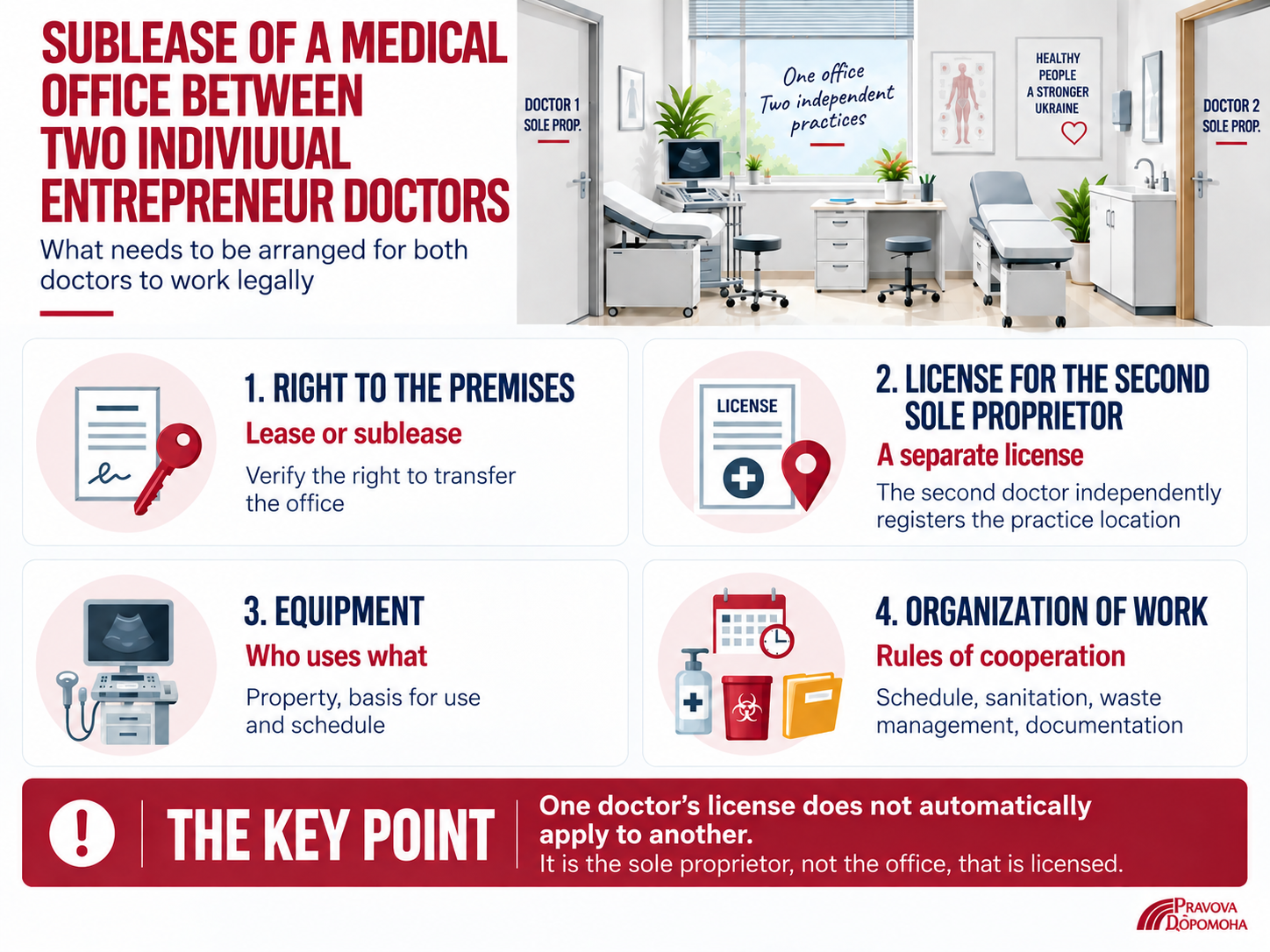
At first glance, the arrangement is simple: sign a sublease agreement, hand over the keys, and set a work schedule. But that is not enough for medical practice. At least four separate legal issues must be addressed at the same time:
- property-related: whether the first FOP has the right to make the premises available to another person;
- licensing-related: whether the second FOP may declare this office as their own place of medical practice;
- material and technical: what equipment the second physician will use and on what legal basis;
- organizational: who is responsible for the sanitary regime, medical waste, cleaning, consumables, medical records, staff, access to equipment, and so on.
The key point is that one physician’s license does not automatically extend to another physician simply because they work in the same office. Therefore, a sublease requires not only a properly documented right to use the premises, but also a coordinated operating model for two independent FOPs that complies with licensing requirements.
Can a FOP Physician Make a Medical Office Available to Another FOP?
Yes. The law does not establish a general prohibition on one FOP physician allowing another FOP to use a medical office. However, the method of documentation depends primarily on the legal basis on which the first physician uses the premises.
- If the office is owned by the first FOP, legally this is not a sublease but a regular lease of part or all of the premises.
- If the first FOP leases the premises from the owner and then makes them available to the second physician, this is a sublease.
This is where the first common mistake arises. Article 774 of the Civil Code of Ukraine provides that a tenant may sublease property to another person only with the landlord’s consent unless otherwise provided by the agreement or by law. The sublease term may not exceed the term of the principal lease agreement.
Therefore, before entering into an agreement between the two physicians, the principal lease agreement must be reviewed.
- If it expressly states that the tenant may sublease the premises or part of them without additional approval, separate consent from the owner is generally not required.
- If the agreement allows subleasing only with the owner’s written consent, that consent must be obtained.
- If the agreement prohibits subleasing altogether, entering into an agreement with the second FOP before amending the principal lease is risky.
For a medical office, we recommend that the owner’s consent be as specific as possible: it should not merely state that “subleasing is permitted,” but should make clear which premises are being transferred, to whom, and for what activity. This is especially important when the second FOP plans to use the office as a place of medical practice.
There is another important point: the first physician cannot grant the second physician more rights than the first physician has. For example, if a FOP physician leases only an 18 m² office and has the right to use a shared restroom and corridor, they cannot use a sublease agreement to “transfer” half of the entire medical center to the second physician.
Accordingly, the subleased premises must correspond correctly to the technical plan of the premises and the principal lease agreement.
Another practical detail is the schedule. A medical office may be used by different physicians at different hours or on different days. For example, one FOP works on Monday, Wednesday, and Friday, while the other works on Tuesday and Thursday.
However, a schedule does not replace the legal basis for using the office. If the second FOP actually conducts their own medical practice on the premises, their right to use that location must be properly documented.
Lease, Sublease, or Joint Activity: How Should Use of a Medical Office Be Documented?
In practice, we see three main models of cooperation between physicians.
|
Model |
When It Applies |
Main Legal Risk |
|---|---|---|
|
Lease |
The first FOP owns the premises and leases them to another physician |
The premises, equipment, or usage arrangement is defined incorrectly |
|
Sublease |
The first FOP leases the premises and subleases them to the second physician |
No right to sublease or no owner consent |
|
Joint activity |
Two business entities combine resources to achieve a common goal |
Attempting to use a joint activity agreement to replace lease and licensing requirements |
Lease
If the physician owns the premises, the simplest option is to enter into a lease agreement with the second FOP. It is important to identify the specific premises: the office number or name, area, floor, and address and, where possible, attach a plan marking the relevant office.
The agreement may separately provide for the right to use common areas such as the restroom, corridor, reception area, waiting room, and so on.
Sublease
If the first physician is not the owner but leases the premises, the right to sublease must be reviewed. In this situation, two agreements must be analyzed at once—the principal lease and the future sublease. The terms of the second agreement must not conflict with the first.
For example, if the principal lease runs through December 31, a sublease cannot be entered into through the following March. Likewise, the subtenant cannot be permitted to use the premises for an activity expressly prohibited by the principal lease.
Joint Activity Agreement
Sometimes physicians try to avoid documenting a lease or sublease altogether and sign a “cooperation agreement” or “joint activity agreement.”
The Civil Code does permit joint activity agreements. The parties may act jointly without creating a legal entity, and the agreement may define how their actions are coordinated, how property is used, how expenses are covered, and how results are allocated.
However, this mechanism should not be used as an artificial substitute for a sublease. If, in substance, one FOP is making a specific office available to another FOP for regular use in exchange for payment, merely calling the document a “cooperation agreement” does not change the economic or legal nature of the relationship.
If you are still reviewing the principal lease or choosing premises, we also recommend reading: Leasing Premises for Medical Practice: Ministry of Health Requirements and the Lease Agreement
Can Two FOP Physicians Hold Medical Practice Licenses at the Same Address?
This is one of the most common questions in our practice. Yes, the same address by itself does not prevent two different FOPs from conducting medical practice there. Licensing legislation does not establish a “one address—one licensee” rule.
Moreover, the law defines a place of business as premises or another facility at which a specific business entity conducts its activity or which it uses for that activity. Material and technical resources are the set of facilities and/or resources that make it possible to conduct the licensed activity.
This leads to an important principle: what matters is not the “exclusivity” of the address, but whether each licensee separately meets the requirements. For example, the same premises may be used by:
- FOP A—a neurologist;
- FOP B—a psychiatrist;
- or, in another model, both FOPs may even have the same medical specialty.
The key requirement is that each physician has their own license for the relevant medical practice and has properly declared the place where that practice is conducted.
Resolution No. 285 of the Cabinet of Ministers of Ukraine requires a license applicant to submit information on material and technical resources and personnel. The prescribed form includes, among other things, the premises, the specialties in which medical practice is conducted there, and the area of the relevant premises.
Therefore, the second FOP handles licensing as a separate business entity: if they do not yet have a license, they obtain one; if they already have a license, but this office has not been declared as a place of practice, the new place of practice must be formalized in the prescribed manner.
For more on updating addresses, premises, equipment, and other licensee information, see “How to Notify the Ministry of Health of Changes in Medical Practice: Rules for Updating a License.”
A particularly risky situation arises when the second physician assumes: “the office is already licensed, so I do not need to do anything.”
A medical office does not itself hold a license. The license belongs to a specific FOP or legal entity.
Therefore, the fact that another licensee already operates at the same address does not legalize the new physician’s activity. It is also important to avoid inconsistencies between the documents of the two FOPs.
Before submitting licensing documents, the entire model should be reviewed as a whole: right to the premises—plan—schedule—specialties—equipment—personnel.
What Should Be Included in a Medical Office Sublease Agreement?
A standard office sublease agreement is usually not sufficient for a medical office. The agreement must address the specific features of medical practice. First, the subleased premises must be identified precisely.
The wording “part of nonresidential premises” without specifying the exact area and office is a weak option, especially if the agreement will later be used as part of the documentary evidence of the second FOP’s right to work at that address. It is better to specify:
- the address;
- the office number or functional name;
- the area;
- the floor;
- the purpose—for conducting business activity in the form of medical practice;
- the right to use auxiliary and common areas.
In practice, it is useful to attach a plan or floor schedule identifying the specific office.
The second key section is the usage schedule. If the physicians work in shifts, the agreement should expressly establish the days and hours of use or provide for a separately agreed schedule. This is especially important where one office and some equipment are shared by both FOPs.
The third section is medical equipment. If the premises are provided together with an examination couch, ultrasound machine, electrocardiograph, gynecological chair, sterilizer, or other property, the wording “office with equipment” is not enough.
The specific list of property, the legal basis for its use, its condition, operating rules, liability for damage, maintenance, and, where applicable, metrological verification should be defined.
The fourth section is the separation of the FOPs’ activities. It is advisable to state expressly that each physician:
- conducts medical practice independently;
- holds their own license;
- independently enters into legal relationships with patients;
- maintains their own medical records;
- receives payment for their own services;
- is responsible for the medical care they provide.
This is especially important if the physicians use a shared reception desk or operate under one commercial brand. The patient should understand exactly who is the provider of the medical service.
The fifth section is termination of the agreement. In medical practice, the sudden loss of the right to use premises may make it impossible to continue operating at the declared location. Therefore, early termination terms, notice periods, and the procedure for returning the premises should be drafted much more carefully than in an ordinary short-term office lease.

What Requirements for a Medical Office Should Be Considered When Subleasing?
DBN V.2.2-10:2022 Requirements
A separate category of risk arises because premises may formally be suitable for office use but unsuitable for the planned medical practice. Medical premises must take into account DBN V.2.2-10:2022 “Healthcare Facilities. Basic Provisions.”
These standards apply to buildings and premises used to provide medical and rehabilitation care and apply to new construction, reconstruction, and major repairs.
! Important professional caveat. The requirements established for new construction or reconstruction should not be mechanically applied to every older premises with the conclusion that every existing medical office must automatically be rebuilt.
Whether a specific requirement applies must be assessed based on the status of the premises, the nature of the works, and the type of medical activity. At the same time, the planning and functional characteristics of the physician’s office should be reviewed at the premises-selection stage. They differ by specialty.
An office suitable for consultations by a neurologist or psychotherapist will not necessarily be sufficient for gynecological procedures, endoscopy, surgical procedures, dentistry, or other interventions. Therefore, the logic that “the first physician obtained a license here, so the premises will automatically be suitable for the second physician as well” is dangerous.
The second FOP physician may have a different specialty and a different scope of medical procedures and, accordingly, different requirements for premises, zoning, and equipment.
For the area and layout requirements for an office used for a particular specialty, see also “Doctor’s Office Area: DBN Standards and Premises Requirements.”
The accessibility of the place of medical practice for persons with disabilities and other persons with reduced mobility must also be reviewed separately. The current Licensing Conditions expressly require each licensee to ensure accessibility of their places of medical practice.
Sanitary and Anti-Epidemic Regime
Another mistake is assuming that if the landlord or clinic owner cleans the office, the second FOP does not need to deal with infection-safety issues at all.
When providing care, a healthcare professional must follow standard precautions. These include, among other things, hand hygiene, the use of personal protective equipment depending on the nature of contact, injection safety, the use of safe equipment and instruments, proper handling of medical waste, and cleaning and disinfection of premises.
Therefore, when a medical office is shared, it is not enough simply to agree on “who cleans.” Sanitary processes must be allocated in a way that ensures they are actually performed.
Medical waste also cannot be left in a “gray area.” Since April 1, 2025, the State Sanitary Standards and Rules for Medical Waste Management, approved by Ministry of Health Order No. 1827, have been in force. They regulate the generation, collection, storage, transportation, and treatment of medical waste.
Therefore, if two FOP physicians generate waste in the same office, the contractual model must correspond to the actual organization of its management. There should not be a situation where the second physician uses the first physician’s container but no document identifies who is responsible for arranging the subsequent handling of the waste.
Also useful in this context: Medical Waste Treatment Agreement: Mandatory Ministry of Health Requirement from 2026
Can the Second FOP Use the First Physician’s Equipment?
Yes. The law does not require every device, examination couch, cabinet, or other item of equipment to be owned by the physician. However, the second FOP must have a genuine and legally clear right to use the equipment required for their medical practice.
This is one of the most common licensing problems. For example, an ultrasound machine purchased by the first physician is located in the office. The second physician also plans to perform ultrasound examinations and lists that machine in their material and technical resources. The fact that the equipment is physically present in the office does not explain the legal basis on which the second FOP may use it.
The most reliable option is to regulate use of the equipment expressly by agreement. This may be a separate lease of movable property or a section of the office lease or sublease with a detailed annex. The annex should identify the equipment by name, manufacturer, model, and, where available, serial or inventory number.
When equipment is transferred, it is necessary to verify not only that it is present, but also its commissioning documents, technical condition, maintenance records, and metrological verification where required by law.
One Device—Two Licensees: Is It Possible?
Yes, in principle, provided that each licensee has a lawful right to use the equipment. However, the actual operating arrangement is critical.
If the equipment can physically be used by only one physician at a time, the documentation should not create the impression that two FOPs simultaneously and independently have it in permanent use. In practice, this is resolved through a schedule.
If both FOP physicians see patients at the same time, it is necessary to assess whether the actual quantity of equipment is sufficient for the declared scope of practice.
What Else Should Be Addressed Regarding Equipment?
The agreement should specify:
- who is responsible for maintenance and repairs;
- who pays for consumables;
- who is liable for damage;
- who monitors metrological verification deadlines;
- whether the second FOP may allow their employees to use the equipment;
- what happens if the equipment malfunctions.
For expensive medical equipment, it is advisable to execute a separate acceptance and transfer certificate. This protects both parties: the owner records the condition of the equipment when it is transferred, and the user understands the limits of their responsibility.
What Tax and Employment Risks Arise When Subleasing a Medical Office?
Subleasing a medical office affects more than the medical practice license. The first FOP effectively begins carrying out another type of business activity—making real estate available for use.
For leasing and subleasing real estate, KVED 68.20 “Renting and Operating Own or Leased Real Estate” applies. Therefore, before receiving rental payments, the first FOP should review their registered KVED codes and tax regime.
FOPs in single-tax group 2 should be especially careful.
The State Tax Service explains that a group 2 FOP may lease or sublease premises to single-tax payers and/or individuals. Therefore, if the subtenant is, for example, under the general taxation system, this creates a tax risk for the group 2 FOP. For this reason, the status of the second FOP should be checked before the agreement is signed.
There is also an area restriction. FOPs in groups 1–3 cannot use the simplified tax system if they lease nonresidential premises or parts of them with a total area exceeding 900 m². The State Tax Service confirms that this rule also applies to subleases.
For an ordinary medical office, this threshold is usually not an issue, but it must be taken into account for large medical centers.
Payments Between FOPs
Rent or sublease payments should be separated from payments for medical services. We do not recommend a model in which, for example, the second physician pays the first physician “30% from each patient” if the payment is actually consideration for the use of the premises.
Such arrangements require separate analysis because they may change the legal nature of the relationship. If the parties want to establish variable rent based on the number of shifts or hours of use, this can be properly structured in the agreement.
Shared Administrator or Nurse
Personnel raises an even more complex issue. For example, an administrator employed by the first FOP may also schedule patients for the second physician, accept their payments, and maintain their documents. Or a nurse may be employed by one FOP but in practice assist two independent physicians.
In such cases, the legal basis on which the employee performs functions for the second business entity must be reviewed. Employees should not be treated as automatically “transferred” together with the office. This is especially critical when an employee is included in the staffing resources required for a particular FOP’s medical practice.
Following amendments that took effect on September 1, 2026, the Licensing Conditions provide, among other things, for at least one healthcare professional for each declared specialty and establish requirements for documenting medical professionals declared when obtaining or expanding a license.
Medical professionals may be employed by both FOPs on a part-time basis.
What to Check Before Subleasing a Medical Office
We recommend conducting a legal audit before signing the agreement and before the second FOP submits licensing documents. The minimum checklist is as follows:
- Right to the premises. Who owns the premises, on what basis the first FOP uses the office, whether the principal lease permits subleasing, and whether separate owner consent is required.
- Premises being used. Whether the specific office, its area, number, floor, auxiliary premises, and common areas can be clearly identified.
- Term. Whether the sublease term exceeds the term of the principal lease.
- Second physician’s specialty. Whether the premises are suitable for the specific medical practice the second FOP plans to conduct.
- Layout and building requirements. Whether the actual layout corresponds to the documentation and whether additional rooms or zoning are required.
- Accessibility. Whether the place of medical practice is accessible to persons with reduced mobility.
- Equipment. Which equipment belongs to the first FOP, which equipment the second FOP may use, on what legal basis, and whether it is sufficient for the declared specialty.
- Work schedule. Whether the two FOPs can realistically use the premises and equipment in accordance with the declared model.
- Sanitary regime. Who is responsible for cleaning, disinfection, hand hygiene, consumables, instrument processing, and other required processes.
- Medical waste. Who arranges its collection, storage, and transfer.
- Personnel. Whether staff are in fact shared, who their employer is, and how their work is reflected in the licensing documents.
- Second FOP’s license. Whether they already hold a valid license or need to obtain one, expand their practice, or register a new place of practice.
- Allocation of responsibility. Who is responsible to the patient for the medical service, who maintains medical records, who receives payment, and who processes personal data.
This audit helps identify problems before they become grounds for a licensing refusal, a tax violation, or a dispute between the two physicians.
How We Help Structure a Medical Office Sublease
Subleasing a medical office is a workable model for private medical practice. It allows an owner or tenant to use premises and equipment more efficiently and allows another physician to begin practice without creating a medical office from scratch.
However, the model works only when not only the agreement, but the entire legal structure, is properly documented.
For more than 15 years, our legal team has provided comprehensive support for projects of this kind: reviewing documents for the premises and the principal lease, checking whether subleasing is permitted, assessing the premises for specific medical specialties, reviewing material and technical resources, preparing lease or sublease agreements and equipment-use documents, and supporting the obtaining, expansion, or updating of medical practice licenses.
If you already have a medical office and want to make it available to another physician—or, conversely, plan to lease an office from another FOP—the optimal approach is to review the legal model before submitting documents to the Ministry of Health and before seeing patients. In medical licensing, it is much easier to build the model correctly from the outset than to fix a situation later when the agreement, equipment, and licensing information already contradict one another.
Leave a request for a consultation: we will help you understand your situation before you sign the first documents or begin purchasing equipment.
Learn more about comprehensive legal support for private medical practice on the service page here.
Services on the topic of this material

Our publications on this matter

Our clients


We are ready to help you!
Contact us by mail [email protected] or by filling out the form:
Other publications by the author

A private clinic using supplied blood components for transfusion does not follow the same licensing route as a blood collection facility. It still needs a hospital blood bank, transfusion immunology testing, hemovigilance, and traceability.

School psychologists, speech therapists, rehabilitation specialists, and massage therapists do not always require medical licensing. The key issue is whether their actual work is educational or corrective, or amounts to medical care or rehabilitation.

For companies with hazardous working conditions, employee medical examinations form part of occupational health management. An in-house occupational health office requires suitable premises, equipment, qualified staff, and medical licensing.

Adding a new medical specialty does not always require another accessibility assessment, while a new location usually does. The key questions are which premises the existing report covers and whether the property has changed.
Our other authors