

Business Relocation and Change of Legal Address: How to Move Officially, Not Just "In Boxes"?
Reviews of our Clients
Business relocation during the war has become the only way for many entrepreneurs to save their companies. In just a few days, teams move to Lviv, Uzhhorod, or Ivano Frankivsk to resume work in a safer environment. However, in this urgency, the legal side is often overlooked: in practice, the company is already operating in western Ukraine, while on paper it is still located in a frontline area.
This creates a serious gap between reality and the official registers. When the company’s official tax address is still located in occupied territories or does not match the place of its actual activity, there is a risk of blocked accounts, tax accounting problems, and inability to obtain licenses or state grants.
Changing the legal address during relocation is not a bureaucratic formality, but a necessary step for the stable operation of the company. It helps avoid claims from regulatory authorities and ensures transparency of business processes in the new region.
How to Legally “Move” Your Business to Ukrainian-Controlled Territory
Physically relocating a business is only half the process. This raises a logical question: does the company need to be registered at the place of relocation, and how can this be done? Yes, if the previous legal address is located in an area of active hostilities. For the company to operate fully in the new location, it is important to officially record these changes in the legal field.
How can the legal address of a legal entity be changed?
Legal relocation of an LLC consists of several key steps.
Registration of Changes with a State Registrar or Notary
This is the basic stage, which begins with preparing a resolution or minutes of the general meeting on changing the company’s legal address. This document must be notarized. It is also important to note that if your charter specifies the old address directly, rather than simply indicating the city on the title page, you must prepare and register a new version of the charter. After that, the document package, together with the completed application, Form 2, is submitted to the registrar so that the relevant entry can be made in the Unified State Register.
Updating Agreements and HR Documentation
Once the address in the Unified State Register has been changed, the old details in the company’s documents become outdated. To avoid legal claims from partners or labor-related inspections, the following documents must be updated:
- Agreements with counterparties. Additional agreements should be prepared for all current contracts. These agreements record the new legal and mailing address for correspondence. This is necessary for receiving primary accounting documents and avoiding payment delays.
- Employment agreements and orders. If employees’ employment agreements clearly specify the place of work, namely the old address, an order should be issued confirming the change of the legal entity’s location. If necessary, changes should also be made to employment agreements or job descriptions.
- Accounting details. Make sure that invoices, acts of completed work, and delivery notes already reflect the new address. Using old details after the changes have been registered may lead to such documents being considered invalid.
Informing the Tax Service
Although data from the register is transferred automatically, it is important to know how to notify the tax authority about a change of a legal entity’s address on your own. In certain cases, this is necessary to avoid account blocking or discrepancies in reports. Read more about these nuances in a separate section of this article.
Obtaining Licenses and Permits at the New Address
Relocating an enterprise to a safe territory is not only about changing one line in the register. If your activity requires special permits, the process becomes much more serious. Particular attention should be paid to regulators:
- Licensing compliance. This is the most critical point. If the company holds a license, for example, for electricity supply, medical practice, or pharmaceutical activity, a change of address requires mandatory notification of the licensing authority.
An application and updated information on the change of the place of business activity must be submitted. Each regulator has its own deadlines, usually from 10 to 30 days. If this deadline is missed, the license may be suspended at the most inconvenient moment. - Interaction with sector-specific authorities. In addition to the tax authority, the company’s relocation should be reported to the authorities that issued specific permits.
Document packages must be prepared to confirm the right to use the new premises, such as lease agreements, in order to prove that the new location meets the established requirements for your type of activity.
This may sound like a substantial amount of bureaucratic work, and it is precisely because of these legal labyrinths that entrepreneurs often postpone re-registration “until later”. However, such an approach is a gamble. Timely recording of changes allows you to work without fear of inspections and ensures continuity of your business.

Why Is It Necessary to Change the Legal Address?
To summarize, without official re-registration, the business effectively ends up in a grey zone. This creates a number of risks that can paralyze the company’s operations.
The main threats for a business whose legal address is located in occupied territories or areas of active hostilities include the following:
- Loss of official correspondence. All requests from the tax service, court summonses, inspection reports, and bank notices are sent exclusively to the legal address. If the company does not receive them, it loses the opportunity to respond to claims in time, which may lead to lost court cases and automatic fines.
- Strict financial monitoring. Today, banking algorithms are especially sensitive to transactions connected with temporarily occupied territories. If a company is formally registered in such a territory but actually operates in another region of Ukraine, this is automatically treated as an increased risk. The consequence may be account blocking, suspension of payments, and a request to provide a full package of documents confirming business relocation.
- Restrictions on activities in dangerous territories. If a company formally remains registered in temporarily occupied territories or in an area of active hostilities, it may lose access to public procurement, lending programs, and international contracts due to security restrictions.
Therefore, changing the legal address of an LLC after business relocation is not only about putting documents in order. It is a strategic matter of business security and survival. The main question is not whether changes should be made, but how quickly you can properly record your new location in order to avoid irreversible consequences.
Tax Accounting After Relocation: Important Nuances
After the registrar enters the new address into the Unified State Register, the information is automatically transferred to the databases of the State Tax Service. However, automation does not relieve the entrepreneur of the need to take active steps. At this stage, many business owners still have an open question: how should the tax authority be notified about a change of a legal entity’s address in the context of actual taxable objects?
To keep your tax history clean, pay attention to the following points:
1. Notification under Form 20 OPP
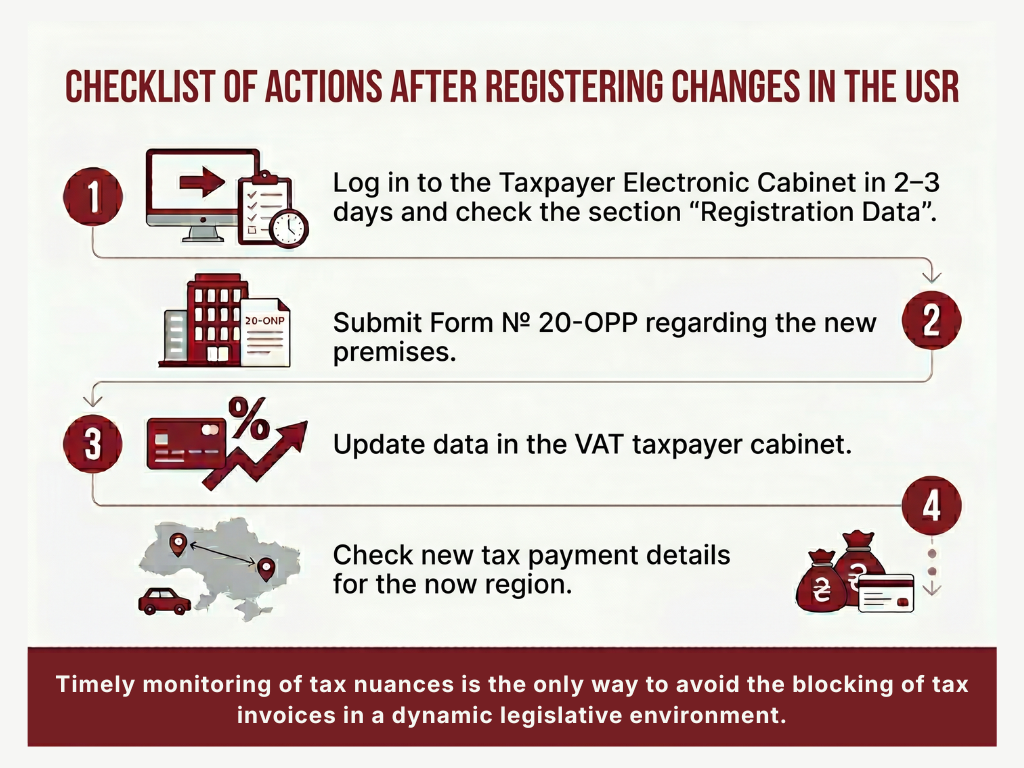
This is an important stage that is often ignored. Even if the tax authority “sees” your new legal address, you are still required to submit a notification on taxable objects, Form 20 OPP, regarding the new facilities you obtained after deciding to relocate your business to a safer territory.
Why this matters: in this form, you record the actual place where business activity is carried out. If you changed the address in the register but did not submit Form 20 OPP for the new premises, a discrepancy arises: according to the documents, you operate at the new address, but there are no officially registered facilities there.
Deadline: within 10 business days after the relevant changes are registered in the Unified State Register.
2. Changing the tax inspectorate and reporting
If a business has moved to another district or region, its main place of tax registration changes. Accordingly, the rules on where to submit reports after changing the legal address also change to some extent.
- Removal from and registration with the tax authority: This process takes place without your participation based on data from the Unified State Register. You can check your current status and the new tax authority in the taxpayer’s electronic account, in the “Registration Data” section.
- Where to pay taxes: Until the end of the current budget year, you may remain a payer of certain taxes, for example personal income tax for employees, at the previous place of registration, even though reporting will already be submitted to the new tax authority. This must be taken into account when preparing payment orders.
3. Checking VAT and single tax registration
If your LLC is a VAT payer or uses the simplified taxation system, make sure that the data in the registers has been updated:
- For VAT payers: although the procedure for registering changes in 2026 has been simplified, it is worth checking whether the change of the VAT payer’s address has been reflected in the Register in order to avoid errors in tax invoices.
- For single taxpayers: an application must be submitted to amend the Single Taxpayers Register so that your tax address corresponds to the data in the Unified State Register.
4. Risk of a documentary audit
Transfer to another tax inspectorate may sometimes become a reason for a documentary audit at the previous place of registration. This is not a mandatory procedure, but the tax authority has the right to “close” your file at the old office only after checking whether taxes have been paid in full. Therefore, before relocation, it is important to conduct an internal audit and make sure that all reports have been submitted correctly.
Legal Support for Business Relocation
Legal business relocation is not only about submitting an application to the registrar. It is a point where a single inaccuracy in the documents can cost the company its normal operations. That is why this issue should not be handled in fragments.
We treat enterprise relocation as a complete process and bring it to a state where you do not have to return to it later. While your business adapts to a new city, we handle everything related to registers, documents, and regulators. What do our services include?
- Comprehensive document preparation: We prepare minutes of general meetings or resolutions, as well as new versions of charters that comply with the requirements of current legislation.
- Turnkey registration: We provide support before the state registrar or notary and ensure that changes are entered into the Unified State Register without refusals or delays.
- Communication with regulators: We prepare and submit notifications to licensing authorities so that your licenses remain valid.
- Legal audit of agreements: We prepare additional agreements for counterparties and internal company orders so that every document of your company contains up-to-date details.
Our experience in supporting licensing and registration matters allows us to carry out relocation with minimal disruption to your business processes. We know all the pitfalls of tax audits when changing an address and help you go through this transition without unnecessary pressure on your team and without interruptions in work.
As a result, you avoid a situation where the address has already been changed, but part of the processes continues to operate under the old rules.
Business relocation during the war is always about speed. But in legal matters, speed without control creates risks that appear later. Contact us, and we will carry out this process so that after the move, only one thing remains for you: stable business operations in the new location.
You can learn more about registering changes in an LLC here.
Services on the topic of this material
Our publications on this matter


Our clients