

How an Industrial Service Company Can Obtain Critical Enterprise Status in Ukraine
Cost of services:
Reviews of our Clients
... our work on joint projects assured us of your high level of professionalism
For a company that services industrial equipment, critically important enterprise status may be directly tied to its ability to retain key employees through mobilization deferments. This is especially relevant for specialists whose work is essential to the operation of production equipment.
A company specializing in the maintenance of glass-melting furnaces at glass-industry enterprises contacted us. Its goal was to determine whether it could obtain critically important enterprise status and, accordingly, use the employee mobilization deferment mechanism for employees liable for military service.
This question cannot be answered by mechanically checking KVED codes alone. It is necessary to determine which specific criterion may apply to the company, which authority is authorized to review the documents, and, most importantly, whether the company can document all the required circumstances.
That is why, as part of the consultation, we analyzed the company’s activities, the available mechanisms for obtaining critically important enterprise status, and the documents that could demonstrate the significance of its services for other enterprises.
You may also find this useful: Updated Rules for Mobilization Deferments for Employees in 2026: What Changed

Client’s Situation: The Company Supports Production Operations but Does Not Produce Glass Itself
The company provides maintenance and repair services for glass-melting furnaces—specialized industrial equipment whose proper operation is essential to the continuity of production at glass-industry enterprises.
The key feature of the situation was that the company does not manufacture glass itself. Its role is to keep equipment used directly in the production processes of other companies operational. Therefore, to identify a potentially applicable criterion, it was not enough to describe the company’s activity simply as “maintenance” or “equipment repair.” We had to determine how closely these services were connected to the continuity of its customers’ production processes.
We had several practical questions to resolve:
- which authority could recognize the company as critically important, given the nature of its activities;
- which criteria could potentially apply;
- whether the company’s existing contracts met the requirements of a specific criterion;
- which documents could confirm the significance of the services for customer enterprises;
- whether the existing contractual documentation was sufficient to substantiate compliance with the criterion;
- what additional supporting evidence had to be obtained before filing.
Because the company worked with industrial facilities and had contracts with businesses in the glass industry, we separately analyzed the possibility of applying under the criteria that were in force at the relevant time both at the Kyiv level and through the Ministry of Economy.
How We Assessed the Possible Routes to Critically Important Enterprise Status
Our work in this case consisted of a legal consultation in which we analyzed the available mechanisms and identified the route the company could pursue to substantiate its eligibility for critically important enterprise status.
We did not assume that a criterion could be applied merely because the company had a particular KVED code. Instead, we first analyzed its actual activities, contractual relationships, and the specific nature of its services.
First Route: Assessing the Possibility of Applying Through the Kyiv City Military Administration
The first route we considered was whether the company could be recognized as important to the territorial community of Kyiv. At the relevant time, the criteria of the Kyiv City Military Administration included specific requirements for companies engaged in the installation, repair, or maintenance of machinery and equipment.
It was important not only to confirm the nature of the company’s activities, but also to meet the prescribed documentary requirements.
During the analysis, we identified a circumstance that was decisive for this particular company: to use this route, it needed valid contracts for works or services with companies registered at legal addresses in Kyiv.
The Client had no such contracts. Therefore, even though the nature of its activities generally fell within the scope of the relevant criterion, its actual contractual documentation did not allow it to properly prove that the required condition was met.
This became a key point of the consultation. We did not recommend that the Client choose this route merely because its activities formally resembled those described in the criterion. We first checked whether the company had documents capable of proving compliance.
Second Route: Assessing the Ministry of Economy Criterion Based on the Importance of the Services to Production
We then analyzed the possibility of using the Ministry of Economy criterion related to meeting the needs of other enterprises and the importance of the relevant services to the continuity of their operations. In this case, the Client’s actual activities provided grounds to consider this route.
The company was not simply providing general technical services. It performed specialized work on glass-melting furnaces—equipment without which the relevant enterprises cannot fully maintain their production processes. We therefore focused on how to substantiate this fact both legally and through documentary evidence.
However, the mere existence of a repair or maintenance contract did not explain why the company was important to the industry. It was necessary to demonstrate that servicing glass-melting furnaces is an essential part of maintaining the production process and that discontinuing those services could result in a shutdown or material disruption of the relevant production operations.
You may also find this useful: How to Reconfirm Critically Important Enterprise Status in 2026
What Exactly Had to Be Proven
One of the main outcomes of the consultation was defining the evidentiary logic. Several points had to be demonstrated consistently.
- The company actually provides the relevant services. This is confirmed by contracts, certificates of completed work, and other documents demonstrating genuine business activity.
- The services are provided to enterprises engaged in production activities. It was important to identify the customer enterprises and the nature of their operations.
- The services are directly related to the operation of production equipment. The work specifically concerns glass-melting furnaces rather than secondary or optional services.
- The absence of these services may affect production continuity. This was one of the key elements in demonstrating the significance of the company’s activities.
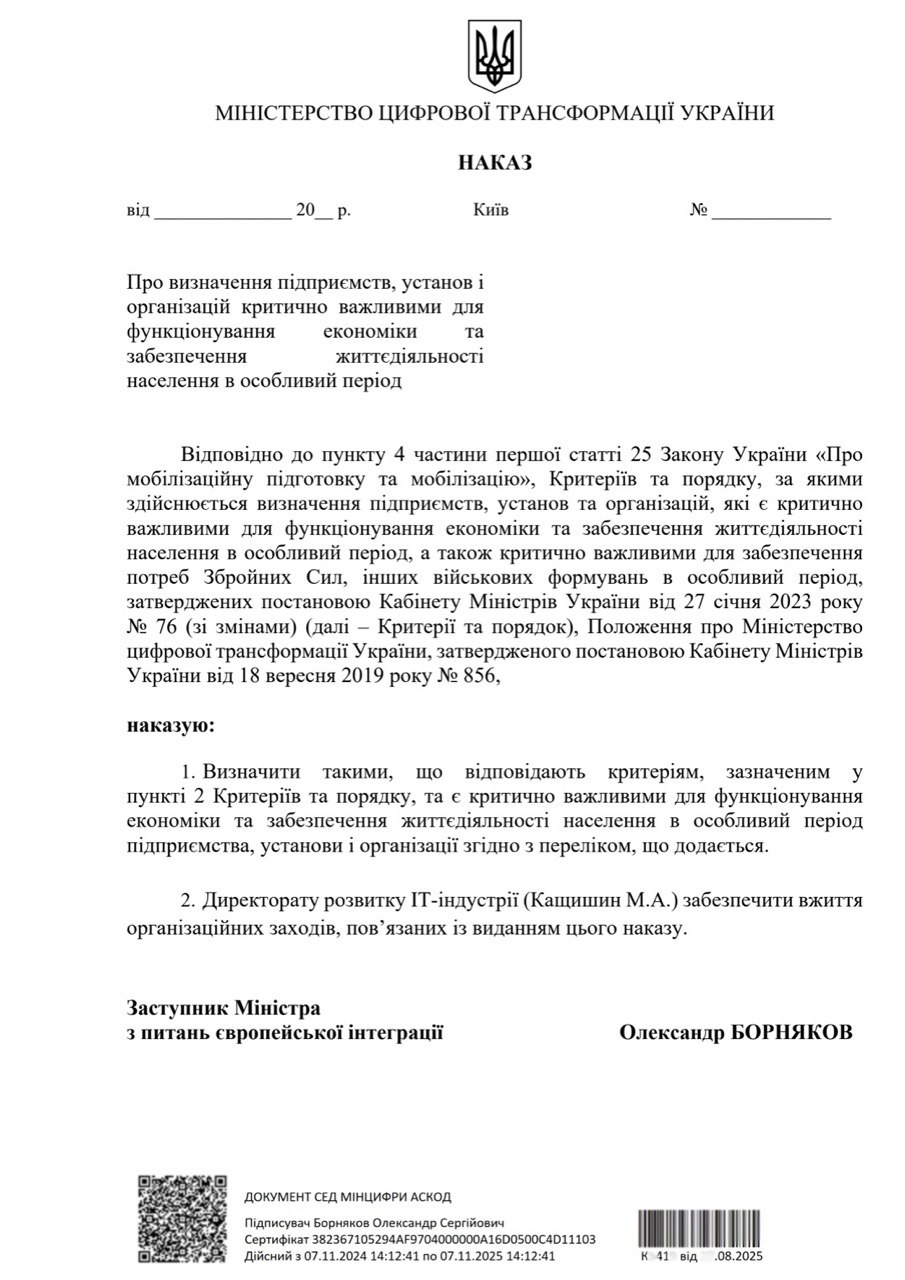
- The importance of the services must be supported by appropriate documents. We determined that this required not only letters from the enterprises serviced by the Client, but also an opinion from the competent government authority.
What Evidence We Identified for the Client
We also explained that a letter from a counterparty should not be a purely formal confirmation of cooperation. Its content had to serve a specific evidentiary purpose: to show what the company actually does, what equipment it services, how that equipment is used, and why the timely performance of the relevant work matters to the production process.
An opinion from the competent government authority was equally important. It was needed because substantiating the significance of the company’s activities required not only the position of its counterparties, but also confirmation from an authorized government authority.
As a result, we identified a set of documents for the Client that would present a complete picture of its activities:
- contracts with the enterprises being serviced;
- certificates of completed work;
- letters from customer enterprises;
- an opinion from the competent government authority;
- documents confirming the company’s types of activity and registration details;
- documents confirming compliance with the other mandatory criteria.
This approach makes it possible to assess not merely whether documents exist, but what function each document serves: every item must prove a specific circumstance on which the argument for critically important enterprise status is based.
Consultation Outcome: The Client Received a Practical Roadmap, Not Just a List of Criteria
As a result of the consultation, the Client received a substantiated route for further action and a list of evidence that needed to be prepared before filing. This avoided wasting time on an option that did not match the company’s actual contractual documentation and allowed the Client to focus on preparing documents for the more relevant route.
If you are also planning to obtain critically important enterprise status but are not sure which criterion applies to your company, contact the lawyers at Pravova Dopomoga—submit the online form on our website or call us. We will analyze your situation and identify a possible path forward.
Services on the topic of this material
Our publications on this matter


Our clients