
Maxillofacial Surgery as a Private Practice: Office and Licensing Requirements
Cost of services:
Reviews of our Clients
…we can confidently recommend the lawyers of Law firm «Pravova dopomoga» as reliable legal partners on the matters of medical practice licensing and other procedures related to the Ministry of Health of Ukraine.
... Having used the services of the Law Firm "Pravova dopomoga", we managed to solve our problems, as well as found a qualified and reliable partner.
If you plan to open a private maxillofacial surgery practice, legal preparation does not begin with completing the Information Form for the Ministry of Health (MOH). First, you need to determine exactly which procedures you will perform, whether an outpatient office is sufficient or you need a healthcare facility with an operating suite, and only then select the premises, equipment, and team for that model.
In this field, a mistake at the outset can be particularly costly: the premises may prove unsuitable for the planned procedures, the equipment already purchased may not match the declared model, or the physician’s qualifications or the composition of the team may not cover the required specialties. By that point, money has already been spent on renovation and equipment, while the launch of the medical practice has to be postponed.
This article explains how maxillofacial surgery differs from surgical dentistry for licensing purposes, which practice format corresponds to different types of procedures, and how to align four key elements: services, premises, equipment, and personnel. This combination determines which package of documents must be prepared for the MOH to license a maxillofacial surgery practice.
Maxillofacial Surgery and Surgical Dentistry: What Is the Difference for Licensing?
When setting up a healthcare business, the legal distinction between maxillofacial surgery (MFS) and surgical dentistry is critical. In practice, business owners often make the mistake of treating MFS as simply “expanded dentistry.” From the perspective of the Ukrainian MOH, however, these are two entirely different specialties, each with its own requirements for licensing, personnel qualifications, and the organization of surgical space.
|
Legal distinction between specialties: key parameters |
||
|---|---|---|
|
Surgical Dentistry |
Maxillofacial Surgery |
|
|
Regulatory specialty |
“Surgical Dentistry” |
“Maxillofacial Surgery” |
|
Physician’s education |
Degree in “Dentistry” + internship/specialization in Surgical Dentistry |
Degree in “Medicine” or “Dentistry” + internship/secondary specialization in Maxillofacial Surgery |
|
Scope and legal extent of interventions |
Strictly within the anatomical boundaries of the oral cavity and the alveolar processes of the jaws |
Soft tissues and bones of the face, neck areas, skull bones, reconstructive surgery |
|
Anesthesia requirements |
Local anesthesia or outpatient sedation |
Frequent use of general anesthesia with an anesthesiologist |
Attempting to complete the Information Form on material and technical resources under the rules for an ordinary dental office will result in the MOH refusing to issue the license.
- Direct limitation of the licensed specialty. A license for “Surgical Dentistry” legally prohibits procedures beyond the oral cavity. Any procedures involving the soft tissues of the face or the bones of the facial skeleton (for example, metal osteosynthesis for fractures or neck reconstruction) are treated as activities performed without the appropriate license.
- Closer alignment with general surgery standards. State Building Standards (DBN) and sanitary standards applicable to general surgery apply to maxillofacial surgery. This creates stricter requirements for zoning, air-exchange rates, sterility, and the overall floor area of the premises.
- Requirements for complex surgical teams. Unlike a routine dental care model, MFS procedures require a full operating team (surgeon, operating room nurse, anesthesiologist, and nurse anesthetist). This requires a larger clinical staff and additional specialties to be declared under the license.
A typical practical risk arises when a physician has credentials in surgical dentistry but plans to perform procedures involving facial bones as part of the actual service offering. In that case, the first step is to verify whether the specialty “Maxillofacial Surgery” is properly documented, rather than trying to “expand” the legal scope of a dental license through wording in the Information Form.
At this stage, it is enough to answer one question: what procedures do you plan to perform, and which specialty legally covers them? The requirements for space, equipment, and the team then depend on the next decision—the format in which the practice will operate.
What Practice Format Can a Maxillofacial Surgeon Use: A Medical Office or a Healthcare Facility?
When choosing the legal form and operating format for a maxillofacial surgeon, the project founders must choose between two models: individual entrepreneur (FOP) with a medical office or a healthcare facility (HCF)—for example, a private clinic organized as an LLC.
The legal format directly depends on the actual list of services you plan to provide. Ukrainian law does not prohibit an individual entrepreneur or a separate medical office from holding a license for “Maxillofacial Surgery,” but the range of procedures permitted in that format will be strictly limited.
Recommended reading in this context: Can an Individual Entrepreneur Obtain a License to Perform Surgical Procedures in Ukraine?
Outpatient Care and the Medical Office Format
The maxillofacial surgery office model (whether for an individual entrepreneur or as part of a healthcare facility) is intended exclusively for outpatient care. It is suitable for consultations and minimally invasive procedures that do not require general anesthesia or prolonged postoperative observation. Procedures permitted in an office setting include:
- Initial and follow-up consultations and primary surgical treatment of uncomplicated wounds of the face and neck.
- Removal of small benign skin and soft-tissue lesions of the face (papillomas, atheromas, nevi) under local anesthesia.
- Collection of biopsy material (needle or incisional biopsy).
- Removal of postoperative sutures, dressing changes, and postoperative examinations.
- Minimally invasive aesthetic and reconstructive medicine procedures under local anesthesia.
It is important to note that there are legal limitations. An office-based practice cannot use general anesthesia or perform reconstructive operations that require inpatient beds or patient observation for more than a few hours.
Healthcare Facility Format (Operating Suite and Day/24-Hour Inpatient Unit)
If the business model includes full-scale surgical operations, establishing a healthcare facility (HCF) is legally and technically required. Procedures and operations that require an HCF setting include:
- Osteosynthesis for fractures of the facial skeleton.
- Reconstructive and restorative surgery on the jaws and soft tissues, including large-volume bone grafting.
- Surgical treatment of complex inflammatory conditions (abscesses and phlegmons of the deep tissue spaces of the face and neck).
- Surgical procedures on the parotid and submandibular salivary glands.
- Orthognathic surgery and rhinoplasty.
- Any procedures performed under general anesthesia or deep sedation.
For this format, the licensing documents must include a fully equipped operating suite, an intensive care/resuscitation unit (or an appropriately equipped post-anesthesia recovery room), and day-care or 24-hour inpatient rooms.
The distinction between the models is especially clear at the anesthesia threshold: if you limit the practice to consultations, biopsies, and minimally invasive procedures under local anesthesia, one organizational model is sufficient. Once you add procedures under general anesthesia, the practice format itself changes. Only after that decision can the premises be meaningfully assessed.
Premises Requirements for a Maxillofacial Surgery Practice
Premises requirements for maxillofacial surgery are not universal. They depend directly on the medical technology and range of services you declare in the Information Form submitted to the MOH.
Model: “Outpatient Maxillofacial Surgery Office” (Minimally Invasive Surgery)
If the service list is limited to outpatient visits, consultations, suture removal, and minimally invasive procedures under local anesthesia, the premises can have a relatively simple structure. Two main rooms are sufficient: the surgeon’s consultation/procedure office and a sterilization room. A separate procedure or treatment room may also be added.
Model: “Outpatient Operating Room / Day Surgery” (Sedation and Minor Surgery)
If the surgeon plans to perform outpatient procedures using intravenous sedation (short-term medically induced sleep), the premises become substantially more complex: a separate outpatient operating room, a preoperative room for hand preparation and team preparation, a sterilization room, and a temporary patient recovery room after sedation are required.
Model: “Inpatient MFS Operating Suite” (Major Surgery and General Anesthesia)
Reconstructive operations, trauma surgery involving the facial bones, and procedures under general inhalation anesthesia require a full operating suite designed in accordance with the State Building Standards for surgical inpatient facilities, including strict zoning by degree of sterility (restricted area, sterile area, high-restriction area, and general hospital area).
The layout must account for a staff sanitary access area, an anesthesia room, a minor operating room with an airlock, a main operating room, and an intensive care/resuscitation unit.
Regardless of the scale of the maxillofacial surgery practice, there are three core regulatory areas that must be satisfied to obtain a positive MOH licensing decision:
- Accessibility and barrier-free access. The premises must be accessible to persons with reduced mobility; the requirements cover the entrance, door openings, thresholds, and restroom. Read more about the current accessibility requirements for healthcare facilities here.
- Lighting and utilities. Consultation rooms must have natural light (operating rooms may be designed without natural light if compliant artificial lighting is provided), a backup power source (generator/UPS to allow procedures to be completed during a power outage), and hot and cold water supplied through elbow-operated or sensor faucets.
- Medical waste disposal agreement. A separate room or cabinet must be designated for the temporary storage of medical waste (used needles, syringes, biological tissue, and surgical waste), with arrangements for subsequent disposal under an agreement with a specialized company. Read more about this here.
The most expensive mistake is to assess the property only after signing the lease or completing renovations. For example, premises may work well for an outpatient office but make it impossible to create a preoperative room, operating room, and patient recovery area without substantial reconstruction. The legal and technical suitability of the location should therefore be assessed against the chosen practice model before irreversible costs are incurred.
Also useful in this context: Renting Premises for Medical Practice: MOH Requirements and the Lease Agreement

What Equipment Must Be Declared for Maxillofacial Surgery?
The list of material and technical equipment in the Information Form submitted to the MOH must correspond to the services you plan to provide, and the medical devices must have the required conformity documents and be properly commissioned.
Equipment should therefore be selected according to the level of the practice rather than copied from someone else’s list. This helps avoid unnecessary purchases while ensuring that equipment required for the declared procedures is not overlooked.
Basic Minimum (Required for Any MFS Practice)
This set is required even for the simplest outpatient MFS office providing consultations, suture removal, primary wound treatment, and minimally invasive procedures under local anesthesia.
- Examination and procedure station: a surgical or multifunctional dental chair with adjustable patient positioning and a shadowless surgical light.
- MFS instruments: a soft-tissue set (scalpels, forceps, needle holders, scissors, retractors) and specialized instruments for bone procedures (elevators, bone rongeurs, chisels, periosteal elevators).
- Sterilization equipment: a medical autoclave and sanitary-regime equipment (germicidal recirculators, a packaging/sealing machine, and a disinfection area/cabinet).
- Emergency care: an anti-shock emergency kit, an Ambu bag with a set of masks, and a source of medical oxygen.
- A high-frequency coagulator or radiofrequency surgical knife.
If your practice goes beyond basic outpatient procedures, specialized equipment is added to the minimum list depending on the complexity of the surgery and the type of anesthesia:
For outpatient procedures and sedation (“day surgery”):
- a surgical motor and a piezosurgery device (piezotome) for safe work with bone tissue;
- an anesthesia patient monitor (BP, HR, ECG, SpO2, capnography);
- a defibrillator and a high-powered medical suction unit (aspirator).
For an inpatient operating suite (orthognathic surgery, osteosynthesis, general anesthesia):
- a full anesthesia machine with anesthetic monitoring and mechanical ventilation;
- a multifunctional operating table with head and neck positioners;
- titanium mini- and microplate systems with osteosynthesis instrument sets;
- a mobile X-ray system (C-arm) for intraoperative imaging;
- intensive care unit equipment (ICU beds, infusion pumps, ventilators).
Equipment itself does not expand the legal scope of the practice. For example, having an anesthesia machine or a C-arm is relevant to the licensing model only if that equipment corresponds to the procedures actually declared. The question of who is authorized to work within this model is addressed separately in the staffing section.
Also of interest: Opening an Operating Suite: Requirements for Premises, Equipment, and Personnel
Requirements for the Maxillofacial Surgeon and Other Personnel
The staffing section answers a separate question: do the documents of each professional confirm the right to perform the work for which that person is being declared in the practice?
Qualification Requirements for a Maxillofacial Surgeon
Unlike general dentistry, the specialty “Maxillofacial Surgery” requires a defined educational and postgraduate training pathway. A physician declared for this position must meet the requirements of the Handbook of Qualification Characteristics of Healthcare Professions (Issue 78).
- Basic higher education: a specialist’s or master’s degree in “Medicine” or “Dentistry.”
- Specialization (postgraduate education): completion of an internship in “Maxillofacial Surgery” (or “Surgery” / “Dentistry” followed by further specialization) or a secondary specialization evidenced by a physician-specialist certificate in “Maxillofacial Surgery” after completing the relevant specialization course at a postgraduate education institution.
- Qualification category and continuing professional development (CPD): a certificate confirming the award or confirmation of a qualification category may be held, and the annual CPD requirements (CPD points) must be completed.
Documents Confirming the Right to Practice the Specialty
When preparing the MOH staffing Information Form, the following package of documents is prepared and verified for each maxillofacial surgeon:
- Diploma in higher medical education (with supplement).
- Physician-specialist certificate in “Maxillofacial Surgery” (critically important: a certificate in “Surgical Dentistry” is not sufficient).
- Certificate of qualification category (if applicable).
- Certificates confirming completion of CPD (courses and thematic advanced training completed in recent years).
- Employment record book or an extract from the Register of Insured Persons (confirming the existing medical work record).
- Document appointing the person to the position (employment order or employment agreement).
Important! The job title does not replace the required specialty certificate. If a professional is an experienced dental surgeon but the documents do not confirm the specialty “Maxillofacial Surgery,” using a different job title in the staffing schedule does not cure the discrepancy.
Additional Medical Personnel: Anesthesia and Operating Room Team
In maxillofacial surgery practice—especially for complex reconstructive procedures, osteosynthesis, or operations involving sedation and general anesthesia—a full multidisciplinary team is often required. Clear regulatory requirements apply to each of these professionals:
- Anesthesiologist:
Responsible for selecting the method of anesthesia (general anesthesia or medically induced sleep/sedation), performing tracheal intubation (which in MFS often requires advanced skills because of facial and jaw anatomy), continuously monitoring vital functions during surgery, and overseeing the patient’s emergence from anesthesia.
Qualification requirements: higher education in “Medicine” + a physician-specialist certificate in “Anesthesiology” (or “Pediatric Anesthesiology” when treating children). The specialty must be declared under the MOH license.
- Anesthesia nurse (nurse anesthetist):
Works directly with the anesthesiologist. The nurse connects and configures anesthesia and respiratory equipment, prepares solutions and medications for anesthesia/sedation, catheterizes peripheral veins, assists with intubation, and maintains the anesthesia record.
Qualification requirements: basic secondary medical education (diploma in “Nursing” or “Midwifery”) + a certificate confirming specialization in “Anesthesiology and Intensive Care.”
- Operating room nurse:
Responsible for preparing the operating suite, sterilizing and laying out surgical instruments, strictly observing aseptic and antiseptic requirements in the operating room, and passing instruments to the surgeon during the procedure.
Qualification requirements: secondary medical education + a certificate confirming completion of specialization training in “Operating Room Nursing.”
Attention! If the anesthesia team has access to medicines containing narcotic drugs, psychotropic substances, or precursors, additional requirements for personnel authorization and internal controls apply. These requirements should be planned together with the permitting process for such medicines rather than after the medical license has been obtained.
How to Obtain an MOH License Specifically for Maxillofacial Surgery
All details of the general licensing procedure (application filing, review periods, and the regulatory framework) are available in our core article on medical practice licensing. Below, we focus on the specific legal issues and common pitfalls that arise when obtaining a license specifically for the specialty “Maxillofacial Surgery.”
Which Specialty to List in the Application and Information Form
The practice of the Ukrainian MOH confirms that “Maxillofacial Surgery” is declared as a separate, independent specialty. Accordingly, the Information Form must list “Maxillofacial Surgery” in the section covering physician specialties.
If you actually combine surgical dentistry and MFS, the documents must reflect both areas in accordance with the real operating model. This is an appropriate solution for professionals who provide both outpatient dental surgery services and more complex procedures involving the soft tissues or bones of the face.
If you are not opening a new practice from scratch but are adding MFS to an existing clinic, you need to assess the scope of changes to the licensing file: the new specialty, premises, material and technical resources, personnel, and, where necessary, a new place of practice. We described the process for such an expansion in the article “How to Expand a Medical License.”
Actual Place of Practice in the Information Form
The section of the Information Form covering the place where medical practice is conducted must describe the structure and purpose of each room:
For the outpatient model, the consultation/procedure room and sterilization room are listed, with the exact floor area and the available procedure/dental chair specified.
For the operating model (outpatient operating room or inpatient facility), the healthcare facility structure must separately identify:
- the operating suite (including the floor areas of the operating room, preoperative room, and anesthesia room);
- the intensive care/resuscitation unit or temporary recovery room;
- the sterilization room.
Important! If you declare surgical procedures involving sedation or general anesthesia but the premises structure lists only a “doctor’s office,” the MOH will refuse the license because the material and technical resources do not correspond to the declared scope of practice.
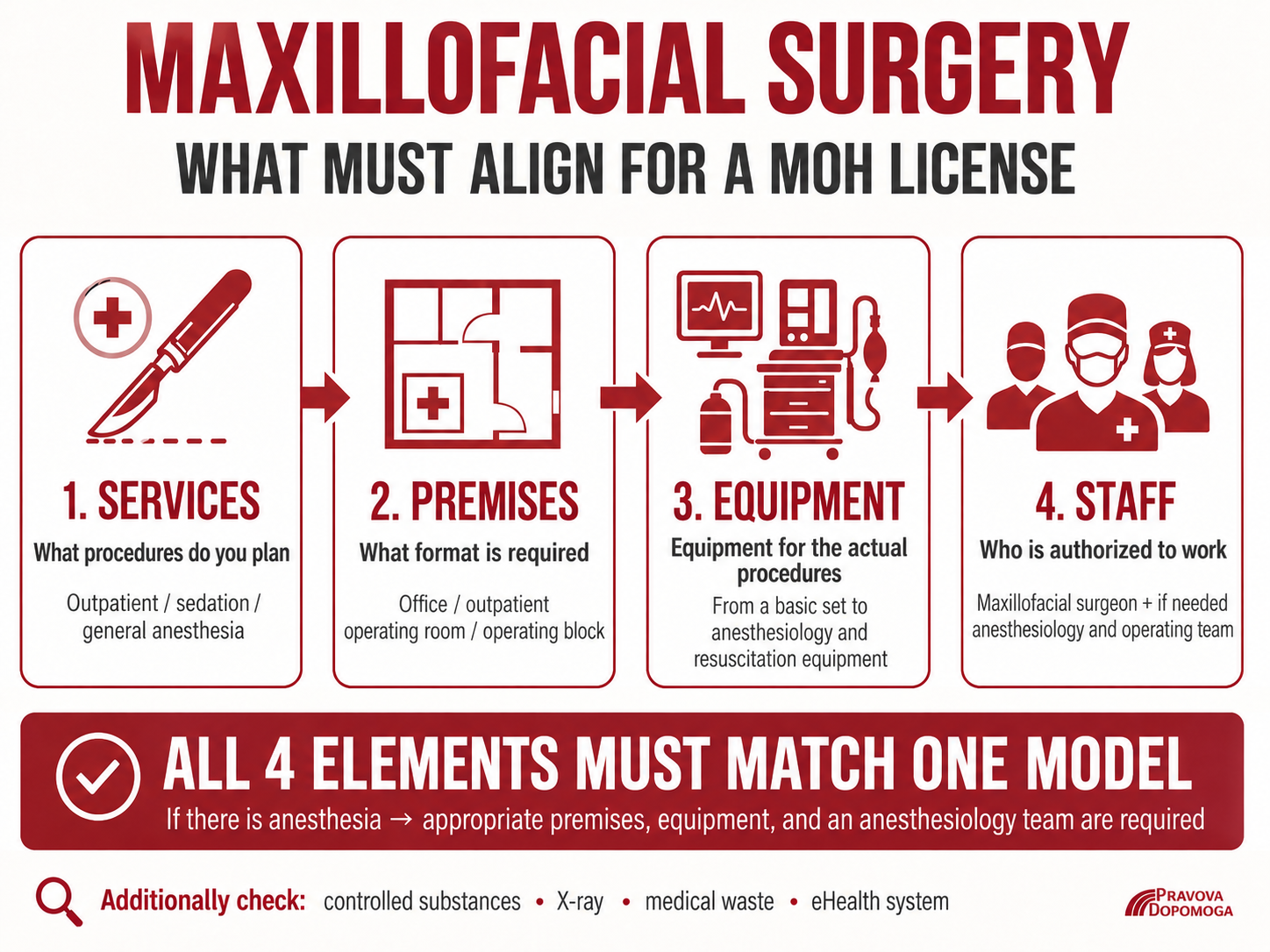
The Logical Link: Services — Premises — Equipment — Personnel
MOH experts assess the Information Form as an end-to-end logical chain. All four components must fully correspond to one another. If even one element is missing—for example, a ventilator is listed but there is no anesthesiologist or nurse anesthetist—the MFS licensing application will be refused.
Where Do Typical Problems Arise When the Practice Model Is Defined Incorrectly?
- Attempting to declare inpatient surgery as an individual entrepreneur operating from an ordinary medical office. An individual entrepreneur may obtain an MFS license, but if the Information Form lists procedures that require general anesthesia or inpatient observation, the MOH will refuse the license.
- Errors involving diplomas and certificates. Documents for a dental surgeon are submitted instead of credentials for a specialist in “Maxillofacial Surgery.”
- An incomplete anesthesia team. Sedation/general anesthesia is declared without including an anesthesiologist and nurse anesthetist with the required certificates in the staffing information.
For example, if the list of services includes procedures under general anesthesia but the Information Form describes only a physician’s office or does not include the anesthesia team, the package is internally inconsistent. A systematic cross-check before filing differs from mechanically completing individual fields because it reveals the inconsistency before the documents reach the MOH.
Related Permits and Organizational Requirements to Consider Before Launch
An MOH medical license confirms the right to conduct the declared medical practice, but for MFS it may not be the only required authorization. The final list depends on the medicines, equipment, and actual operating model. This section addresses what else must be checked before the first patient is treated, in addition to the MOH license.
Controlled Medicines for Anesthesia
If the anesthesia protocol uses medicines containing narcotic drugs, psychotropic substances, or precursors, a medical license alone is not sufficient. A separate license from the State Service of Ukraine on Medicines and Drugs Control is required for the relevant types of activities involving those substances.
Important! Sedation or general anesthesia itself does not automatically create this obligation—the specific list of medicines must be checked first.
This decision should be made together with the anesthesiologist before the final design is completed. The separate license affects the storage premises, the National Police permit for their use, the list of responsible persons, personnel authorization, recordkeeping, and internal procedures. Therefore, if your medicines fall within the controlled lists, the medical licensing process and the narcotic/precursor authorization process should be planned in parallel.
For more information about the procedure itself, see our service page “Precursor License”, and for the staffing requirements, see “Personnel Authorization to Work with Precursors: Requirements and Liability”.
X-Ray Equipment
If the practice will use a C-arm, CT scanner, or other X-ray installation, the authorization regime for the use of ionizing radiation sources must be checked separately. Some installations may require licensing by the State Nuclear Regulatory Inspectorate of Ukraine, while others may fall within exemption criteria.
This affects premises design, radiation protection, equipment documentation, and personnel requirements, so this issue should be resolved before the equipment is purchased and installed.
Medical Waste
Before operations begin, it is not enough merely to designate a place for temporary waste storage. For licensing compliance, a valid agreement with an appropriate operator must be in place and its details must be correctly reflected in the Information Form. This is particularly relevant to MFS because of sharps, biological materials, and surgical waste.
For guidance on how to verify the contractor and the agreement itself, see “Medical Waste Disposal Agreement: How to Choose a Contractor and What to Check.”
eHealth, MIS, and Documents Required Before the First Patient
Receiving the MOH licensing decision does not complete the preparations for actually seeing patients. The healthcare facility and its medical professionals must be set up in the Electronic Healthcare System (eHealth) through the selected medical information system (MIS), using qualified electronic signatures (QES) and the required medical documentation. Informed consents, local policies, and agreements must also be prepared for the actual service model. We described the technical eHealth setup process separately in “Registration in eHealth: Healthcare Facility and Individual Physician Entrepreneur”.
As a result, the full MFS launch process is broader than simply “obtaining an MOH license”: first the medical model is defined, then the premises, material and technical resources, and team are built around it; next, the medical license is obtained, while any additional permits and organizational requirements arising from your particular service list are addressed in parallel.
How to Avoid Mistakes When Obtaining a Medical License and Protect Your Time and Budget
Opening a private maxillofacial surgery practice is a complex investment and legal project in which even a small mistake in defining the operating model, selecting the premises, or preparing personnel documentation can lead to months of delays and refusals from the Ukrainian MOH. This is why support from a healthcare lawyer is important.
For more than 15 years, our law firm has specialized in comprehensive legal support for medical businesses in Ukraine, assisting with licensing for both large medical centers and private medical practices operated by individual physicians. You can involve us at any stage: while you are still defining the service list, selecting premises, assembling the team, or already have an almost-complete Information Form.
The scope of work can be tailored to your specific needs. For a maxillofacial surgery practice, we can:
- Analyze your planned service list and help determine the optimal format (individual entrepreneur or healthcare facility, outpatient office or operating suite) to avoid unnecessary infrastructure costs.
- Conduct a legal review of the premises for compliance with State Building Standards (DBN), accessibility requirements, and sanitary rules before documents are filed with the MOH.
- Verify the diplomas, certificates, qualification categories, and CPD documentation of medical personnel.
- Assist with obtaining a license for activities involving narcotic drugs, psychotropic substances, and precursors if your anesthesia model uses controlled medicines.
- Verify the authorization regime for X-ray equipment and the documents that must be completed before the equipment is put into operation.
- Check related pre-launch organizational requirements, including the medical waste agreement, eHealth/MIS setup, and the practice’s internal documentation.
- Professionally complete and file the document package with the Ukrainian MOH, monitor its legal review, and support the project until the order granting the license is published.
- Prepare local regulatory documents, patient informed consent forms, and agreements for the provision of medical services.
If the premises have already been leased, renovations completed, or some equipment purchased, the project does not necessarily have to start “from scratch.” In that situation, it is advisable first to audit the actual level of readiness and identify the remaining discrepancies within the model already created.
Planning to open a private maxillofacial surgery practice or add this specialty to an existing medical business? Contact the lawyers at Pravova Dopomoga: call our toll-free number or submit an online request through the website.
Services on the topic of this material
Our publications on this matter


Our clients