

Pediatric Services in a Private Clinic: What to Check Before Launch
Reviews of our Clients
... our work on joint projects assured us of your high level of professionalism
Launching pediatric services in a private clinic is not simply a matter of adding a “pediatrician consultation” to the price list or starting to book children with doctors who already treat adult patients.
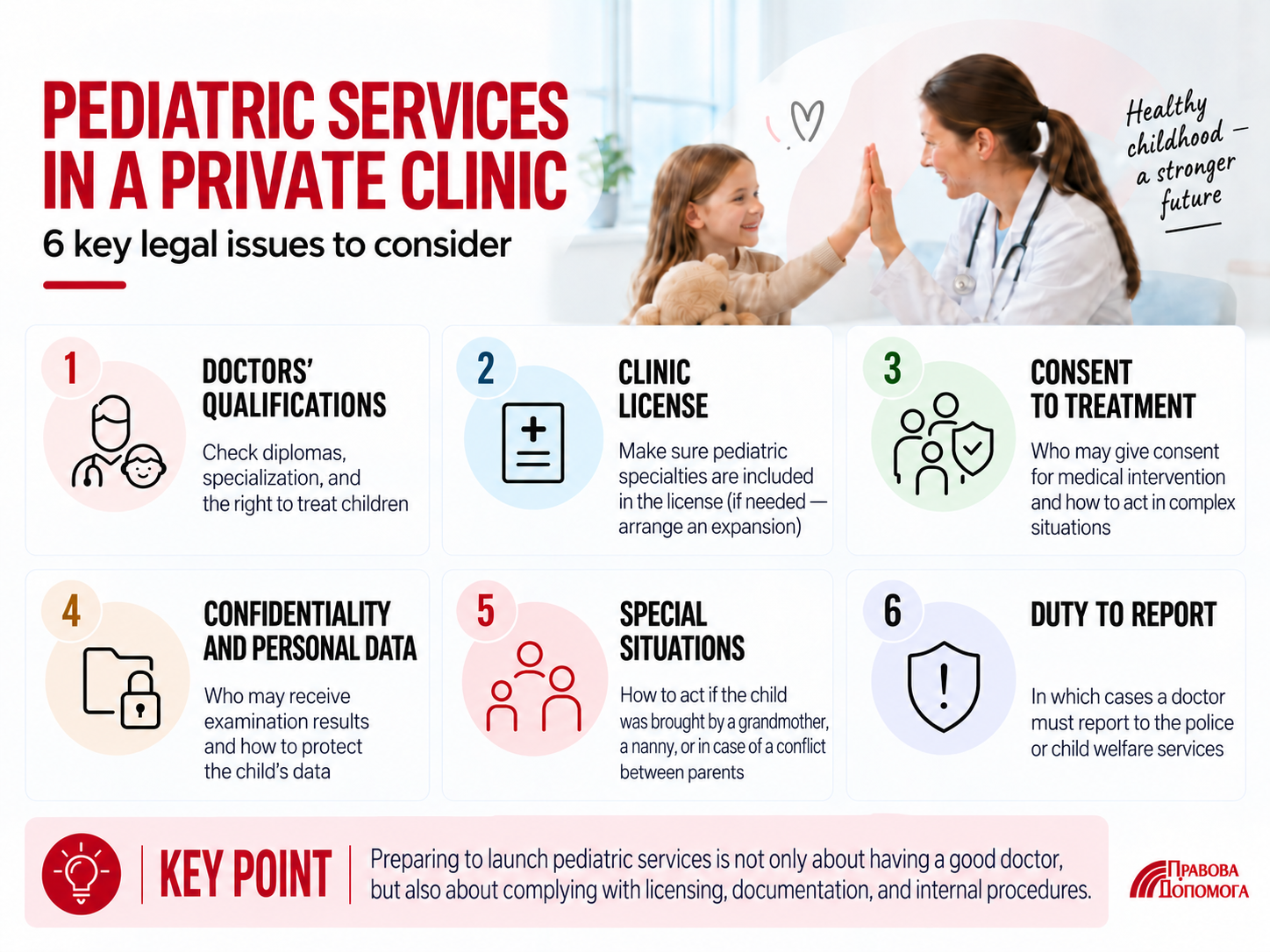
Working with minors when launching pediatric services in a private clinic creates a separate legal framework for the medical facility: it is necessary to determine which doctor is legally permitted to treat a child, who may consent to a medical intervention, who may receive examination results, what to do if a child is brought in by a grandparent or nanny, how to act when divorced parents disagree, and when a doctor is not merely permitted but legally required to notify the police or child welfare authorities.
An error at any of these stages can turn an ordinary outpatient visit into a complaint from the parents, a dispute over disclosure of medical confidentiality, a personal data violation, or questions about the clinic’s compliance with licensing requirements.
For a private medical facility, it is therefore not enough to have a good doctor who “knows how to work with children.” The doctor’s qualifications must match the declared medical specialty, and the clinic itself must have clear internal procedures for working with minor patients.
Can a Doctor Who Treats Adults See Children in a Private Clinic?
One of the most common mistakes private clinics make when working with minors is assuming that if a doctor can diagnose a particular condition in an adult, the doctor can automatically treat a child as well.
From a legal perspective, that is not enough.
Medical practice in Ukraine is conducted under a license, and staffing must correspond to the specialties in which medical care is actually provided. At the same time, the Nomenclature of Medical Specialties expressly distinguishes a number of “adult” and pediatric specialties.
For example, pediatric cardiology, pediatric neurology, pediatric otolaryngology, pediatric ophthalmology, pediatric dentistry, pediatric urology, and pediatric surgery are separate specialties. Before launching the relevant service, the clinic must separately verify whether the individual doctor has the required specialization to work with children and whether that area is reflected in the clinic’s licensing documents. The same approach applies to other specialties that Ukrainian law recognizes as distinct pediatric specialties.
That is why, even before launching pediatric medical services, the clinic should review not only the doctor’s diploma but the doctor’s entire professional qualification path: internship, specialization, specialist physician certificate, the position in which the doctor is employed, and the specialty under which the clinic is authorized to practice medicine.
At the same time, the rule that “a child may be treated only by a doctor with a pediatric specialty” should not be applied mechanically either. For example, a general practitioner—family physician works with patients of different ages, and Ukrainian law expressly provides for the participation of a family physician alongside a pediatrician in the medical supervision of children.
The right question for the clinic is therefore not “does our doctor know how to work with children?” but:
- do the doctor’s official specialty, qualification documents, position, and the clinic’s licensing configuration permit the doctor to provide the specific medical care to a child that the clinic is offering to the patient?
This review is particularly important if the clinic already treats adults and plans simply to “expand” appointments to children. In that situation, the actual list of services must be compared with the current license, the doctors’ qualification documents, and the Nomenclature of Medical Specialties.
Otherwise, the clinic may advertise pediatric services without having properly documented staffing arrangements to provide them.
Practical example: a clinic already provides cardiology services and wants to begin seeing children. Hiring a doctor whose documents confirm the specialty of “pediatric cardiology” does not by itself expand the clinic’s authority to provide this care. If pediatric cardiology is not included in the current licensing model, in 2026 it must be added as an expansion of medical practice by filing the application under Appendix 8 together with updated information. The detailed procedure is explained in “How to Expand a Medical Practice License in 2026: New Rules and Procedures”
Starting September 1, 2026, there is another staffing requirement when expanding a medical practice license to pediatric specialties: for each declared specialty, the facility must have at least one healthcare professional, including a part-time employee. If such a doctor is listed in the license expansion documents, the employment agreement with that doctor must be concluded no later than one month after the Ministry of Health issues its decision to expand the license.
Important! Before launch, the clinic’s staffing audit should answer three questions at once: which pediatric services the clinic plans to offer, which specialties must be included in the licensing model for those services, and whether the documents of the specific doctors confirm their right to provide those services. Reviewing only the staffing table or only the diplomas leaves a risk that the actual treatment of children will not match the declared medical practice model.
Who May Bring a Child to an Appointment and Consent to Medical Treatment?
The clinic must distinguish between two situations from the outset: who physically brought the child to the appointment and who has legal authority to make decisions about medical care. These are not always the same person.
A child may be brought in by a grandparent, nanny, godparent, or another adult whom the parents trust. But that person’s mere presence at the appointment does not give the clinic grounds to assume that the person may consent to any intervention or change in treatment.
If the patient is under 14, consent must be obtained through a person who has the relevant authority under the law. Depending on the circumstances, this may include parents, adoptive parents, guardians, custodians, and other legal representatives.
That is why asking at reception, “Are you here with the child?” is not enough. The clinic must understand the adult’s legal status and whether that person may consent to the actions the doctor plans to perform.
For example, a grandmother may bring a child to a scheduled follow-up examination. But if, during the appointment, a new procedure, invasive intervention, or material change in treatment becomes necessary, her presence alone does not resolve the consent issue.
Likewise, the clinic should not automatically assume that an ordinary power of attorney fully replaces the status of a legal representative. It may be used for certain organizational or representative actions, but the clinic must separately assess whether it is sufficient for the specific medical decision involved.
The safer approach is to establish an internal procedure in advance: which documents the administrator checks, when accompaniment by another adult is sufficient, and when consent from a legal representative must be obtained before medical actions begin.
Situations in which parents are divorced or live separately also require special attention. The fact of divorce or that the child lives with one parent does not automatically terminate the other parent’s parental rights. The clinic should therefore not rely solely on which parent brought the child to the appointment or with whom the child actually lives.
A safer operating model is to determine in advance which documents the administrator must review depending on who brought the child and in which cases consent from a legal representative must be obtained before medical actions begin.
Divorced Parents: Who May Give Consent and Receive Information About the Child?
Divorce or the fact that one parent lives separately does not in itself terminate that parent’s parental rights. Ukrainian law is based on the equality of the mother’s and father’s rights and obligations toward the child. A parent who lives separately does not cease to be a legal representative merely because the child actually lives with the other parent.
For the clinic, this means that the statement “the child lives with me, so do not tell the other parent anything” is not, by itself, a sufficient legal basis to deprive the other parent of rights provided by law.
There is likewise no universal rule requiring the clinic to obtain the signatures of both parents before every routine medical intervention. The issue becomes more complex when the clinic is already aware of an actual conflict—for example, one parent insists on a procedure while the other objects in writing.
In such a situation, staff should not independently “decide which parent is right.” The clinic should review the relevant documents, determine whether there are court decisions or other legal restrictions, document the parties’ positions, and identify the lawful next steps depending on the nature of the intervention.
A pediatric clinic therefore needs more than a standard consent form: it needs a procedure for identifying the legal representative and an action plan for conflicts between the child’s representatives.

How Should a Clinic Work With Patients Aged 14–18? Consent to Medical Treatment and Information for Parents
For a clinic, one of the most legally complex areas of working with minors begins at age 14.
Clinics often continue to treat a 16- or 17-year-old patient the same way they would treat a six-year-old child: the mother approves every decision, the mother signs every document, test results are sent to the mother, and the teenager is effectively not treated as an independent participant in the medical relationship. Legally, this approach is incorrect.
Once a patient turns 14, the clinic can no longer rely on the familiar model in which all decisions are documented solely through the parents. The teenager acquires an independent role in decisions about their own treatment: the clinic must establish the teenager’s position, and for routine medical treatment it should not automatically regard only the signature of the mother or father as sufficient.
This follows, in particular, from Article 284 of the Civil Code of Ukraine, which links reaching age 14 with the right to choose a doctor and consent to recommended methods of treatment. The general rule in Article 43 of the Fundamentals of Ukrainian Health Care Legislation also distinguishes between the patient’s own consent and the consent of a legal representative for younger children.
A situation involving a 16-year-old patient therefore should not work as follows: the parents bring the child in, the mother signs the form, and the clinic asks nothing further. But the opposite approach—completely excluding the parents from information and decision-making once the patient turns 14—is also incorrect.
Parents, adoptive parents, guardians, and custodians retain the rights regarding information about a minor’s health provided by law. Therefore, for patients aged 14–18, the clinic must effectively operate within two legal dimensions at the same time: the teenager’s participation in treatment decisions and the authority of the teenager’s legal representatives.
Particular care is required when the teenager and the parents disagree. There is no universal rule that “parents decide until age 18.” The type of intervention, the patient’s condition, whether there is an immediate threat to life, and any special rules applicable to the specific medical procedure will matter.
Certain types of treatment may have their own consent requirements. For example, legislation governing certain new treatment methods or unregistered medicines requires, for patients aged 14–18, the minor’s separate expression of will together with the written consent of the parents or other legal representatives.
In addition, for some medical procedures, a special rule may modify the general rule. For example, legislation governing certain new treatment methods or unregistered medicines expressly requires, for persons aged 14–18, both their written consent and the written consent of their parents or other legal representatives.
Accordingly, a private clinic should have an age-based consent matrix: a separate procedure for children under 14, patients aged 14–18, and adults, together with a list of procedures for which special legislation establishes additional requirements.
The matrix should be turned into a practical workflow for reception staff and doctors: patient age → type of intervention → who gives consent → who may receive medical information → what to do in the event of a conflict. This prevents the decision from depending on which employee happens to be on duty that day.
This is significantly safer than leaving every doctor alone with the question: “Whose signature do I need this time?”
How Should a Clinic Handle a Child’s Medical Data, Examination Results, and Photo/Video Materials?
When working with minors, a clinic simultaneously handles several types of information: examination and test results, medical conclusions, photographs of injuries, video recordings of procedures, and sometimes materials the team would like to use on the website or social media.
The legal regime applicable to these materials depends on why they were created and who will have access to them.
If photographs, videos, or other information are needed by the doctor for diagnosis, treatment, or maintaining medical records, they remain part of the patient’s medical information. Access to such materials cannot be determined arbitrarily: the clinic must establish which employees can see the data, where it is stored, and to whom it may be disclosed.
Information about health status requires a separate approach. It is subject to an enhanced level of legal protection, so obtaining a general consent to personal data processing is not enough. The clinic must understand the specific purpose for which the information is collected and used.
Risk arises particularly often when medical materials are used outside the treatment process.
For example, the clinic takes “before/after” photos, records part of an appointment, films a procedure, or wants to publish a video featuring a child on Instagram or TikTok. At that point, the issue is no longer merely the maintenance of medical records, but a separate use of the patient’s image and information.
Therefore, consent allowing the clinic to process data for the provision of medical care should not automatically extend to advertising, publications, or promotion of the clinic.
For such materials, it is safer to have a separate consent form clearly stating:
- what exactly may be used—photographs, video, a testimonial, or other material;
- for what purpose;
- where it may be published;
- whether the child’s name or other identifying information may be used;
- who gives such consent on behalf of the minor.
A pediatric clinic should therefore separate at least two processes: handling data for treatment and using materials for external communications or marketing. A single universal clause in a consent form creates more risk than protection here.
Consent to treatment, processing medical data for treatment, and using a child’s image in marketing materials are different legal purposes.
For marketing photography or video recording, it is advisable to use a separate document specifying what may be recorded, for what purpose, where the material may be published, and whether information about treatment may be used. For teenagers aged 14–18, the legally more robust model is also to take into account and document the minor’s own wishes, rather than relying only on a parent’s signature.
You may also find this useful: Medical Marketing Without Fines: How to Manage Social Media Properly
May Parents Record Their Child’s Appointment at the Clinic?
A separate issue is recording inside the clinic by patients themselves or by parents.
A medical facility may establish internal rules for photography and video recording on its premises, especially where recording could disclose other patients’ data, capture medical records, or infringe employees’ personal non-property rights. These rules are better established in internal documents and properly communicated to visitors in advance rather than invented during a conflict at reception.
For a pediatric clinic, data protection should begin not with the wording of the website privacy policy, but with practical questions: to whom may an administrator disclose test results by phone, to which email address may a medical document be sent, may one divorced parent obtain medical information, and who has access to photographs of the child taken at the clinic?
These routine daily operations are the most common source of real confidentiality risks.
What Should a Clinic Do if It Suspects Violence or a Threat to a Child?
When working with children, a doctor may sometimes receive information that goes beyond a purely medical issue. This includes situations where injuries, the child’s condition, or the behavior of adults gives grounds to suspect that the child may be in danger. In such cases, the doctor should not limit the response to a conversation with the parents or other legal representatives.
Healthcare facilities are subject to a specific response mechanism when circumstances may indicate child abuse, inadequate care, or another threat to the child’s safety (Resolution of the Cabinet of Ministers of Ukraine No. 585). If such a suspicion arises during examination or treatment, the information must be reported to the authorized authorities in accordance with the prescribed procedure.
Depending on the circumstances, the report may be made to the police and, where a child is involved, also to the child welfare service. For certain cases, the law requires prompt reporting, including within 24 hours.
The Ministry of Health separately establishes the procedure for medical professionals in such situations. It covers not only the act of reporting itself, but also the signs a doctor should pay attention to when working with a child.
Not every bruise automatically means abuse, and not every visit triggers a report. However, repeated injuries, injuries accompanied by inconsistent explanations, signs of fear, or other circumstances that may indicate violence or a threat to the child’s safety already require documentation and application of the clinic’s internal protocol. For example, a one-time sports injury supported by a consistent medical history and a series of injuries of different ages that an adult explains differently are not legally equivalent situations. For the doctor, the latter may be a legal trigger for applying a special procedure.
There is another requirement that matters for the clinic manager: employees who come into contact with children must be familiar with the rules for protecting children from violence, and the head of the facility approves a plan for such staff education specifying topics, frequency, formats, and responsible persons. This means that the requirement should exist not only in one doctor’s job description, but in the working procedures of all staff who come into contact with children.
At the same time, reporting to competent authorities in the manner prescribed by law should not be equated with unlawful “disclosure of medical confidentiality.” Where the law requires a medical facility to provide information to protect a child, the clinic must comply. However, the information should be provided to the appropriate authority, using the prescribed procedure and only to the extent necessary, and the fact of the report should be documented.
Important! A medical clinic should not be searching for the child welfare service’s phone number for the first time when a child showing signs of abuse is already sitting in front of the doctor. The correct model is to have an internal procedure in place in advance: who records the signs, whom the doctor informs, who contacts the police and child welfare service on behalf of the facility, which documents are completed, and who monitors the follow-up actions.
What if Parents Refuse Treatment for Their Child?
An even more difficult situation arises when the danger results not from violence but from the parents’ own behavior—for example, when they categorically refuse medical care that the child needs.
A legal representative’s refusal of medical treatment does not always mean that the doctor should merely document the refusal and stop acting. If such a decision creates a danger to the child’s health, the law places responsibility for the consequences of failure to provide necessary care on the parents or persons acting in their place. If the child’s condition is critical, the medical facility must also properly document the situation and warn the relevant persons of the possible legal consequences.
At the same time, the clinic must distinguish between two different situations: when obtaining consent is physically impossible and when the child’s representative consciously objects to treatment.
The possibility of providing care without consent under Article 43 of the Fundamentals of Ukrainian Health Care Legislation applies to emergency situations involving a real threat to life where obtaining an expression of will is objectively impossible. An express refusal by the parents does not, by itself, turn the situation into an “inability to obtain consent.”
Accordingly, where medical necessity conflicts with the parents’ position, the clinic needs a separate action protocol: what must be documented in the medical records, who makes the decision within the facility, and in which cases the clinic must contact authorities authorized to protect the child’s rights and interests.
How to Prepare a Private Clinic to Launch Pediatric Services
In pediatric medicine, all of these risks are interconnected. For example, changing the list of services affects the licensing and staffing model, the patient’s age affects the consent procedure, and the status of the accompanying adult affects whether medical information may be disclosed. Before launch, the clinic should therefore review not an isolated form or specialty, but the minor patient’s entire journey through the clinic—from booking the appointment to receiving results and the staff’s response to unusual situations.
In practice, clients come to us with the task of launching medical services for children and teenagers in two situations: either the clinic already treats adults and wants to add pediatrics or pediatric subspecialties, or the pediatric service line is still being prepared and the correct licensing and operational model needs to be built from the outset. In both cases, reviewing the license alone is insufficient—the doctors’ documents and the clinic’s daily processes must also correspond to the new service model.
We can therefore begin with a legal audit of your clinic’s specific model: compare the planned pediatric services with the current license and doctors’ documents, review age-based consent rules, the handling of the child’s representatives, access to medical information, and the internal response protocol for risks to the child. The audit will show what needs to be changed before launch and what can already be used.
As a result, you receive a launch map for the pediatric service line: which specialties need to be added, which doctors may be declared, which consent forms and internal procedures are required for reception staff and medical personnel, and what can remain unchanged in the clinic’s current model.
If the issue concerns only the license, we can prepare the expansion for the required pediatric specialties. If the pediatric service line is being launched from scratch, we can handle both the licensing component and the internal staff documentation at the same time. More information about licensing support is available on the Medical Practice License page.
Planning to add pediatrics or pediatric subspecialties? Contact us—submit an online request on the website or call our toll-free number.
Services on the topic of this material
Our publications on this matter


Our clients


We are ready to help you!
Contact us by mail [email protected] or by filling out the form:
Other publications

Adding a pediatrician to the service list is not enough. A pediatric service line changes licensing, physician qualification, consent, medical data, and front-desk procedures for working with minors.

School psychologists, speech therapists, rehabilitation specialists, and massage therapists do not always require medical licensing. The key issue is whether their actual work is educational or corrective, or amounts to medical care or rehabilitation.

Adding a new medical specialty does not always require another accessibility assessment, while a new location usually does. The key questions are which premises the existing report covers and whether the property has changed.

Two independent private doctors may use the same medical office, but one practitioner’s license does not cover the other. Each must properly document the premises, equipment, schedule, and licensing basis for their own practice.
Our other authors