

Registering Charter Amendments for Charitable Organizations to Obtain Non-Profit Status
Cost of services:
Reviews of our Clients
Many charitable organizations in Ukraine are already operating in practice: they collect charitable contributions, implement projects, and work with donors. However, they do not have non-profit status. The reasons are quite typical: the organizations were established a long time ago, used template or outdated charters, or simply did not make inclusion in the Register of Non-Profit Institutions and Organizations a priority at the registration stage.
As a result, an organization may carry out its activities in full, but without non-profit status (or after losing it), it is taxed under the general rules as a corporate income tax payer. Donations, grants, and other receipts are included in its income, and its tax liabilities are determined in accordance with the general tax rules, in particular, at the basic corporate income tax rate of 18%, pursuant to Subparagraph 136.1 of Article 136 of the Tax Code of Ukraine.
If tax is not paid or is underpaid, the tax authority has the right to assess additional tax liabilities and impose penalties and late payment interest in accordance with the requirements of the Tax Code of Ukraine. These financial consequences may apply to the entire period during which the tax obligations were not properly fulfilled.
If your organization is in this situation, meaning that it is already operating but does not have non-profit status, and you plan to obtain it, simply submitting an application to the tax authority will not be enough. The first step should be to amend the constituent documents and bring the charter into full compliance with the requirements of current legislation.
You might also like: Primary Documentation of a Charitable Organization: Requirements and Risks
Why Non-Profit Status Is Important for a Charitable Organization
Before moving on to the requirements and procedure, it is worth understanding what the organization gains as a result. This will help determine whether the outcome justifies the effort involved.
For an already operating charitable organization, non-profit status is a fundamental condition for stable and secure operations. It directly affects the charity’s tax arrangements and its ability to attract funding. In particular, non-profit status allows an organization to:
- Avoid paying corporate income tax on funds used exclusively for charitable activities.
- Officially work with grant programmes, major donors, and international organizations without restrictions.
- Increase the level of trust among businesses, volunteers, and the public sector.
Thus, non-profit status not only provides tax relief but also creates a solid foundation for transparent, effective, and long-term operations. It opens up access to a wider range of funding opportunities, facilitates cooperation with partners and donors, and helps the charitable organization focus on what matters most: fulfilling its mission and helping those in need.

What Legal Requirements Must Be Met to Obtain Non-Profit Status
For a charitable organization to be included in the Register of Non-Profit Institutions and Organizations, its constituent documents, primarily its charter, must comply with the mandatory requirements of the Tax Code of Ukraine, in particular Paragraph 133.4 of Article 133.
In practice, the wording of the charter is a key factor examined by the tax authority when making its decision. What must it contain?
- A prohibition on the distribution of income. The charter must expressly state that the income (profit) of the charitable organization may not be distributed among its founders, participants, members of governing bodies, or any related parties. Payments to employees are permitted only in the form of salaries, compensation, and other payments provided for by law, provided that they do not constitute a disguised distribution of profit.
- Use of funds exclusively for statutory activities. All income and assets of the charitable organization must be used exclusively to achieve its statutory objectives, including charitable programmes and projects, providing assistance to beneficiaries, covering the organization's operating costs (rent, utilities, and administrative expenses), and pursuing the goals and objectives set out in its charter.
Any vague or general wording referring to “other needs of the organization” without linking those needs to its statutory activities may be regarded by the tax authority as a violation of the non-profit status requirements. - The procedure for transferring assets upon termination of activities. The charitable organization's charter must clearly specify that, in the event of liquidation, reorganization (merger, acquisition, or division), or termination of activities, all its assets are transferred to one or more other non-profit organizations of the relevant type or credited to the state budget in cases provided for by law.
- Compliance with current legislation. Many charitable organizations operate under charters that have not been updated for years. Even if such an organization conducts its activities properly in practice, outdated or incomplete provisions in its charter may serve as formal grounds for refusal.
Therefore, before submitting the documents, it is advisable to conduct a legal review of the current version of the charter and bring it into compliance with the requirements of the Tax Code of Ukraine.
Once the requirements that the charter must meet are clear, the next question is how to make these amendments and officially register them. Let us look at the process step by step.
Procedure for Amending the Charter and Submitting Documents: A Step-by-Step Guide
The process of bringing a charitable organization into compliance to obtain non-profit status consists of several logical stages.
- Legal audit of the constituent documents. At this stage, the charter is thoroughly reviewed for compliance with the requirements of Article 133.4 of the Tax Code of Ukraine, and potential grounds for refusal by the tax authority are also assessed.
- Preparation of a new version of the charter. An updated charter is drafted, incorporating amendments that take into account both tax legislation requirements and the specifics of the organization's actual activities.
- Adoption of a resolution by the highest governing body. A general meeting of members is held, and minutes are prepared to document the approval of the new version of the charter.
- State registration of amendments in the Unified State Register (USR). The amendments to the constituent documents are submitted to the state registrar or a notary together with the required set of documents.
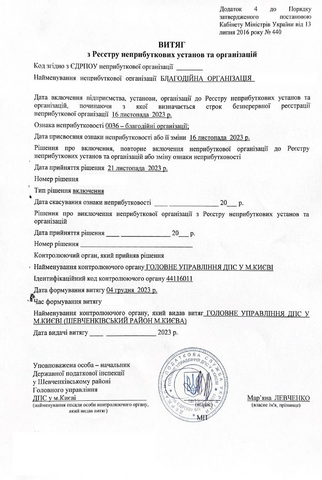
- Inclusion in the Register of Non-Profit Institutions and Organizations. After the amendments have been entered into the USR, the organization submits an application using Form 1-RN to the controlling authority. You can download a sample completed Form 1-RN registration application here.
Please note: An application for non-profit status can also be submitted to the state registrar using Form 2 when registering amendments under the “one-stop shop” principle, which significantly speeds up the procedure.
The tax authority generally reviews the documents within up to 3 business days of receiving them.
Although the process appears straightforward, these are precisely the stages at which errors most often occur, resulting in refusal.
Successful case: How to Register a Religious Organization in Ukraine: From Charter to Non-Profit Status
The Cost of a Mistake: Risks of Independently Submitting Documents for Inclusion in the Register
Even seemingly minor inaccuracies at any of these stages can result not in a minor correction request, but in a complete refusal to include the organization in the Register, requiring the entire process to be repeated. The most common technical errors that lead to refusal include:
- charter provisions that have remained unchanged since the organization was established and do not comply with the current version of the Tax Code of Ukraine;
- missing or incorrectly worded provisions governing the use of the organization's income (profit);
- errors when completing the Form 1-RN application or submitting an incomplete set of documents;
- constituent documents that do not meet the requirements for transferring assets upon termination of activities;
- technical inaccuracies in the organization's details (EDRPOU code, name, or head's information) that complicate the document review process.
Each of these errors means more than just a delay. It entails another document submission cycle and a repeated review, resulting in lost time for an organization that should already be operating under the non-profit tax regime.
If the controlling authority refuses the application, the organization has the right to reapply with corrected documents or challenge the decision through administrative or court proceedings. However, both options further extend the time required to obtain non-profit status.
What does this mean for a charitable organization? While you go through another round of corrections and registrations:
- Major donors put cooperation on hold because they cannot transfer funds without creating risks for their own accounting and reporting.
- Grants for which project proposals have already been prepared go to other foundations with fully compliant documentation.
- The organization loses weeks of operational time, maintaining its office and staff without receiving any actual funding.
Registering Amendments to a Charitable Organization: Legal Assistance
Trying to amend a charter through trial and error is the most expensive way to learn. The procedure for obtaining non-profit status for an organization that is already operating is often complicated by technical errors, outdated charter provisions, or improperly documented resolutions of governing bodies. As a result, even seemingly minor inaccuracies can lead to refusal to include the organization in the Register.
We provide comprehensive legal support to charitable organizations at every stage of bringing their documents into compliance:
- conducting a detailed legal audit of the constituent documents;
- identifying and eliminating potential grounds for refusal by the tax authority;
- preparing a new version of the charter or amendments to it;
- providing support throughout the state registration of amendments;
- preparing a complete set of documents for submission to the tax authority;
- assisting with the organization's inclusion in the Register of Non-Profit Institutions and Organizations.
This approach ensures not merely that the documents are submitted, but that the organization's activities are brought into compliance with legal requirements, providing a stable legal status for its continued operation as a non-profit organization.
If you are planning to bring your foundation's constituent documents into compliance or have faced a refusal to grant non-profit status, contact us.
Services on the topic of this material

Our publications on this matter


Our clients
We are ready to help you!
Contact us by mail [email protected] or by filling out the form:
Other publications by the author

Stock balances in Form No. 1-OP should be reconciled not only with warehouse records but also with storage locations, product codes, and source documents. Specific rules apply to responsible storage, imports, and exports.

A foreign company may still trigger CFC reporting even if it had no operations or income. The key factors are Ukrainian tax residency, ownership or actual control, while CFC notices and annual reports follow different filing rules.

A tax authority may interpret a transaction differently only when an audit begins, after the exposure has accumulated for years. An individual tax consultation allows a business to obtain an official position in advance for its specific transaction model.

Returning to Ukraine is not required for divorce in most cases. Depending on whether the spouses have minor children and both agree to divorce, the process may go through Diia, the civil registry, or court, while child and alimony issues can be handled separately.
Our other authors