

Drug Storage During Martial Law in Ukraine: What Has Changed
Reviews of our Clients
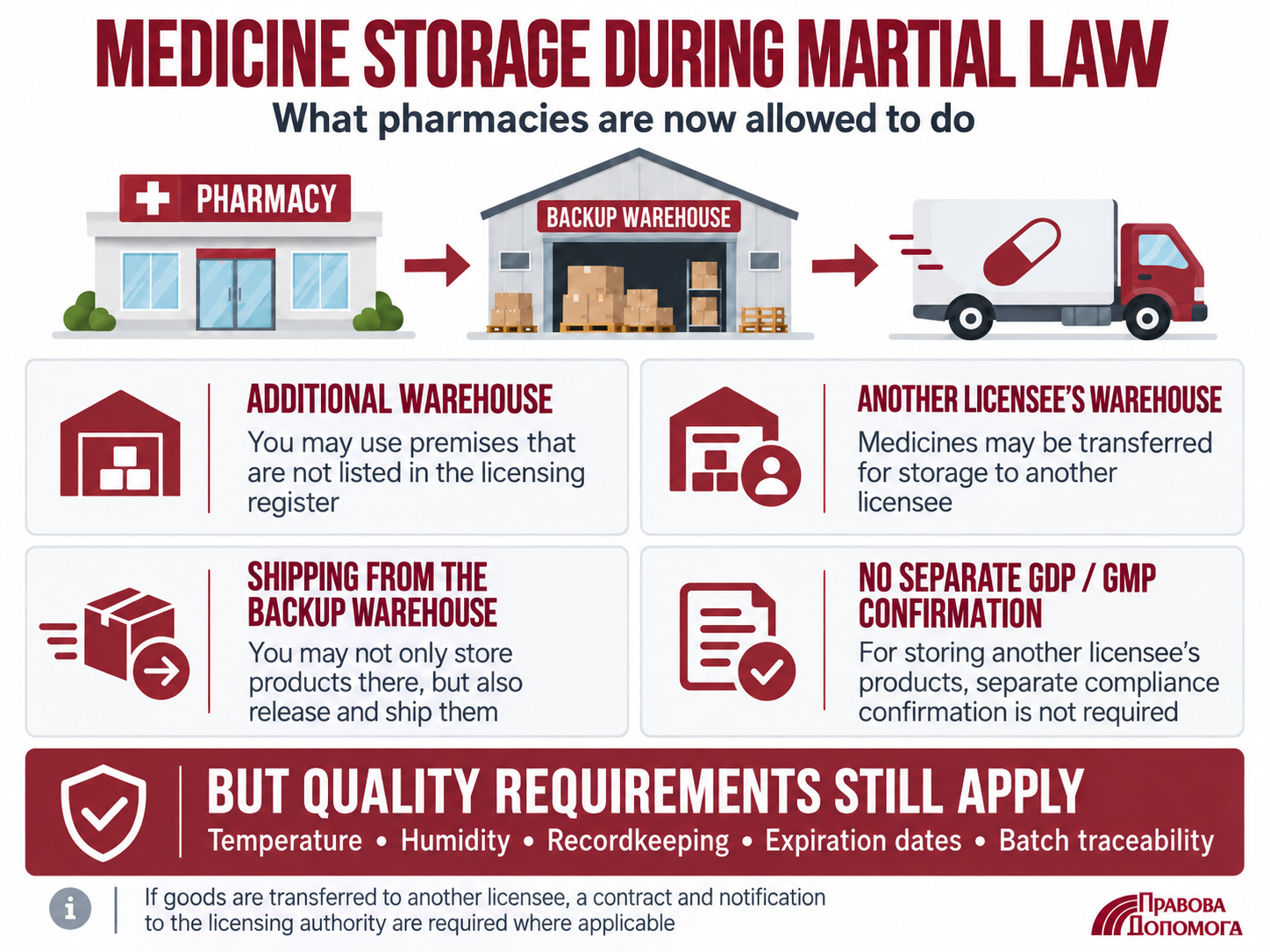
The Cabinet of Ministers of Ukraine has allowed pharmaceutical businesses to organize the storage of medicinal products more flexibly during martial law. Pharmacies and other licensees may use additional warehouse premises even if information about them is not included in the licensing register or if the premises belong to another licensee.
The relevant amendments were introduced by Resolution of the Cabinet of Ministers of Ukraine dated August 26, 2026 No. 1062. The amendments to the current version of the Licensing Conditions took effect on September 3, 2026 and apply to paragraph 31¹ of the Licensing Conditions, approved by Cabinet of Ministers Resolution No. 929.
This decision is particularly important amid ongoing attacks. If the main medicinal product warehouse is damaged, located in a dangerous area, or temporarily inaccessible, the licensee may move the products to other premises and continue supplying medicines.
Below, we explain what new options are now available to pharmacies and how they can use them.
What Has Changed in the Rules for Storing Medicinal Products?
During martial law, licensees are allowed to receive and store:
- medicinal products;
- active pharmaceutical ingredients;
- excipients used in the manufacture of medicines;
- related products.
For this purpose, licensees may use not only their own warehouse premises listed in the licensing register, but also:
- additional premises that are not listed in the register;
- warehouse premises belonging to another licensee.
In addition, medicinal products and related products may now be released and shipped directly from such warehouses.
This is an important change because paragraph 31¹ previously expressly allowed products to be stored in such warehouse premises but did not provide for their release or shipment directly from those premises. The Licensing Conditions now expressly allow products to be released and shipped from such warehouse premises.
Accordingly, the licensee can now build a complete backup logistics chain: receive goods at additional premises, store them there, and then ship them to a pharmacy, healthcare facility, or another lawful recipient.
For example, a pharmacy chain stored its main stock of medicines at a single warehouse. After the building was damaged, the goods had to be moved urgently. Under the new rules, the company may use suitable backup premises and continue shipping medicines from there to its pharmacies. It does not need to wait for the warehouse to be added to the licensing register before using this wartime mechanism.
Can a Pharmacy Store Medicines at Another Licensee’s Warehouse?
Yes. The new rules expressly allow this. If a pharmacy owner does not want to keep the entire stock of medicinal products in one area because of the risk of attacks, the owner may arrange with another licensee to store part of the products in that licensee’s warehouse. Ownership of the goods does not transfer to the company providing the warehouse. The medicinal products remain the property of the pharmacy, while the other licensee merely accepts them for storage.
This arrangement must be properly documented. In particular, the parties should determine:
- which products are being transferred;
- where they will be stored;
- who will receive and ship the goods;
- who will monitor temperature and other storage conditions;
- who will be responsible for damage to or loss of the products;
- how the parties will exchange documents;
- what to do if a particular batch of medicines is recalled or prohibited.
In other words, a pharmacy cannot simply place boxes of medicines in available space at someone else’s warehouse. It must know where each batch is located, the conditions in which it is stored, and to whom it is subsequently transferred.
Does an Additional Warehouse Need to Be Added to the Licensing Register?
Paragraph 31¹ of the Licensing Conditions expressly states that licensees may use warehouse premises that are not listed in the licensing register. Therefore, during martial law, an additional warehouse may be used without first adding it to the register.
At the same time, if medicinal products are transferred for storage to another licensee under an agreement, a separate requirement under paragraph 31 of the Licensing Conditions applies: the licensee must notify the licensing authority that the agreement has been entered into (or amended), specifying information about the business entity with which the agreement was concluded, the agreement details, and the address of the pharmaceutical warehouse.
However, it is important not to confuse the use of a backup warehouse with obtaining a pharmacy license.
If an entrepreneur is only planning to open a pharmacy, they cannot list another licensee’s warehouse instead of their own pharmacy premises. To obtain a license, the applicant must have a pharmacy that meets the requirements for floor area, zoning, equipment, staff, and work organization.
The option to use an additional or third-party warehouse becomes available only after the license has been obtained. It is a backup storage option for products, not a substitute for the pharmacy itself.
In this context, you may also find this material useful: Amending a Pharmacy License: How to Avoid Fines and Revocation

Is GDP or GMP Confirmation Required When Storing Another Licensee’s Medicines?
Another simplification concerns the storage of products owned by another licensee. New subparagraph 2¹ provides that, in this case, the licensee providing the storage is not required to provide confirmation of compliance with the requirements of:
- Good Distribution Practice (GDP);
- Good Manufacturing Practice (GMP), in the cases specified by the Licensing Conditions.
However, this does not mean that medicinal product storage requirements have been abolished altogether. What is no longer required is the specific separate confirmation of compliance provided for in paragraphs 28 and 58 of the Licensing Conditions. The licensee must still ensure product quality and traceability.
Therefore, before transferring the goods, it is advisable to check not only whether the other company holds a license, but also the warehouse itself: its equipment, temperature conditions, zoning, record-keeping system, and backup power supply.
Which Medicinal Product Storage Requirements Remain Mandatory?
The new rules simplify logistics, but not the quality requirements for medicinal products. Even if a warehouse is not listed in the licensing register or belongs to another company, the licensee must:
- comply with the storage conditions specified by the manufacturer;
- monitor temperature and humidity;
- protect medicines from damage, contamination, and unauthorized access;
- keep expired, returned, damaged, or prohibited medicines separate;
- maintain records of products received and shipped;
- monitor expiration dates;
- ensure traceability of every batch.
Traceability means that the documents must make it possible to track the entire movement of a medicinal product: who supplied it, when and in what quantity it was received, where it was stored, and to whom it was shipped.
For example, the State Service of Ukraine on Medicines and Drugs Control has prohibited the sale of a specific batch of a medicinal product. The pharmacy must quickly check whether that batch is present not only in the retail premises but also at the backup warehouse, stop its shipment, and arrange for its withdrawal.
The general requirements for the storage and movement of medicinal products are established by the Licensing Conditions approved by Cabinet of Ministers Resolution No. 929, while quality control procedures for wholesale and retail trade are governed by Order of the Ministry of Health of Ukraine dated September 29, 2014 No. 677.
Also relevant for existing licensees: New Requirements of the State Service of Ukraine on Medicines and Drugs Control: What Pharmacy and Pharmaceutical Licensees Must Submit by November 2026
How Should the Storage of Medicines at Another Licensee’s Warehouse Be Documented?
Before transferring medicinal products, the parties must enter into a written agreement. This may be a safekeeping agreement or another agreement covering all actual operations involving the products. The agreement should specify:
- the address of the warehouse premises;
- the list of products being transferred;
- the required storage conditions;
- the procedure for receiving and shipping products;
- the responsible persons;
- the rules for maintaining and transferring documents;
- the inventory procedure;
- liability for loss of or damage to the goods;
- the parties’ actions in the event of an accident, power outage, or product recall.
In addition to the agreement, the pharmacy business should update its internal procedures and define how employees will act in specific situations. For example, if a refrigerator at the backup warehouse fails overnight, it should be clear in advance who receives the temperature deviation alert, who arranges the transfer of the medicines, and who decides whether they may subsequently be sold.
These details make it possible not merely to execute an agreement formally, but to protect the products in practice.
How the New Rules Simplify Pharmacy Operations During Martial Law
During martial law, a licensee is not limited to warehouse premises listed in the licensing register. It may use additional warehouse premises or the warehouse capacity of another licensee, provided that the requirements established by the Licensing Conditions are met. The licensee can now arrange a backup warehouse in advance, distribute products among several premises, and prepare an alternative supply route. If one location is damaged or becomes temporarily inaccessible, the pharmacy will be able to resume operations more quickly.
This is also an important change for entrepreneurs who are only planning to open a pharmacy. Wartime risks can be taken into account while the business is still being prepared: select the main premises, obtain the license, and then arrange backup storage for part of the inventory.
For example, an entrepreneur opens a pharmacy in Kyiv. To obtain the license, they prepare their own pharmacy premises, purchase the required equipment, hire employees, and submit documents to the licensing authority. After the license is obtained, part of the inventory may be placed at another licensee’s warehouse in another district, provided the appropriate contractual arrangements are made and the licensing authority is notified in the case specified by paragraph 31 of the Licensing Conditions. If the main location is damaged, this can help prevent the loss of the entire stock and restore supplies more quickly.
For those who are only planning to launch a pharmacy business, the step-by-step guide “Opening a Pharmacy from Scratch in 2026: Formats, Requirements, and License” may also be useful.
How We Can Help a Pharmacy Business
We can assist both with opening a new pharmacy and with arranging backup storage of medicinal products for an existing licensee. The scope of work depends on whether you are preparing to launch the business or already operate and want to use the new options available during martial law.
If you are planning to open a pharmacy, we can help prepare the business for licensing. In particular, we can:
- help negotiate and execute a lease for premises to be used as an additional warehouse;
- determine what equipment needs to be purchased;
- review the documents of the pharmacy manager and other employees;
- prepare the application and information on the material and technical resources;
- submit the documents and support the review process.
For an existing pharmacy business, we can separately help organize the use of an additional or third-party warehouse. We will review the premises documents, help define the procedures for receiving, storing, and shipping products, and prepare or review the agreement with the other licensee and the internal procedures for operating the backup warehouse.
It is also advisable to determine in advance who is responsible for temperature conditions, record keeping and batch traceability, as well as the actions to be taken if products are damaged, there is an emergency power outage, or a medicine is recalled. This makes it possible not only to document backup storage formally, but also to establish a clear operating model in case the main location becomes temporarily inaccessible.
If you are planning to open a pharmacy or already hold a license and want to arrange backup storage of medicinal products, contact the lawyers at Pravova Dopomoga. We will help prepare the documents, review the premises, and properly arrange the use of an additional warehouse in accordance with the current requirements.
Learn more about our full-service support for obtaining a pharmacy license on the service page: Pharmacy License in Ukraine
Services on the topic of this material
Our publications on this matter


Our clients