
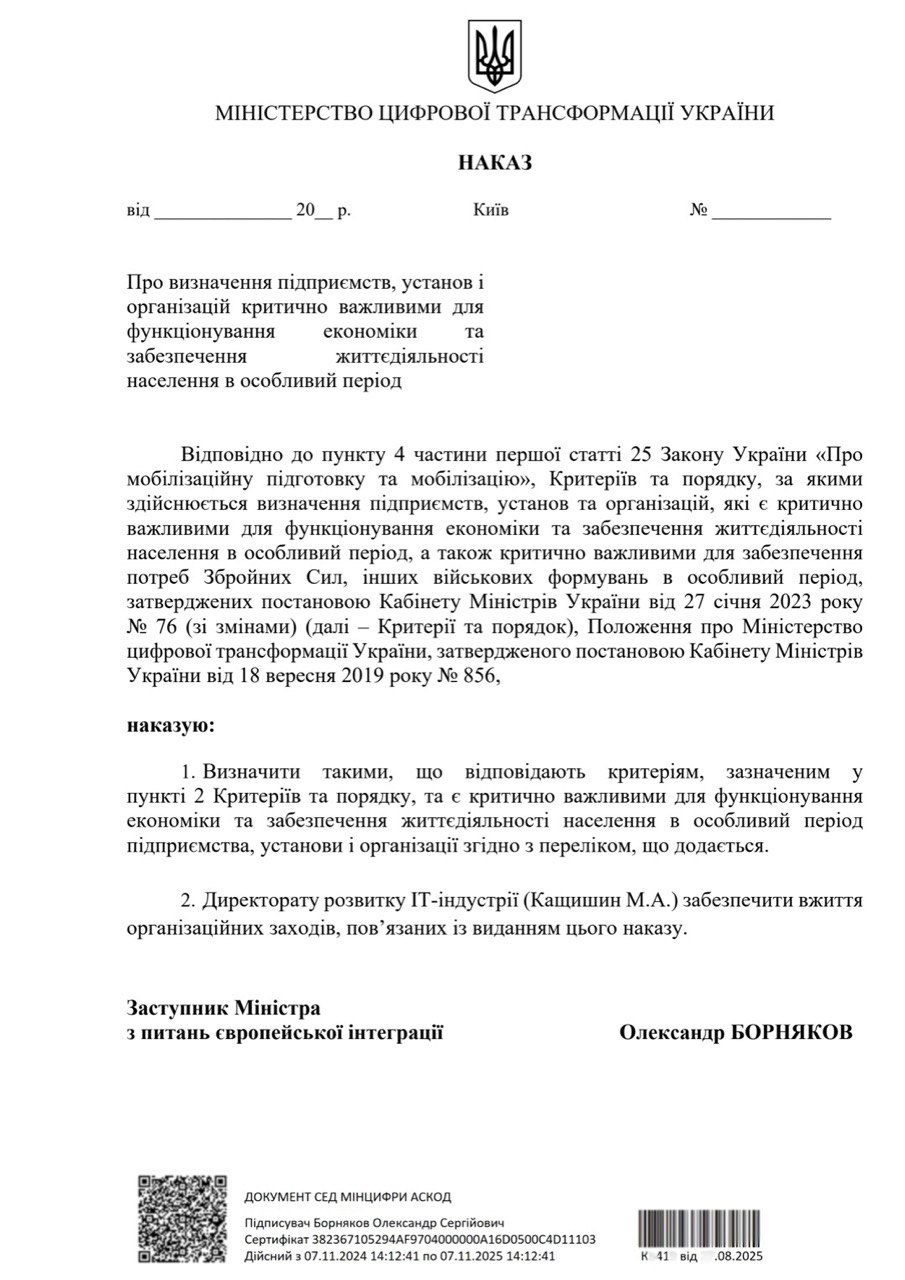
Changes to Obtaining Critical Enterprise Status in Diia.City
Cost of services:
Reviews of our Clients
... our work on joint projects assured us of your high level of professionalism
Recent amendments to Resolution No. 76 have become pivotal for all Diia City companies planning to obtain Critical Enterprise Status and reserve key specialists from mobilization. The state has clarified the eligibility criteria, the procedure for confirming the status, and document requirements, and has introduced a separate mechanism for Diia City residents to confirm financial sustainability and compliance with the Law on the Digital Economy. This makes the process formally more structured, but at the same time more demanding in terms of the quality and completeness of submitted documents.
In the context of prolonged mobilization and businesses’ need to retain key specialists, the relevance of these changes has increased significantly. A correct understanding of the new rules directly affects whether a company can protect its team, maintain operational stability, and fulfill contractual obligations. The new procedure creates additional opportunities for IT companies, while simultaneously increasing responsibility for substantiating compliance with the criticality criteria. For this reason, careful legal support is required.
In this article, we examine how the procedure for confirming Critical Status has changed for different types of Diia City residents and how to avoid refusals due to formal errors.
You might also like: Employee Reservation Quotas: How to Calculate Them and Increase the Limit to 100%
Specifics of Obtaining Critical Enterprise Status for Diia City Residents
Amendments to Resolution No. 76 introduced a separate and more detailed approach to how Diia City residents can confirm their compliance with the criteria for critical enterprise status. The legislator has effectively singled out IT companies as a distinct category, as they operate under a special legal regime and undergo the residency procedure differently from ordinary enterprises.
The key change is that the requirement to submit tax reporting for the most recent tax period does not apply to Diia City residents that obtained their status in accordance with Part Three of Article 5 of the Law. Instead of a standard tax declaration, such companies must submit a separate set of documents confirming their economic activity and compliance with the requirements of Article 13 of the Law on the Development of the Digital Economy.
For such residents, the state has established two options, one of which must be confirmed with documentary evidence:
1. Confirmation of compliance with the requirements of point 1 of part two of Article 13 of the law
The company must prove that during three full months after obtaining Diia City residency it received economic inflows of at least EUR 20,000 calculated at the National Bank of Ukraine exchange rate as of January 1 of the current year. These amounts may consist of:
- revenue from the sale of goods, works, or services;
- royalties, if they are not included in sales revenue;
- grants;
- investments.
All such inflows must be supported by copies of contracts and primary documents such as invoices, acceptance certificates, bank statements, and similar records. The documents must be certified by the head of the enterprise.
2. Confirmation of compliance with the requirements of part three of Article 13 of the law
As an alternative, a resident may submit documents confirming compliance with other criteria предусмотрені for this group of companies. This option is important for entities operating in specific segments of the IT market that may not have regular revenues in the first months but meet other Diia City requirements.
As a result of these changes, the legislator has created a mechanism that makes it possible to distinguish active Diia City residents from formal ones and to grant critical enterprise status only to companies demonstrating real economic activity. This increases the transparency and justification of employee reservation and ensures access to this procedure specifically for IT companies that play a meaningful role in supporting the economy and technological development.
You might also like: How Not to Lose the Status of a Critical Enterprise
Segmentation of Diia City Residents Who Qualify Under the Old Rules and Who Fall Under the New Ones
To obtain Critical Enterprise Status, Diia City resident companies must meet a general set of criteria established by the state. Diia City residency itself already serves as one of the prerequisites for critical status, as the legislator explicitly recognizes the IT sector and the digital economy as strategically important under martial law.
However, residency alone is not sufficient. A company must also meet additional requirements that confirm its stability, solvency, and real economic role.
These requirements include the absence of tax arrears, compliance with average salary standards, and the proper submission of tax reporting. These criteria are considered baseline, and for most residents they determine eligibility for critical status.
The key distinction is that after November 15, 2025, the legislator divided Diia City residents into two groups, for which the procedure for confirming critical status now differs.
First Group of Diia City Residents
These are companies that obtained Diia City residency under the general procedure. This means they already met all mandatory requirements at the moment they acquired resident status. For them, the criticality criteria have remained unchanged and the documentation package is standard. This category operates under the familiar mechanism: residency status, compliance with salary requirements, absence of outstanding liabilities, and proper tax discipline are sufficient to apply for Critical Enterprise Status.
Second Group of Diia City Residents
These are the so-called simplified Diia City residents. This category includes startups that obtained temporary residency in accordance with Part Three of Article 5 of Law No. 1667. They do not yet meet all mandatory requirements, but they carry out qualified digital activities and demonstrate a high level of qualified income. For these companies, the state has introduced an additional level of verification.
Such enterprises must submit documents confirming real business activity and gradual compliance with Diia City requirements. If a company has held resident status for three months, it must prove receipt of economic inflows in the established amount. If the residency has been in effect since the previous year, the company must submit an annual report accompanied by an independent auditor’s opinion. This mechanism effectively separates genuine startups from those that registered formally but do not conduct active operations.
As a result, the criteria for Critical Enterprise Status for Diia City residents now depend on how a company entered the regime. For those who met all requirements from the outset, the old rules continue to apply. For startups, however, the procedure has become more complex and requires tangible proof of economic activity.
Risks for IT Businesses in Case of Non-Compliance With the New Requirements
Failure to comply with the updated requirements for obtaining Critical Enterprise Status may have serious consequences for businesses. First and foremost, a company risks being denied the status and, as a result, losing the right to reserve employees from mobilization. This may lead to the departure of key specialists and the suspension of critical projects, which is especially sensitive for IT and defense-related teams.
Formal errors in documentation, such as incomplete tax reporting confirmations, missing primary documents, or inaccurate financial data, may also serve as grounds for refusal, even if the company substantively meets the criteria. For Diia City residents, an additional risk lies in improper preparation of documents confirming compliance with the requirements of Article 13 of the Law.
Companies working under defense contracts face another specific risk. Indicating a number of employees that exceeds the limit stipulated in the contract may result in rejection of the entire application package.
As a result, failure to comply with the new rules exposes businesses to staff losses, contract disruptions, and reduced operational stability, consequences that can be critical under wartime conditions.
You might also like: Hiring Employees Liable for Military Service: Military Registration Upon Employment
Legal Support for Diia City Residents
The procedure for obtaining Critical Enterprise Status has evolved from a formality into a full-scale legal process of confirming compliance. We help companies go through it without stress or the risk of refusal.
- Audit and strategy: we clearly determine which group of residents your company belongs to, whether under the old rules or the new ones, and prepare a comprehensive list of documents tailored specifically to your case.
- Financial evidence base: we prepare a full package of financial proof, including primary documentation, contracts, and bank statements, so that the commission has no doubts about the reality of your economic activity.
- Support for Defense Tech and R&D: we have deep expertise in working with companies performing defense contracts. We assist with preparing confirmations under contracts with the Ministry of Defense and substantiating the number of employees subject to reservation.
- End-to-end communication: we handle interaction with relevant ministries or regional military administrations, monitor each stage of review, and promptly respond to requests, minimizing your involvement in bureaucratic processes.
We provide a solid legal foundation that enables you to lawfully reserve key specialists and fulfill contracts without staffing risks.
Submit a request to receive a legal consultation or to engage legal support for obtaining Critical Enterprise Status today.
Our clients