
Foreign Company, Taxes in Ukraine: CFC Rules and Effective Management
Cost of services:
Reviews of our Clients
... our work on joint projects assured us of your high level of professionalism
You set up a company in Cyprus, Estonia, or the UAE, pay very little tax there, and assume the matter is settled?
In reality, registering a company abroad does not, by itself, change anything for you personally. If you remain a Ukrainian tax resident, Ukrainian law continues to apply to your foreign-source income—and, in some cases, to the profits of the foreign company itself.
Registering a company abroad does not, by itself, mean that its Ukrainian owner’s obligations automatically shift to another country.
Therefore, before starting a business abroad, it is important to analyze not only the corporate laws and tax rates in the chosen country. You also need to:
- determine the owner’s tax residency (ultimate beneficial owner);
- assess whether the controlled foreign company (CFC) rules apply;
- determine how future dividends and other payments will be taxed;
- understand where the company will actually be managed.
A common mistake among owners is to choose a jurisdiction based on the corporate tax rate or registration cost and only afterward discover that the structure creates double taxation or an unwanted CFC status. Fixing this after registration takes longer, costs more, and is not always possible without losses.
In this article, we explain what determines your tax status, when a company becomes a CFC, when the company itself becomes a Ukrainian tax resident, and what must be checked before registration rather than afterward.
Place of Effective Management: When a Foreign Company Itself Becomes a Ukrainian Tax Resident
The jurisdiction where a company is incorporated is not the only factor determining its tax status.
The Tax Code of Ukraine uses the concept of a foreign company’s place of effective management. Ukraine is considered the place of effective management if, in particular:
- meetings of the foreign company’s executive body are held in Ukraine more regularly than in any other country;
- management decisions and the current operating activities of company officers are predominantly carried out from Ukraine;
- the company’s activities are actually managed predominantly from Ukraine, regardless of whether the persons concerned have formal legal authority.
In certain situations, additional factors include management of bank accounts, maintenance of accounting or management records, and personnel management from Ukraine.
This is particularly important for structures where the company is formally registered abroad, but its Ukrainian owner actually runs the entire business from Ukraine: personally enters into key contracts, manages bank accounts, makes commercial decisions, coordinates personnel, sets the budget, and oversees day-to-day operations.
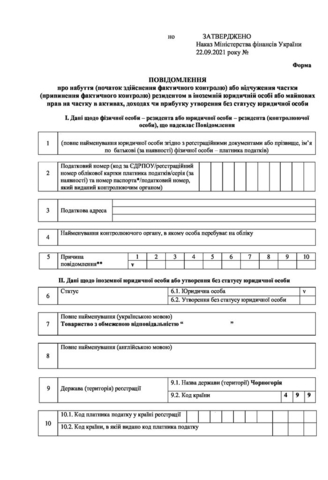
If a foreign company’s place of effective management is in Ukraine, it may use the mechanism provided by the Tax Code of Ukraine to acquire Ukrainian tax resident status. This involves a tax registration procedure, including submission of an application using Form № 1-ІК. A foreign company that acquires the status of a Ukrainian resident taxpayer under these rules is not treated as a CFC.
This is why the CFC rules and the place-of-effective-management rules must be viewed as two different tax regimes:
- In the first case, the foreign company remains foreign, but under certain conditions its profit is taken into account at the level of its Ukrainian controlling person.
- In the second case, the issue concerns the tax status of the company itself.
For an international structure, it is also important to consider the law of the country of registration and the applicable international treaty, because simultaneous tax ties to two countries may require a separate analysis of tax residency rules and double-taxation relief.
Related: How Can You Cease Being a Ukrainian Tax Resident?
Foreign Company with a Ukrainian Owner: How the Structure Works
A foreign company is a separate legal entity and, as a rule, meets its corporate and tax obligations under the laws of the country where it is incorporated or tax resident. The taxation of its owner is determined separately.
When determining the tax consequences in Ukraine, the primary question is whether the individual is treated as a resident for tax purposes, not simply whether the person is a Ukrainian citizen.
The Tax Code of Ukraine establishes a sequence of criteria for determining tax residency:
- place of residence;
- permanent place of residence;
- center of vital interests;
- presence in Ukraine for at least 183 days during the tax year and, in certain cases, citizenship and other criteria provided by the Code.
Having family, business activities, and other enduring personal or economic ties to Ukraine may also be relevant when determining the center of vital interests. Therefore, the common assumption that spending more than 183 days abroad automatically ends Ukrainian tax residency is incorrect.
If an individual remains a Ukrainian tax resident, they are subject to personal income tax (PIT), including on income from sources outside Ukraine. Foreign-source income is expressly included in a resident’s taxable income.
For a Ukrainian resident who owns a foreign company, there are effectively two separate areas of tax analysis. The first concerns the company’s obligations in the country where it is incorporated or tax resident; the second concerns the owner’s taxation and reporting obligations in Ukraine.
When a Foreign Company May Be Treated as a CFC
One of the key issues for a Ukrainian owner is the application of the CFC rules established by Article 39-2 of the Tax Code of Ukraine.
A foreign company may qualify as a CFC if it is controlled by an individual or legal entity that is a Ukrainian tax resident.
As of 2026, a controlling person may include, in particular, a Ukrainian resident who:
- directly or indirectly owns more than 50% of a foreign legal entity;
- owns more than 10% if several Ukrainian residents collectively own 50% or more of that company;
- regardless of the formal ownership percentage, independently or together with related parties that are Ukrainian residents, exercises actual control over the foreign company.
Actual control is assessed based on more than the shareholder register. Relevant factors may include the ability to issue binding instructions to management bodies, control bank accounts, enter into material transactions on behalf of the company, influence profit distributions, and other factual circumstances of management.
Therefore, ultimate beneficial owner status and CFC controlling person status should not be automatically equated. For Ukrainian tax purposes, the criteria in Article 39-2 of the Tax Code of Ukraine must be assessed specifically, including the direct and indirect ownership structure and actual control.
For example, a Ukrainian may be the UBO of a Polish company while owning 30% of its capital. However, if the remaining 70% is owned by one foreign partner and the Ukrainian does not exercise actual control, they will not meet the above criteria for a CFC controlling person. At the same time, if the person is a Ukrainian tax resident, their interest in the foreign company must still be assessed under the CFC rules.
Related: Who Is Required to File a CFC Report?

CFC Reporting in 2025: What Changed and How Controlling Persons Should Proceed
Being recognized as a CFC controlling person creates two separate obligations for an individual: notify the State Tax Service (STS) of the acquisition or disposal of an interest within 60 days, and file a CFC report annually together with the tax return on property status and income. The portion of the CFC’s adjusted profit corresponding to the controlling person’s interest is included in their taxable income and taxed at 18% PIT and a 5% military levy.
At the same time, the law provides grounds for excluding CFC profit from taxable income—for example, if there is an international treaty with the CFC’s country and the relevant financial criteria are met, or if the aggregate income of all CFCs of the controlling person does not exceed the equivalent of EUR 2 million. It is important to distinguish an exemption from tax from an exemption from reporting: even if no tax is payable, information about the foreign company must still be reported.
We have already explained this process in detail, including specific filing deadlines, the abbreviated report form, and other procedural details, in our article “Filing a CFC Report in 2025: New Requirements and Liability.”
Receiving Dividends and Other Income from a Foreign Company
A separate level of taxation arises when the Ukrainian owner actually receives income from the foreign company.
For ordinary dividends accrued by a nonresident in favor of an individual who is a Ukrainian resident, the Tax Code provides for a 9% PIT rate. In 2026, such taxable income is also subject to a 5% military levy. For other types of foreign-source income, the general PIT rate is typically 18%, with a 5% military levy, unless the Code provides for a special regime.
An individual’s foreign-source income is reported in the annual tax return on property status and income. As a general rule, the return is filed by May 1 of the year following the reporting year, and self-assessed tax liabilities are paid by individuals by August 1. For income earned in 2025, the corresponding 2026 deadlines were April 30 and July 31.
If tax has already been paid on the income in a foreign country, the relevant Ukrainian double tax treaty should be reviewed. Where the treaty and the Tax Code provide the necessary grounds, foreign tax paid may be credited against the Ukrainian PIT liability, provided it is properly documented. Ukrainian law, however, does not provide for a similar reduction of the military levy by the amount of tax paid abroad.
There are also several other important points:
- If the foreign company is also the owner’s CFC, special rules apply under Article 170.13 of the Tax Code of Ukraine. These rules are intended, among other things, to prevent the same portion of profit from being taxed twice.
- If CFC profit is distributed before the CFC report is filed and the corresponding amount is included in taxable income, a 9% PIT rate may apply to that distributed income.
- If the profit has already been included in taxable income as CFC profit, the Code provides mechanisms under which the corresponding amount is not included in income again; if the distribution is made within certain time limits, a PIT recalculation may also be available.
Accordingly, “dividend tax” cannot be analyzed separately from the CFC rules: the outcome depends on whether the company is a CFC, the period in which the profit was generated, whether it was previously included in the Ukrainian tax base, and when it is distributed.
What to Check Before Registering a Company Abroad
The choice of jurisdiction should begin not with the nominal corporate tax rate or the cost of company registration, but with the future operating model.
Before registration, you should review:
- Owner’s tax residency. Where the individual will actually live, where their family, business, principal assets, and center of vital interests are located.
- Ownership structure and CFC rules. What percentage a Ukrainian resident will own directly and indirectly, who will exercise actual control, and what notices and reports will need to be filed in Ukraine.
- Tax regime in the chosen jurisdiction. Corporate tax, rules for determining the company’s tax residency, and accounting, audit, and local reporting requirements.
- Availability of CFC exemptions. In particular, the existence of an international treaty or tax information exchange mechanism, the effective corporate tax rate, the composition of active and passive income, and the aggregate income of all CFCs of the controlling person.
- How profits will be paid to the owner. Dividend tax rates in Ukraine and in the company’s jurisdiction, any withholding tax, and the provisions of the applicable double tax treaty.
- Place of actual management. Who will make key decisions, and from which country, and who will manage bank accounts, personnel, accounting, and operations.
- Company’s economic substance. For many structures, a registered office and a nominee director alone are not enough. Actual operations, personnel, office space, assets, and management processes may be significant for tax and banking purposes. The STS also treats the absence of adequate economic substance as a risk indicator when analyzing CFCs.
- Relationship model between the company and the owner. It should be clear in advance whether the owner will receive dividends, salary, director’s fees, interest, return of contributed capital, or other payments, since each may be subject to different tax treatment.
This type of advance review makes it possible to assess not just a single tax rate, but the overall tax burden and compliance requirements of the entire structure. Our company conducts comprehensive reviews on this basis, helping clients establish businesses safely while taking all relevant tax considerations into account.
Legal Support for Starting a Business Abroad
For a Ukrainian tax resident, registering a foreign company should begin with designing the structure—not filing documents with a foreign registry. Our company can:
- determine the owner’s tax status in advance;
- assess the proposed company against the CFC criteria;
- analyze the tax consequences of profit distributions;
- assess place-of-effective-management risks;
- compare several jurisdictions based on the actual business model;
- select the jurisdiction and legal form;
- design the ownership structure;
- register the company in your chosen jurisdiction;
- analyze double tax treaties;
- analyze CFC implications and the place of effective management;
- provide recommendations on ongoing corporate and tax compliance.
This approach allows you to choose a jurisdiction based not only on registration cost or the nominal tax rate, but also on how the foreign company will operate alongside its owner’s Ukrainian tax residency.
With us, tax is not just theory—it is practical optimization. We work with a network of practicing accountants and lawyers not only in Ukraine but also abroad, in the jurisdiction you need.
Contact us if your goal is a properly structured business!
Answers to frequently asked questions
Can You Legally Avoid CFC Status by Registering the Company in the Name of a Trusted Person?
Registering the company in the name of a nominee owner does not eliminate tax risks; it creates new ones. These may include difficulties proving actual control during audits and potential liability for concealing the true beneficial owner.
If CFC Profit Is Tax-Exempt Because of the EUR 2 Million Threshold, Do You Still Need to File a Report?
Yes. Exemption from tax and exemption from the reporting obligation are two different things.
Is a Registered Office and Nominee Director Abroad Enough to Prevent a Company from Being Considered Managed from Ukraine?
No. Formal registration and having a director abroad do not, by themselves, guarantee this. If key management decisions and actual management of the company are predominantly carried out from Ukraine, its place of effective management may be recognized as being in Ukraine.
Services on the topic of this material

Our publications on this matter


Our clients