

New Reservation Rules from 27 October 2026: What Resolution No. 1328 Changed
Cost of services:
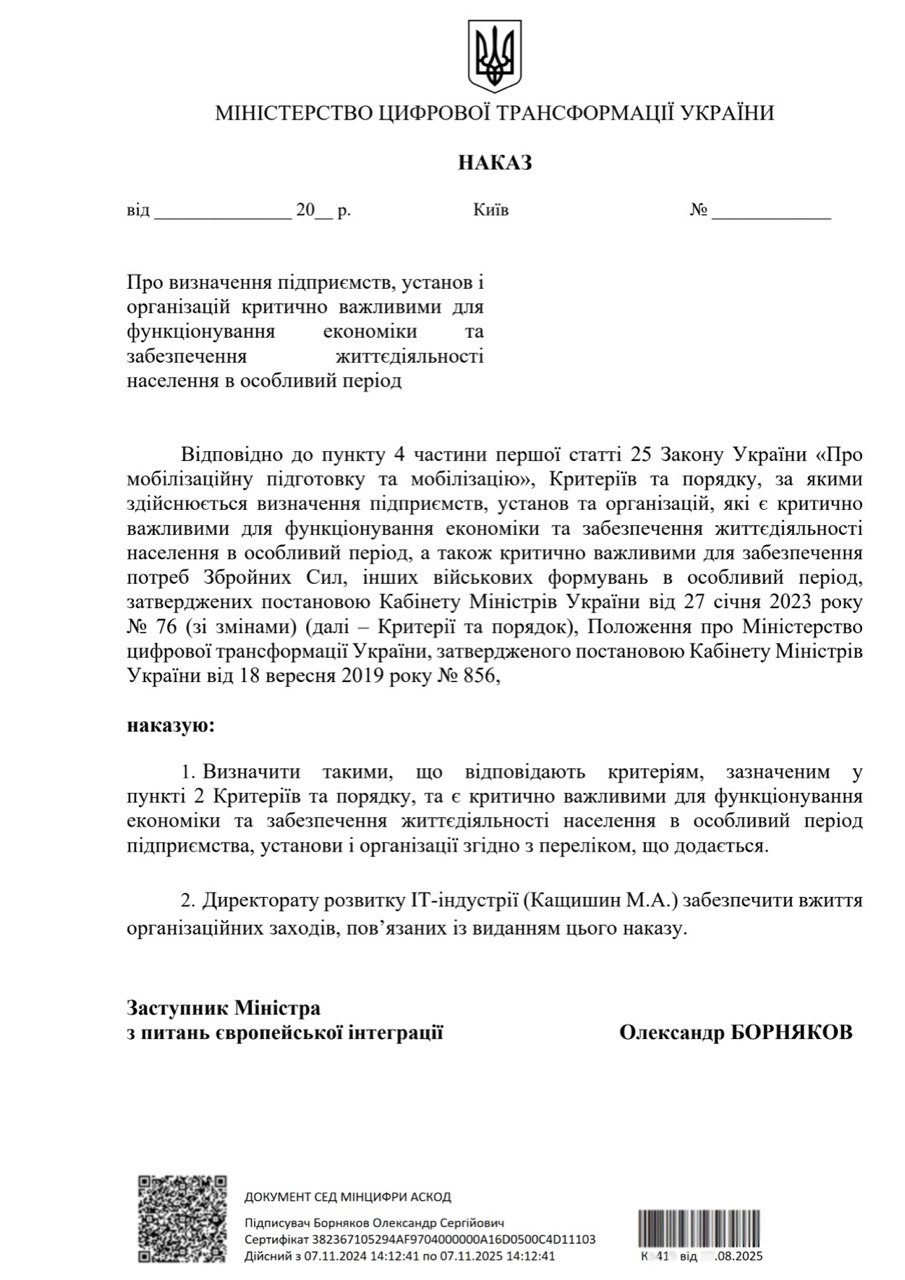
Reviews of our Clients
... our work on joint projects assured us of your high level of professionalism
Since October 27, 2026, new reservation rules have been in effect: critical enterprise status and the right to reserve more than 50% of employees are now granted only taking into account the recommendations of the new Coordination Centre for the Organisation of Reservation. Defence and energy enterprises could previously reserve all of their employees liable for military service, but now they may reserve no more than 95% of the number stated in the decision.
If you are a manager or HR officer at an enterprise that already has status or is preparing documents to obtain it, the new employee reservation rules determine whether you keep your status, how many people you can reserve, and how long you now have to wait for a decision. Employers most often ask us whether the company will lose its status after the criteria are reviewed, when to apply—now or after the new requirements come out—and whether errors in military registration will get in the way. Below, we explain what exactly has changed, whom it affects, and what to do right now so that your employees’ deferrals do not end together with your status.
Changes in Reservation: Before and After October 27
The main change is in the approval chain: a new participant now stands between your application and the authority’s decision. The other changes either follow from this or are specific clarifications for certain industries.
|
Issue |
Before October 27, 2026 |
From October 27, 2026 |
|---|---|---|
|
Who grants status |
the ministry or regional administration on its own, within 10 working days |
the same authority, but after recommendations from the Coordination Centre; time limits of up to 7 working days, up to 1 month, and up to 3 working days |
|
How a refusal is issued |
a decision on noncompliance with the criteria |
a letter from the authority explaining which criterion the enterprise does not meet |
|
Who allows reserving more than 50% |
the Ministry of Defence, on proposals from the Interagency Working Group |
the authority that granted the status, taking into account the Centre’s recommendations |
|
Defence industry (DIC) and fuel and energy complex (FEC) |
reserved all employees liable for military service within the number stated in the decision |
no more than 95%; above 95%—by a separate decision of the Ministry of Defence or the Ministry of Energy |
|
International technical assistance projects |
up to 50% of employees liable for military service; only those involved in the project were reserved |
up to 50% of the participants in one project, but no more than 7 people |
|
Days to reserve employees after the limit is increased |
5 working days |
10 working days |
|
Military registration |
there was no separate ground for refusing to consider a limit increase |
two or more violations by the head within 12 months are a ground for refusing to consider a proposal to increase the limit |
|
Tax debt |
any tax debt prevented status |
debt that arose while the budget was not making payments to the enterprise is not taken into account until those payments are received |
|
Industry criteria |
authorities agreed them with the Ministry of Economy and the Ministry of Defence |
authorities agree them with the Centre; current criteria are to be reviewed |
Ministries and regional administrations were required to review their industry and regional criticality criteria: if the criterion your status rests on is removed, the status will be revoked. Other current status decisions remain valid until the end of their term. The new reservation rules of 2026 were introduced by Cabinet of Ministers Resolution No. 1328 of 23.10.2026. This is not a new reservation law: the government amended Resolution No. 76, which approved both the Reservation Procedure and the Criticality Criteria. The resolution was published in “Uryadovyi Kurier” on October 27, 2026, and entered into force the same day.
What has stayed the same: the basic 50% limit; the salary requirement for a reserved employee; up to 100% for enterprises in areas of hostilities on the list of the Ministry for Development of Communities and Territories (Ministry for Development); up to 75% for heat and water supply, wastewater disposal, and household waste management; beneficiaries are reserved outside the 50% limit; the 72 hours the system takes to check a list submitted in Diia. Resolution No. 1328 did not change the rules of temporary 45-day reservation.
Coordination Centre for the Organisation of Reservation: A New Three-Stage Procedure
The Coordination Centre is a temporary advisory body of the government. It does not make decisions on status, but the authority now makes no decision without its recommendations. Advisory means that the Centre gives the authority an opinion—to support the application, refuse it, or have it revised—while the decision is signed by the authority.
The Centre is headed by the Deputy Minister of Economy and the Deputy Minister of Defence, and its members include representatives of 11 more agencies, from the Ministry of Digital Transformation and the Ministry of Energy to the Security Service of Ukraine (SBU) and intelligence. When an issue of another agency is considered, that agency’s representative votes together with the Centre’s members.
These functions of the Centre will be important for you:
- it agrees the industry and regional criteria that ministries and administrations use to determine criticality;
- it issues recommendations on status and on reservation above the limit;
- it monitors information about employees liable for military service at an enterprise that has applied for status, through the Unified State Register of Conscripts, Persons Liable for Military Service, and Reservists, the Pension Fund web portal, and the Diia portal;
- it may recommend revoking status, in particular when law enforcement agencies have approached it. Such a recommendation is a ground for the authority to consider revocation.
The Application Goes Through Three Stages
Their order matters for planning:
- As before, documents are submitted to the ministry for your sector or to the regional administration; the list of sectors decided by administrations has changed, as explained below. Within up to 7 working days, the authority checks whether the enterprise meets the criteria and sends the application to the Centre. The Procedure does not provide for the enterprise to apply to the Centre separately: it is the authority that applies to the Centre.
- The Centre issues recommendations no later than one calendar month from the day it receives the authority’s application. If the authority justifies urgency, the Centre will consider the application without delay—within up to 7 working days.
- After receiving the recommendations, the authority has up to 3 working days to decide on status or send a letter stating the reasons for refusal.
In total, the maximum time limits come to about a month and a half, compared with the former 10 working days. These are the time limits set by the resolution; the time needed to collect certificates and any requests from the authority are not included. The same scheme also applies to enterprises critically important for the needs of the Armed Forces.
If status was not granted or was revoked, appeals are brought against the authority’s decision or its refusal letter. The Centre’s recommendation is an interim opinion of an advisory body, so it will most likely not be a separate subject of dispute.
Reservation Limit After Resolution No. 1328: 50%, 95%, and Who Can Reserve More
The basic limit has not changed: 50 percent of employees liable for military service. What has changed is who allows more and under what procedure, as well as the limit for defence and energy enterprises.
|
Who |
How many can be reserved |
How to get more |
|---|---|---|
|
Most enterprises and institutions with critical status |
up to 50% |
a decision of the authority that granted the status, taking into account the Centre’s recommendations |
|
DIC enterprises recognized by the Ministry of Defence as critical for the economy; FEC enterprises, their contractors, and domestic manufacturers of transformer equipment recognized by the Ministry of Energy |
up to 95% of the number stated in the decision |
a decision of the Ministry of Defence or the Ministry of Energy, taking into account the Centre’s recommendations |
|
Enterprises critically important for the needs of the Armed Forces |
all employees liable for military service within the number stated in the status decision |
— |
|
Enterprises in areas of hostilities on the Ministry for Development’s list |
up to 100% |
no change |
|
Heat and water supply, wastewater disposal, household waste management |
up to 75% |
no change |
|
Representative offices of donor institutions and implementers of international technical assistance projects |
up to 50% of the participants in one project, no more than 7 people |
more than 7 people—a decision of the State Secretary of the Cabinet of Ministers, taking into account the Centre’s recommendations, if more than seven employees liable for military service are directly involved in implementing one project; the cap is 50% of the total number of employees liable for military service |
|
Representative offices of nonresidents, the Ukrainian Red Cross Society, and other Ukrainian humanitarian organizations |
up to 50% |
a decision of the Ministry of Economy (representative offices of nonresidents, including branches of foreign humanitarian organizations) or the Ministry for Development (the Ukrainian Red Cross Society and other Ukrainian humanitarian organizations on its list), taking into account the Centre’s recommendations |
For DIC and FEC enterprises, 95% is more than just a new figure. The resolution expressly requires that everyone directly engaged in production processes be reserved within these limits. So if an enterprise used to reserve its entire staff, the people who will now have to remain unreserved will be sought among employees who are not directly involved in production.
“Project reservation” is a colloquial name for the last rule. The resolution does not use this term: it refers to employees who directly carry out the tasks of one international technical assistance project. The limit is calculated separately for each project, and it may not exceed seven people. An exception above seven people is possible by a separate decision of the State Secretary of the Cabinet of Ministers under the conditions shown in the table.
A decision to increase the limit is valid for up to one year. After it is made, the authority enters the new limit into the Unified List via Diia, and from that day you have 10 working days to reserve people. If you do not make it in time, the decision becomes invalid. When the decision to increase the limit expires, the deferrals granted must be annulled within 5 working days starting from the day after the expiry date.
How to calculate the limit itself—who is included in the total number of employees liable for military service and who is not—we covered in the article “Employee Reservation Quotas: How to Calculate and Increase the Limit to 100%.”
Review of Criticality Criteria: Is Your Status at Risk?
Status granted under an industry or regional criterion of “importance for a sector of the national economy or the needs of a territorial community” is at risk. Ministries and regional administrations set these criteria themselves, and the resolution instructed them to review the criteria within ten days from October 27, 2026, and agree them with the Centre. After that, the authorities check whether enterprises meet the updated criteria. If the criterion under which you were granted status has been removed, the status decision is revoked, and your employees’ deferrals are annulled along with it.
If a criterion was not removed but changed—say, the threshold was raised—the resolution gives no separate rule for this. But the authorities must check whether enterprises meet the updated criteria, so there is a risk in this case too. The other criteria—taxes of more than EUR 1.5 million per year, foreign currency earnings, strategic importance, no tax debts, salary level—were not changed by the resolution, except for the exception for debt caused by delayed budget payments (more on that below).
In parallel, the government has given a new description of what kind of enterprise can be critical at all. It is one whose shutdown or significant downsizing due to the mobilization of employees would harm defence capability (in particular defence contracts and the production of weapons, drones, and ammunition), critical infrastructure, the supply of essential goods, medicines, and fuel to people, or macro-financial stability—budget revenue, foreign currency earnings, investment. The harm must be supported by verifiable indicators. For an applicant, this means that simply naming your industry is not enough; you need figures that show the consequences of a shutdown.
The new description names 13 sectors, from DIC and energy to retail, IT, banking, and communications, as well as emergency rescue services. Another sector can be added if the Centre approves it on a reasoned request from the relevant ministry.
Keep these points in mind when determining the authority:
- Regional administrations decide on municipal enterprises and enterprises in their territory only for some of these sectors (for example, construction, retail, energy, housing and utilities, extraction and processing, agricultural production).
- For an IT company, determine the authority by its field of activity and the basis for obtaining status; check an application to the Ministry of Digital Transformation against the relevant criteria.
- Before applying, check the current industry or regional criteria and any amendments to them on the official website of the authority you are applying to. Make sure you are using exactly the requirements under which the authority will consider your application.

What Will Happen to Existing Statuses, Limits, and Applications
The resolution’s transitional provisions cover three situations.
- A status decision in force on October 27, 2026, remains valid until the end of the term for which it was adopted, unless it is revoked following the review of the criteria.
- A Ministry of Defence decision to increase the limit adopted before Resolution No. 1608 of December 8, 2025, entered into force remains valid within the term of the status, but no longer than until December 8, 2026. Ministry of Defence decisions adopted after December 8, 2025, remain valid within the term of the status and the term stated in the decision itself.
- The resolution does not separately mention applications submitted before October 27, 2026, and not yet considered. The new version of the Criteria makes no exception for them, so the authority will probably process them through the Centre. If you applied before October 27 and there is still no decision, write to the authority and ask it to explain in writing what stage your application is at and under what procedure it is being considered.
Deferrals that employees already have remain valid as long as the status and the limit decision are in force. If the status is revoked, the deferrals are annulled.
Military Registration Now Affects the Limit
Military registration violations can now close off an enterprise’s path to a higher limit. If, over the past 12 months, there have been two or more documented registration violations by the head, or the head has been held administratively liable for them, this is a ground for the Centre to refuse to consider a proposal to reserve above the limit. The words “in particular” in the resolution mean that these are not the only grounds for refusal.
The resolution does not set such a direct ground for the status itself. But the Centre monitors register data on the applicant’s employees liable for military service, so it is worth putting your registration data in order before you apply. Before applying, it is advisable to check whether someone responsible for military registration has been appointed, whether employee data match the register, and whether any administrative offense reports have been drawn up against the head.
Our lawyers have dealt with a situation in which a small company asked us to support it with critical enterprise status, and while preparing the documents, it turned out that the company had not kept military registration records since it was registered. We advised against applying in that state: it carried a risk of refusal, and since Resolution No. 1328, registration violations by the head also close off the path to a higher limit. So the Client is first setting up military registration and at the same time renewing certificates that are about to expire, and will apply only after that.
We covered typical registration errors in the article “Military Accounting After Reservation: Corporate Errors.”
Changes to the Reservation Procedure: Which Paragraphs of Resolution No. 76 Were Amended
For those checking reservation Resolution No. 76 as amended, paragraph by paragraph:
|
What was changed |
What it means |
|---|---|
|
Procedure, para. 5 |
DIC and FEC are no longer on the list where all employees are reserved; the head of the audit oversight body has been added; SE “State Rear Operator” has been replaced by SE “Ukrainian Center ‘Bezpeka’” |
|
Procedure, para. 6 |
government authorities reserve more than 50% based on proposals agreed with the Centre |
|
Procedure, para. 8 |
more than 50%—by decision of the authority that granted the status; a ground for refusal due to military registration; 7 people per project; 95% for DIC and FEC; for enterprises critical for the needs of the Armed Forces—within the number stated in the decision |
|
Procedure, para. 9 |
representative offices of nonresidents and humanitarian organizations: more than 50%—by decision of the Ministry of Economy or the Ministry for Development, proposals go to the Centre |
|
Procedure, para. 9-1 |
what a decision to increase the limit contains; 10 working days to reserve |
|
Criteria, para. 2 |
industry criteria—after agreement with the Centre; exception for debt caused by delayed budget payments |
|
Criteria, para. 4 |
new version: what harm the status prevents, the list of sectors, which authorities decide |
|
Criteria, paras. 6 and 13 |
new procedure and time limits involving the Centre; refusal by letter |
|
Criteria, para. 18 (new) |
the Centre’s recommendation to revoke status is a ground to consider revocation |
|
the Interagency Working Group no longer deals with reservation |
The debt exception works like this: a debt for taxes or the unified social contribution (USC) that arose during a period when no payments were made from the state or local budget to fund the enterprise or pay for its goods, works, or services does not stand in the way of status until the day those payments are received. This must be confirmed by a certificate from the budget funds administrator or the Treasury authority.
What Employers Should Do Under the New Rules: A Checklist
Your steps depend on whether you have status and how soon your decisions expire:
- Take your status decision and check who adopted it, until what date it is valid, and under which criteria it was granted. If they include an industry or regional criterion, find out whether your authority has updated it.
- If the Ministry of Defence increased your limit before Resolution No. 1608 entered into force, plan for the fact that after December 8, 2026, the decision will no longer be valid. A new one goes through the Centre: allow for the time limits of the new procedure—up to 7 working days at the authority, up to one calendar month at the Centre, and up to 3 working days for the decision—plus 10 working days for reservation.
- For DIC and FEC enterprises, recalculate 95% of the number in the decision and draw up a list of employees directly engaged in production: they must be reserved.
- Check your military registration and whether any administrative offense reports have been drawn up against the head over the past 12 months.
- If you have tax debt due to delayed budget payments, order a certificate from the budget funds administrator or the Treasury.
- If your application was submitted before October 27 and there is no response, send the authority a written request.
Should You Apply Now or Wait for the New Criteria
The resolution itself recommends submitting documents in advance. Waiting is risky: the review now takes longer, and if your status or limit decision expires first, your employees’ deferrals will end. But applying blindly is not advisable either. If your status rests on an industry criterion and the authority is still updating it, your application may already be assessed under the new version. So first find out what your authority has published, and compare your indicators with both the current and the updated criteria. In our cases, the expected industry criteria did not appear on the day they were expected, so it is not worth counting on an exact release date.
What This Means for a Reserved Employee
A reservation-based deferral depends on the employer’s status and limit. Check it in the “Reserve+” app and ask your employer until what date the status is valid and whether the criterion under which it was granted is being reviewed. If the status is revoked, the deferral will be annulled. In that case, it is worth checking whether you have another ground for deferral under Article 23 of the Law of Ukraine “On Mobilisation Preparation and Mobilisation”. At a defence or energy enterprise, an employee directly engaged in production must be reserved under the new rules as well, provided that they meet the other reservation conditions.
Why You Should Entrust the Review to a Lawyer
Status was obtained a year ago under a ministry criterion, the limit was once increased by the Ministry of Defence, and in recent months military registration was handled by a person who has since left. Under the new rules, each of these circumstances affects either the status or the limit, so they should be checked together, not one by one.
What we will do:
- check which criterion your status rests on and whether the review affects it;
- calculate how many employees you can reserve under the new rules and until what date your status and limit decisions are valid;
- check military registration and employee data in the registers before you apply;
- prepare an application for status or a limit increase and set out the time limits under the new procedure;
- if status was refused or revoked, analyze the reasons and the options for appeal.
To assess your situation, we will need the status and limit decisions, the number of employees liable for military service, and the expiry dates of current deferrals. What is included in support with critical enterprise status and how we work is described on the service page.
Answers to frequently asked questions
Can You Now Reserve 100% of Employees?
Yes, but not every enterprise can. Up to 100% may be reserved by enterprises in areas of hostilities on the Ministry for Development’s list, while enterprises critically important for the needs of the Armed Forces may reserve all employees liable for military service within the number stated in the status decision. Others get more than 50% only by a separate decision of the authority after recommendations from the Coordination Centre. Defence and energy enterprises recognized as critical by the Ministry of Defence or the Ministry of Energy now have a baseline of up to 95%.
Who Decides on Reserving More Than 50%?
The authority that granted the enterprise its status, taking into account the recommendations of the Coordination Centre. For DIC and FEC enterprises, above 95%—by decision of the Ministry of Defence or the Ministry of Energy. For representative offices of nonresidents, above 50%—by decision of the Ministry of Economy; for the Ukrainian Red Cross Society and other Ukrainian humanitarian organizations on the Ministry for Development’s list—by decision of the Ministry for Development, taking into account the recommendations of the Coordination Centre.
What Happens to Reservation If a Criticality Criterion Is Removed?
The decision on status granted under that criterion will be revoked, and employees’ deferrals will be annulled. This applies to status obtained under the industry or regional criterion of “importance for a sector or community.”
How Long Does the Review Take Under the New Rules?
Under the maximum time limits of the resolution: up to 7 working days at the authority, up to one calendar month at the Coordination Centre (or up to 7 working days under the urgent procedure), and up to 3 working days for the decision. In total, that is about a month and a half.
Should You Wait for Updated Criteria Before Applying?
There is no point in waiting unnecessarily: the resolution recommends submitting documents in advance, and the review now takes longer. But before applying, find out whether your authority has updated its industry criteria, and compare your indicators with them.
Services on the topic of this material
Our publications on this matter


Our clients
We are ready to help you!
Contact us by mail [email protected] or by filling out the form:
Other publications by the author

A business does not have to build its own shelter if a suitable one nearby has free places and real access. How to find it, agree with its owner and prepare documents.

Cancellation of employee reservation ends the deferment of a reserved employee: who cancels it and when, the grounds under the Reservation Procedure, the steps in Diia, deadlines, what happens to the employee and the limit, and the employer's liability.

How to divorce a foreigner in Ukraine: when a joint application to the registry office is enough, when a court is needed, which court hears the case, what to do if the foreign spouse lives abroad, objects or cannot be found, and which documents to prepare.

Banks, neobanks or payment institutions, documents and proof of funds, video identification, Ukrainian rules on transfers and tax, and why banks refuse.
Our other authors