

Ukrainian Company Without an EU Office: When GDPR Applies and What to Check Before Your First European Client
Reviews of our Clients
... our work on joint projects assured us of your high level of professionalism
A typical scenario: a Ukrainian IT company or SaaS provider agrees to work with an EU client. Before signing the contract, the client requests a DPA, a list of sub-processors, a description of security measures, data retention and deletion rules, and an explanation of the basis for transferring data to Ukraine. This is often when the company discovers that, although it has individual policies, it does not understand which GDPR requirements actually apply to its business model.
For the business, the risk extends beyond potential liability for violations. A lack of preparation can delay a contract, force the team to urgently revise documents, or lead it to accept obligations the product cannot actually fulfill.
Preparation should therefore begin with three questions, rather than the purchase of a “GDPR document package”: whether the GDPR applies to the specific operations, whether the company acts as a controller or processor, and how personal data actually flows. This helps avoid unnecessary work while ensuring that nothing capable of blocking a European contract is overlooked.
When GDPR Compliance Requirements Apply to a Ukrainian Company
Yes. The absence of an EU office does not exempt a Ukrainian company from the GDPR. The Regulation may apply if the business specifically offers goods or services to people in the EU or monitors their behavior there. However, an incidental visitor from the EU or the mere existence of a contract with a European company does not automatically settle the question. The specific operations and each party’s role need to be assessed.
Article 3 of the GDPR establishes territorial criteria. Three situations are particularly relevant to a Ukrainian company.
- The processing is connected with the activities of the company’s EU establishment. This does not necessarily mean a separate legal entity: the stability of the activities and the actual connection between the processing and the European establishment matter.
- A company without an EU establishment offers goods or services to people in the EU. Payment is not a prerequisite. What matters is evidence of an intention to target that market: advertising aimed at specific countries, delivery to the EU, prices in the relevant currency, local domains, languages, and other indications of an intention to serve people in the EU. The mere fact that a Ukrainian website is accessible from Europe is generally insufficient.
- The company monitors the behavior of people in the EU—for example, by building profiles or systematically analyzing their actions for prediction or personalized advertising. Not every technical log constitutes “monitoring,” so the purpose, scale, and subsequent use of the data need to be assessed.
It is also important not to confuse a person’s location with their citizenship (citizenship alone is not a criterion under Article 3). Data concerning a French citizen in Ukraine does not automatically fall under the GDPR simply because of their passport. Conversely, a Ukrainian citizen specifically offered a service while in Poland may qualify as a person in the EU for the purposes of this provision.
For a business, this means that whether the GDPR applies to the company cannot be determined solely by its country of registration or its users’ citizenship.
For example, if a Ukrainian SaaS provider has an English-language website that a few people from Germany happen to visit, this alone is insufficient to automatically bring the entire business within the GDPR’s scope. The situation changes, however, if the company launches advertising aimed at Germany, adapts its offering to that market, or systematically analyzes the behavior of people in the EU for personalization.
The company’s first practical question should therefore be “Which specific operations involve people in the EU, and why?”, rather than “Do we have users from Europe?”
Related reading: How to Create a Website and Run an Online Business: Legal Aspects of Website Creation
Defining the Roles of Personal Data Controllers and Processors
For B2B companies, this is one of the most common sources of confusion. A contract with an EU company does not mean that every operation performed by the Ukrainian supplier automatically falls under the GDPR pursuant to Article 3(2). However, data protection requirements may still apply to the project through the contract and the client’s own requirements.
A Ukrainian developer or SaaS provider often processes data for the European client’s purposes and under its instructions, rather than for its own purposes. In this part of the relationship, the Ukrainian company may be the processor and the client the controller.
The mere fact that a processor sells services to an EU company is not equivalent to offering goods or services to people in the EU under Article 3(2). However, the European controller must engage processors that provide sufficient guarantees and enter into an agreement under Article 28.
What does this mean for the business? Even if the GDPR’s direct application to all your operations requires a separate assessment, the European client may review security, sub-processors, international data transfers, incident response procedures, and the DPA’s terms before signing the main contract.
A company can also hold two roles at the same time: it may be a processor for data in the client’s customer database and a controller for its own employees’ contact details, marketing leads, or website analytics. Policies and contracts must reflect this distinction.
For example, a SaaS provider may store its German client’s user data exclusively under that client’s instructions while independently collecting prospective clients’ contact details through its own website. In the first situation, the company may act as a processor; in the second, it determines its own purposes for processing.
If these roles are not distinguished at the outset, one error leads to others: inappropriate contracts, incorrectly allocated responsibilities, and documents that do not reflect how the product actually works.

Seven Audit Steps Before Signing a DPA with an EU Business Partner
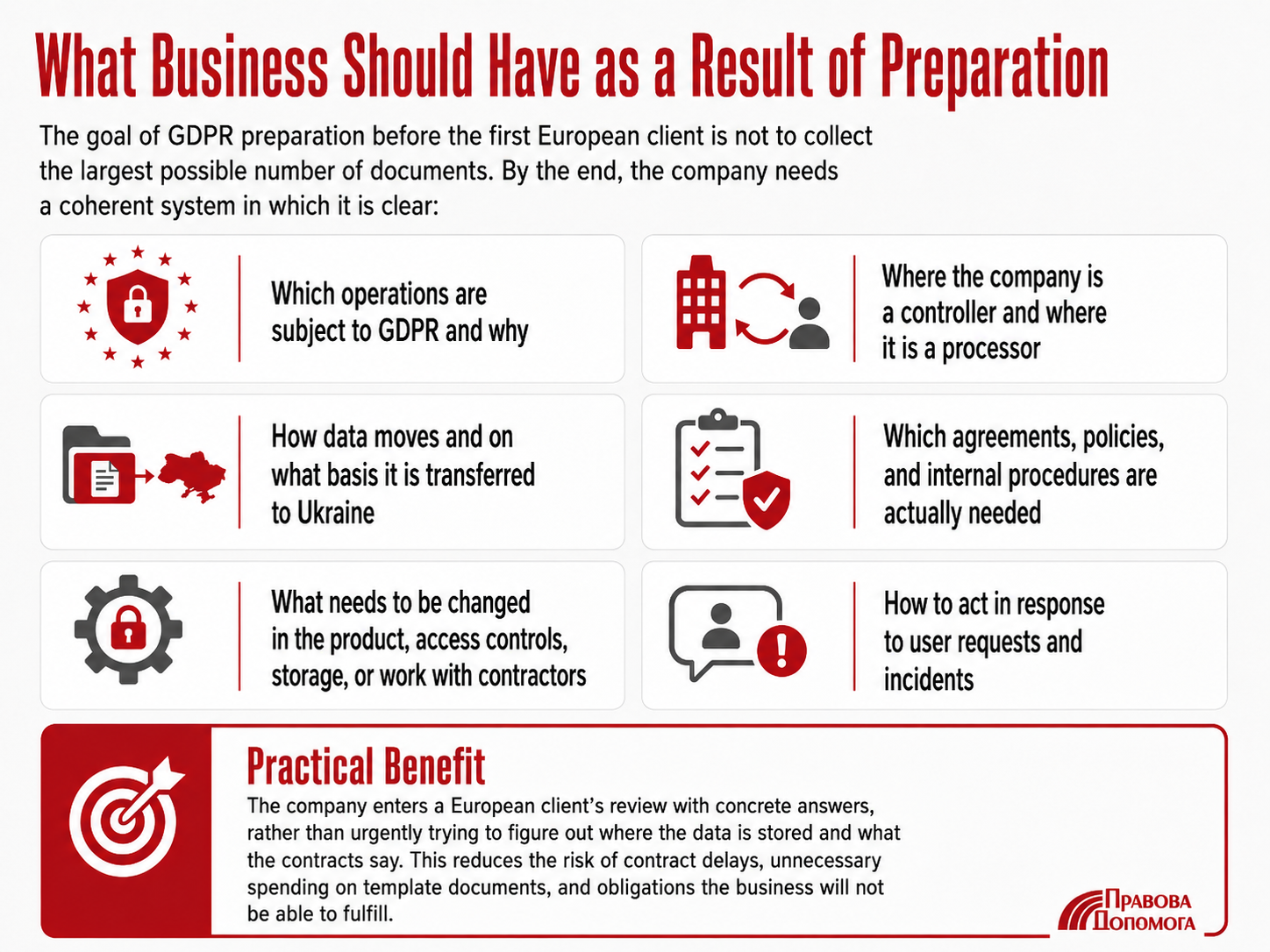
Thorough preparation is not about having the longest privacy policy. Your business partner needs to see that documents, contracts, technical processes, and actual data flows are consistent. Before signing the contract, complete these seven checks.
Understand Which Specific Operations Fall Under the GDPR
Create a brief map: who the person is, whether they are in the EU, what product is offered to them, what indicators of a target market exist, whether their behavior is monitored, and where the company has establishments. Assess specific operations, rather than “the company as a whole.”
This map helps avoid starting a GDPR project without a clear understanding of its scope. Within a single company, some operations may fall directly under the Regulation, others may be subject to requirements through a client contract, and some may have no connection to the EU at all.
The practical benefit of this analysis is avoiding the use of resources on requirements that do not apply to a particular operation while ensuring that the requirements the client will actually check are addressed.
Correctly Define the Controller and Processor Roles
- The controller determines the purposes and essential means of processing.
- The processor acts on the controller’s behalf and under documented instructions.
The designation in the contract does not settle the issue if the party’s actual conduct differs.
The role determines notices to individuals, responses to requests, the agreement under Article 28, engagement of sub-processors, incident notifications, and the allocation of responsibilities. Simply taking a contract template that already labels the Ukrainian company a “processor” is therefore insufficient. First, check whether its actual operating model supports that designation.
This is particularly important for a SaaS provider that performs some functions at the client’s direction while using some data for its own purposes, such as billing, security, marketing, or analytics.
Check the Data Flow from the EEA to Ukraine
Ukraine is not among the countries covered by a European Commission adequacy decision. Transfers of data from the European Economic Area to a Ukrainian company therefore generally require another mechanism under Chapter V of the GDPR.
When the Ukrainian recipient is not subject to the GDPR for the processing concerned, the European Commission’s 2021 Standard Contractual Clauses (SCCs) are often used in practice. A signature alone is insufficient, however. The parties must select the correct module, describe the transfer, check onward recipients, assess the risks of access to the data, and identify any additional technical and organizational measures needed.
If the Ukrainian recipient is already directly subject to the GDPR under Article 3 for this processing, the current 2021 clauses should not be applied mechanically. The European Commission explains that this set is not intended for an importer already subject to the GDPR. The transfer mechanism must be assessed separately in that situation.
For the company, this is one area where a ready-made template is particularly risky. A signed document alone does not mean that the correct transfer mechanism has been selected.
For example, even if a Ukrainian SaaS provider receives data from its client under an appropriate mechanism, it also needs to understand whether it transfers that data onward to a cloud service, support service, or another contractor. This is why the entire data flow is reviewed, rather than just the contract between the two main parties.
Prepare Supporting Evidence, Not Just a Policy
A European client may request more than a single document: it may ask for evidence of how the system works in practice. Depending on the role, scale, and risk, this may include:
- a data map or record of processing activities;
- a description of technical and organizational measures;
- a data processing agreement;
- a list of sub-processors and a procedure for notifying the client of changes;
- retention and deletion rules;
- a procedure for responding to individuals’ requests;
- a data breach response plan;
- a data protection impact assessment (DPIA) for high-risk processing;
- international transfer documentation.
The aim of preparation here is not to assemble the largest possible folder of documents. Far from it.
The business benefits much more from first identifying exactly what the client may request for the specific operating model and what evidence the company can actually provide. For example, if a document specifies a data deletion procedure that the technical team cannot carry out, the document’s mere existence does not solve the problem. Instead, the company creates a written promise that does not reflect the product’s capabilities.
You may also be interested in: IT Documentation: Legal Protection for IT Developers
Check Whether an EU Representative and a DPO Are Required
If Article 3(2) applies to a company outside the EU, Article 27 generally requires it to designate an EU representative in writing. An exception exists for processing that is occasional, does not involve large-scale processing of special categories of data or criminal conviction data, and is unlikely to pose a risk to individuals’ rights and freedoms. A conclusion that the exception applies should be documented, rather than simply leaving the representative undesignated.
Not every company needs a DPO. Article 37 links the obligation, among other things, to regular and systematic large-scale monitoring or large-scale processing of special categories of data as a core activity. Even without such an obligation, the company should still designate someone responsible for the processes and communication.
Check Whether the Product Can Deliver What the Documents Promise
A policy may be legally sound, but that alone is insufficient. Users must have a practical means of accessing their data and correcting or deleting it where appropriate.
Retention periods must be enforced in the main system, backups, and contractors’ services. Employees’ access rights must match their roles, and a change in an employee’s role or termination of employment must trigger an access review.
During an incident, the processor must notify the controller without undue delay. The controller assesses the risk and, where notification to the supervisory authority is required, must notify it without undue delay and, where feasible, within 72 hours of becoming aware of the breach.
This step often requires more than a lawyer’s involvement. Each legal requirement must be translated into a specific product capability or internal process.
For example, a privacy policy may provide for a user’s right to delete their data. However, if the support team does not know where to direct the request, some information remains in third-party services, and the technical team has no procedure for complete deletion, a formal policy does not solve the problem.
When preparing to work with a European client, the company therefore needs to check both what its documents say and whether it can fulfill the promises made in its contracts and policies.
Distinguish the GDPR from Individual Countries’ Local Rules
The GDPR provides a common framework for the EU, but it does not replace member states’ national rules. Additional requirements may apply to marketing communications, cookies, employee data, video surveillance, or particular sectors. Launching in Germany, Poland, or Spain may therefore require a separate local supplement to the overall compliance program.
This is particularly important as a business scales. Being prepared to work in one European market does not automatically mean that the company is ready for every EU country.
At the same time, this does not mean rebuilding the entire system before working with each new client. If the core processes are already properly established, the review generally focuses on the local requirements that vary by country or type of activity.
Why This Checklist Cannot Replace an Assessment of Your Company
The seven points above are useful for an initial self-assessment. However, the same checklist produces different answers for different business models. Two SaaS companies may have similar websites but different roles, sub-processors, data flows, and product functions.
This is precisely why starting with a universal document package is risky. First, you need to understand the actual arrangement: what data the company receives, why, from whom, where it goes, who has access, and what happens to it after the contract ends. Only then does it become clear which documents are needed and which changes must be made to your specific processes or product.
Related reading: Documents Required on a Website Selling Goods or Services
Three Mistakes That Undermine GDPR Implementation and Block Contracts
- Mistake one: The company promises “full GDPR compliance” without understanding its data flows. During due diligence, the client discovers unaccounted-for analytics services, backups, or support team access. The issue extends beyond the omitted service itself. To the business partner, this signals that the company does not have a complete picture of where its users’ data goes.
- Mistake two: The Standard Contractual Clauses have been signed, but the annex lacks an accurate description of the data, purposes, recipients, and security measures. The document formally exists, but it does not reflect the transfer in practice. The company has therefore already spent time on the document but must still return to analyzing actual data flows during due diligence.
- Mistake three: The policy describes individuals’ rights, but the product cannot fulfill a request to delete or export data. The legal text then creates an additional promise that the business does not keep.
All three situations share a common cause: the company starts with documents rather than its actual operating model.
This is why thorough GDPR preparation can save both legal costs and the time of developers, management, and the team that would otherwise have to urgently fix processes during client negotiations.
GDPR Documentation and Support from an IT Lawyer
Before working with its first European client, a company needs a coordinated system: an applicability assessment, a data map, defined roles, appropriate contracts, an international transfer mechanism, effective procedures for exercising user rights, contractor oversight, and a tested incident response plan. The length of its document package is secondary.
For the company’s management, the final result should be even simpler: clarity about which requirements apply to the business, where the gaps are, what needs to be done before the contract, and what can be left out because the business does not need it. This is the difference between a formal “GDPR folder” and a system the business can actually use.
Pravova Dopomoga’s lawyers can assess GDPR applicability, conduct a gap analysis, prepare contractual and internal documentation, and support implementation alongside the technical team.
Our work begins by determining exactly what the individual company needs, rather than selling the largest possible set of GDPR documents. This approach helps identify critical gaps before negotiations or client due diligence, prioritize changes, and avoid using the team’s resources on requirements that do not apply to its specific model.
For you, this means less time studying the GDPR on your own and a more practical outcome: legal requirements become clear tasks for management, the technical team, marketing, and other responsible staff.
If you already have a prospective EU client or are just preparing to enter the European market, call us or complete the form on our website. A lawyer will analyze your situation and help determine which GDPR requirements apply to your company and where to begin preparing.
Find out more about our service here: Personal Data Protection in Your Business.
Services on the topic of this material

Our publications on this matter


Our clients
We are ready to help you!
Contact us by mail [email protected] or by filling out the form:
Other publications by the author



A business does not have to build its own shelter if a suitable one nearby has free places and real access. How to find it, agree with its owner and prepare documents.

The current age limit, automatic exclusion in the Register, steps if you were not excluded, and what happens to people excluded earlier and re-registered.
Our other authors