
Taxation of Security Services: Transition to the General Tax System 2026

Reviews of our Clients
... our work on joint projects assured us of your high level of professionalism
In 2026, the security services sector underwent significant tax changes: the state effectively closed access to the single tax system for the security services sector. Now, both private entrepreneurs and companies in this niche have lost the right to use the simplified taxation system, forcing the entire market to switch to general taxation rules. At the same time, requirements for tax accounting and reporting have become significantly stricter.
These changes force businesses to adapt to the new rules, namely to:
- check registration documents and make the relevant changes if necessary;
- review the organizational and legal form of the business, if necessary;
- review the structure of income and expenses.
In this material, we will examine the key changes in the taxation of the security business, their consequences, and the practical aspects of these changes.
You might also like: Ministry of Internal Affairs Inspection of Security Companies in 2026: Action Plan and Preparation
Changes in the Taxation of Security Activities: What Changed from January 1, 2026?
From January 1, 2026, the following KVED codes for security activities are prohibited for taxpayers using the simplified taxation system:
- 80.10 Activities of private security services.
- 80.20 Security systems service activities.
- 80.30 Investigation activities.
What should a security business do after this ban is introduced? There are several recommended ways to respond to these changes:
- Change the type of activity. An entrepreneur or company may reclassify its business activity and start providing other services. In this case, it is also necessary to remove from the Unified State Register the KVED codes that previously allowed the business to carry out security activities.
- Continue carrying out security activities, but under the general taxation system.
Please note! Security companies and individual entrepreneurs that did not voluntarily withdraw from the simplified taxation system by January 20, 2026, automatically lose their single tax payer status from April 1, 2026.
Income from security services received by such companies during the period from January 1 to March 31, 2026, is taxed at a single tax rate of 15% and a military levy rate of 1%.
You might also like: Proper Selection of Business Activity Codes (KVEDs) for LLCs: Legal Support for Business Expansion in Ukraine
General Taxation System for Security Businesses
The general taxation system is a system that provides for the payment of taxes not on the amount of funds received into the bank account, but on net profit, meaning the difference between income and expenses. For companies and entrepreneurs, this means:
- the need to keep full records of income and expenses;
- documentary confirmation of all income and expenses;
- submission of expanded tax, financial, and statistical reporting.
This approach is more complex than the simplified taxation system, but it allows for more flexible management of the tax burden.
Advantages and Disadvantages of the General Taxation System for Security Businesses
To make a balanced decision, it is necessary to analyze the general system through the lens of the benefits and challenges your company will face. This is not just a change of tax regime, but a new competitiveness strategy.
Advantages:
- taxation of net profit only;
- no restrictions on the amount of income received;
- more opportunities for business scaling.
Disadvantages:
- more complex accounting and tax records;
- a larger volume of primary documentation and reporting;
- expenses for additional administrative support, such as an accountant or administrative and financial manager.
Despite the increase in administrative expenses, the general taxation system removes the “glass ceiling” from your development. The absence of income limits allows you to participate in large tenders and service facilities of national or international importance. Proper accounting setup from the start neutralizes most of the disadvantages mentioned above.
What to Pay Attention to When a Security Company Switches to the General Taxation System
Switching to the general system requires preparation. It is a comprehensive process that affects every part of the company’s operations, from the legal department to accounting. What should security business owners do?
- Develop a financial model of income and expenses. This will help you respond in time to the amounts of taxes that will need to be paid.
- Compare the efficiency of operating through an individual entrepreneur and an LLC. The general taxation system sets different rules for each format.
- Organize all accounting and tax processes with subsequent integration of internal standards and reporting rules.
- Update client agreements by revising provisions in relations with counterparties and integrating the VAT component into contract texts, if required by the chosen system.
- Check the availability of employee employment documents.
- Control the transition period. It is necessary to make sure that assets and debts are reflected correctly, and that all reports and payments under the simplified system have been submitted without delays.
Such a systematic approach allows you to turn the transition from a source of stress into an area for development. Understanding each point gives the owner control over the situation and confidence in a risk-free future.
Please note! Remember that any changes in management or ownership must be officially recorded. One of the key steps is the timely submission of a notice to the Ministry of Internal Affairs regarding changes in the security company. You can read more about what is mandatory in 2026 here.
Taxation of Individual Entrepreneurs Under the General System
Many security business owners are wary of the general taxation system because of its bulky reporting and confusing calculations. However, this model opens up hidden ways to reduce the tax burden if you understand all the details of how it works.
For individual entrepreneurs working in the security sector, switching to the general system entails the obligation to pay the following taxes:
- personal income tax, PIT, at 18% of net profit;
- military levy at 5% of net profit;
- single social contribution, SSC, at 22%, but not less than the minimum insurance contribution, which in 2026 is UAH 1,902.34.
Features:
- PIT and military levy are charged on net profit, meaning the difference between income and expenses, not on all income received;
- expenses must be confirmed by documents, either originals or electronic versions of properly signed primary documents, such as acts of services rendered, expense invoices, or other primary documents that can confirm the individual entrepreneur’s expenses;
- maintenance of an income and expense ledger.
Practical Example of Calculating the Tax Burden
Let us consider a hypothetical situation where an individual entrepreneur provides security services.
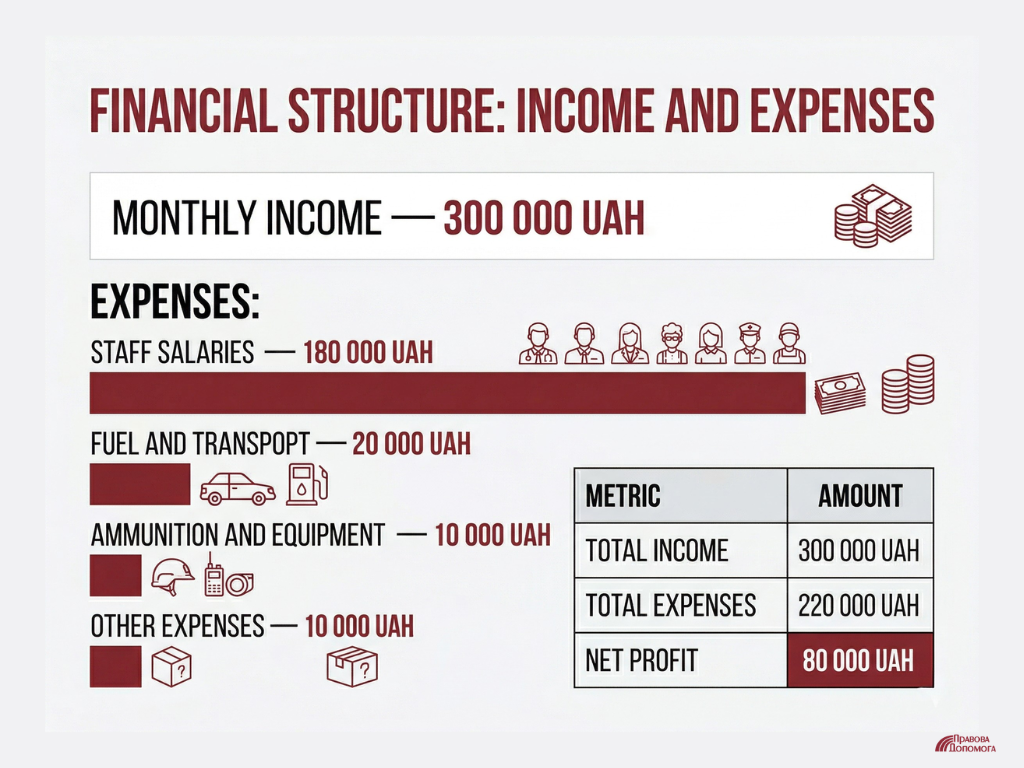
From net profit, the individual entrepreneur pays:
- personal income tax, PIT, 18%, UAH 14,400;
- military levy, 5%, UAH 4,000;
- single social contribution, SSC, 22%, UAH 1,902.34, the minimum contribution.
The total tax burden, meaning the total amount of taxes paid by the individual entrepreneur, will be UAH 20,302.34 per month.
Please note!
- Military levy and PIT are paid in advance by the 20th day of the month following each calendar quarter, except for the fourth quarter, based on actual accounting data.
- SSC is paid monthly or quarterly by the 20th day of the month following the reporting quarter.
- Income declaration by an individual entrepreneur under the general taxation system is carried out once a year, by May 1 of the year following the reporting year. For example, the report for 2025 is submitted by May 1, 2026, using the Tax Declaration on Property Status and Income.
Taxation of Legal Entities, LLCs, Under the General System
Operating as a limited liability company under the general taxation system is the standard model for large and medium-sized businesses. It provides transparency that is clear to banks and major clients.
Security companies operating as LLCs and carrying out security activities pay the following taxes after switching to the general system:
- corporate income tax at 18% of net profit;
- VAT at 20% of taxable income, provided the established turnover threshold is exceeded or in the case of voluntary registration. The threshold is UAH 1,000,000.
Important aspects of operating an LLC under the general taxation system:
- maintaining full accounting and tax records;
- all expenses and income must be confirmed by documents;
- control over expenses, their economic justification, and their connection with the company’s business activities;
- mandatory VAT registration upon reaching income of UAH 1,000,000;
- mandatory monthly registration of tax invoices after obtaining VAT payer status.
Calculation for a Legal Entity, VAT Payer
Let us consider a hypothetical situation where a legal entity under the general taxation system, registered as a VAT payer, provides security services.
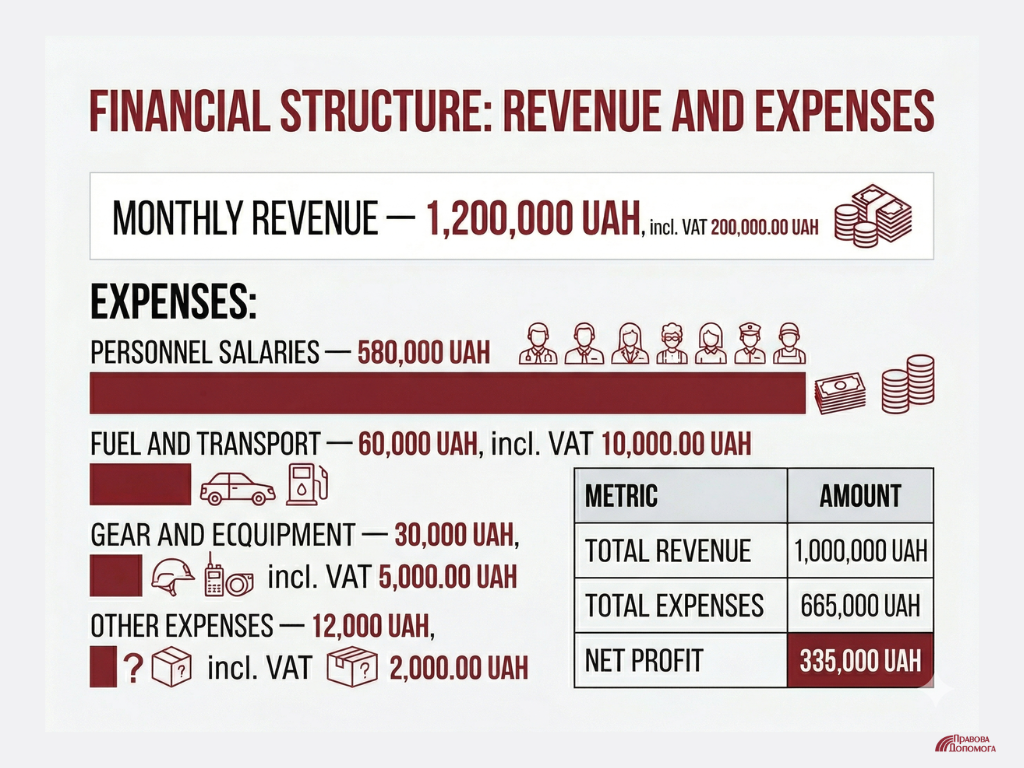
From net profit, the LLC pays:
- corporate income tax, 18%, UAH 60,300;
- additionally, the LLC declares and pays VAT in the amount of the difference between tax liabilities, 20% VAT formed on income transactions, and tax credit, 20% VAT formed on purchased or paid expenses. In our case, the VAT amount payable is UAH 183,000, calculated as UAH 200,000 minus UAH 10,000, minus UAH 5,000, minus UAH 2,000.
The total tax burden, meaning the total amount of taxes paid by the LLC, will be UAH 243,300 per month.
In this situation, we see a high tax burden due to the company’s minimal expenses. Therefore, after switching to the general taxation system, it is critically important to properly, fully, and timely account for expenses. Otherwise, the tax burden may increase significantly.
Please note!
- Declaration of income and payment of corporate income tax by an LLC under the general taxation system is carried out once a year, by March 1 of the year following the reporting year.
- When a company reaches a taxable income of UAH 40 million per year, it switches to quarterly reporting and quarterly payment of corporate income tax.
VAT declaration and payment are carried out on a monthly basis. The declaration is submitted by the 20th day of the month following the reporting month, and VAT is paid by the 30th day of the month following the reporting month.
Based on the previous examples, it becomes clear that company expenses under the general taxation system are one of the key indicators that help a business control its tax burden and reduce the tax base.

What Can Be Recognized as Expenses for Taxation Purposes Under the General System?
For a security business, expenses may include:
- employee salaries;
- purchase of uniforms and equipment;
- transport and fuel expenses;
- office rent;
- communication and software costs;
- equipment depreciation;
- consulting and outsourcing services.
The main condition for the legality of expenses is that all of them must be documented and directly related to the business activity. Understanding this principle allows the manager to make effective management decisions that directly affect the financial result.
Successful case: When Should a Security Specialist Be Paid?
Nuances for Beginners: Launching a Security Company from Scratch
Launching a security business has a number of specific requirements that should be taken into account from the very beginning. Unlike ordinary trade, every step here is controlled not only by the tax authorities, but also by the Ministry of Internal Affairs, which requires special attention to documentation.
First, the activity is subject to mandatory licensing. Providing security services without it is prohibited. Therefore, the first step should be obtaining the relevant permit: Obtaining a Security Activity License.
Second, it is necessary to choose the correct organizational and legal form. Most often, this is an LLC, since it allows you to:
- work with major clients;
- scale the business;
- minimize the owner’s personal risks.
The optimal solution is professional LLC and legal entity registration, which helps avoid mistakes at the start. It is also important to:
- properly register personnel;
- formalize contractual relations with clients;
- prepare internal documents, such as instructions, agreements, and policies;
- decide on the taxation system.
A comprehensive approach to the start guarantees that your business will remain resilient to any external changes.
Accounting Support for Security Activities: Why Is It More Complex Than Ordinary Trade?
Security activity is a complex mechanism where every component must operate within the law and licensing conditions. Standard accounting often cannot cope here because of the narrow specifics of the industry.
1. Licensing and regulation. Since security activity is subject to mandatory licensing, this means:
- constant monitoring of compliance with licensing conditions;
- reporting that may be checked by the regulator;
- risk of fines or loss of license due to accounting errors.
2. Personnel accounting. Security companies usually have:
- a large number of employees;
- shift schedules, including night and 24-hour duties;
- tracking of hours worked by facility.
This complicates payroll calculation, additional payments for night work, holidays, overtime, and the maintenance of timesheets.
3. Specific client agreements. Security services often include:
- different tariffs, such as on-site guarding, monitoring services, and response services;
- individual terms;
- penalties and liability for incidents.
This means more complex income accounting, closing acts of completed work, and analyzing profitability for each facility.
4. Accounting for special equipment and assets. Security activity uses:
- uniforms;
- special equipment, such as gas sprays, radios, and similar items;
- transport.
This requires separate inventory accounting, control over issuance and return, and depreciation.
Thus, the specifics of the industry require an accountant to have deep knowledge not only of the Tax Code, but also of the licensing requirements of the Ministry of Internal Affairs and the nuances of labor law. This is why accounting outsourcing from specialists who understand the specifics of the security business is an investment in your safety.
You might also like: Frequently Asked Questions about Security Services
Comprehensive Support for Security Businesses: From Registration and Licensing to Tax Accounting
Whether you have been operating in the market for a long time and need to adapt to the 2026 tax changes, or are only planning to enter this industry, “Pravova Dopomoha” becomes your strategic partner. We do not simply advise on taxes. We provide a full cycle of legal and accounting support for the safe operation of your business.
We can help you with:
- Obtaining a license to carry out security activities, ensuring that all stages of the Ministry of Internal Affairs review are completed.
- Developing documents for working with clients and contractors that genuinely protect your interests.
- Developing employment documents that take into account all specific security work schedules.
- Setting up and supporting turnkey accounting and tax records.
- Consultations for your team, including tax planning strategies.
Get an individual solution for your company without postponing the setup of business processes until the last moment. Schedule a professional consultation to develop a personalized strategy for launching or transforming your security company in accordance with the current 2026 standards.
Learn more about outsourced accounting support for businesses from our specialists here.
Need to obtain a security activity license? Get complete information here.Services on the topic of this material


Our publications on this matter


Our clients