

NGO Charter Amendments in Ukraine: Documents and Procedure
Reviews of our Clients
The charter is the main founding document of a non-governmental organization (NGO). However, over time, its provisions may become outdated or cease to reflect the actual activities of the organization. In such cases, it becomes necessary to amend the charter and approve a new version.
Amendments to the charter acquire legal force only after state registration in accordance with the procedure established by law. We will explain the procedure and highlight its potential pitfalls.
When Is It Necessary to Amend the Charter of an NGO?
Not every change in a non-governmental organization's activities requires amendments to its charter. However, if the relevant information is expressly set out in the charter, updating it requires approval of a new version of the document.
The need to make amendments most commonly arises in the following cases:
- a change in the name of the non-governmental organization;
- a change in the organization's registered address (if the address is specified in the charter);
- a change in the organization's purpose, objectives, or areas of activity;
- expansion or clarification of the types of statutory activities;
- changes to the procedure for joining the organization or terminating membership;
- changes to the structure of governing bodies;
- revision of the powers of governing bodies;
- changes to the procedure for convening and holding the General Meeting;
- changes to quorum and voting requirements;
- establishment of new separate subdivisions or changes to the procedure governing their activities;
- bringing the charter into compliance with legislative amendments.
In many cases, updating the charter in a timely manner helps avoid problems when implementing grant projects, attracting funding, and undergoing inspections.
Learn more: What Changes in a Public Organization Are Subject to State Registration in 2026
What Amendments Can Be Made to the Charter of a Non-Governmental Organization: List of Provisions
The law does not establish an exhaustive list of amendments that may be made to the charter of a non-governmental organization. Members of an NGO have the right to independently determine its internal structure and operating procedures within the limits of the law. However, the most common amendments concern:
- the organization's full and abbreviated name;
- its purpose and areas of activity;
- the procedure for acquiring and terminating membership;
- the rights and obligations of NGO members;
- the structure of governing bodies;
- the procedure for forming governing bodies;
- the terms of office of officials;
- the procedure for convening and holding the General Meeting;
- decision-making procedures;
- the procedure for using the organization's property and funds;
- the activities of separate subdivisions;
- the procedure for reorganizing or terminating the NGO's activities.
For example, we are often approached by NGOs planning to implement international grant projects. In one such case, it became necessary to supplement the charter with provisions allowing General Meetings to be held remotely using electronic communication tools and electronic voting.
The previous version of the charter provided exclusively for the physical presence of organization members, which effectively made it impossible to make decisions promptly when some members were abroad. After the relevant amendments were made, the organization was able to hold meetings in accordance with its charter without risking challenges to the decisions adopted.
You might also like: Changing the Management and Governing Structure of a Public Organization
Who Has the Right to Amend the Charter of a Non-Governmental Organization: Quorum and Voting Procedures
The procedure for adopting a decision to amend the charter is determined by the non-governmental organization's own charter.
As a rule, the exclusive right to approve a new version of the charter belongs to the highest governing body: the General Meeting of the NGO's members. The General Meeting adopts the decision to make amendments, approves the new version of the charter, and appoints the person authorized to carry out the state registration of those amendments.
For the decision to be legally valid, the following requirements must be observed:
- the procedure for convening the General Meeting;
- requirements for notifying the organization's members;
- the established quorum of members present at the meeting;
- the required number of votes to adopt the decision;
- requirements for preparing the minutes of the General Meeting.
Failure to comply with even one of these requirements may constitute grounds for refusing state registration or subsequently challenging the decisions adopted.
In practice, quorum and the required number of votes are the issues that most often cause difficulties. It is important to remember that the Law of Ukraine “On Public Associations” does not establish uniform requirements for all non-governmental organizations. These requirements are determined by the provisions of each organization's individual charter.
What Quorum Is Required to Amend the Charter of a Non-Governmental Organization?
For example, the charter may stipulate that the General Meeting has a quorum if more than half of the organization's members are present, and that a decision to amend the charter requires at least a two-thirds majority of the votes of those present. Another charter may establish a quorum of 75% of the members or provide that a decision to amend the charter requires a three-quarters majority or another qualified majority specified in the charter itself. That is why, before convening a General Meeting, it is necessary to review the current version of the charter and ensure that all its requirements will be met.
If the charter does not contain clear rules on quorum, voting procedures, or the adoption of decisions to make amendments, it is advisable to first specify exactly how many votes are required to amend the charter and decide on other matters.
This is done by bringing the charter into compliance with legal requirements and the organization's operational needs. This will help you avoid disputes among NGO members and reduce the risk of refusal to register the amendments or of decisions being challenged in court.
You might also like: Amendments and signing of the Charter: who has the right to sign

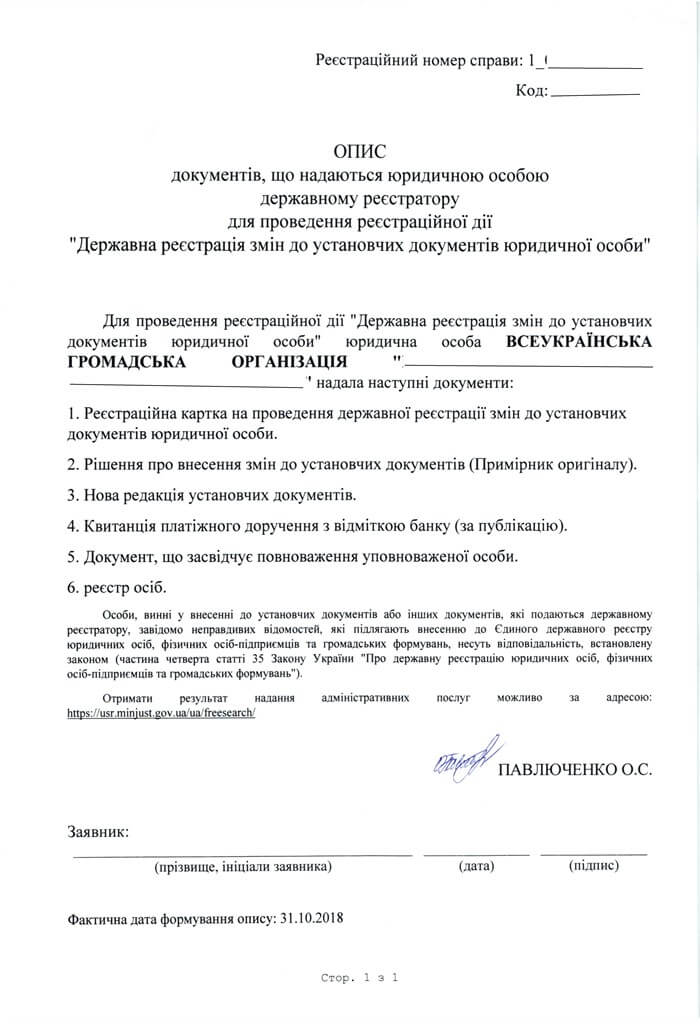
Documents Required to Register Amendments to the Charter of an NGO
The list of documents usually includes:
- an application for state registration of a legal entity, namely a public association;
- the minutes of the General Meeting approving the amendments to the charter;
- the new version of the charter;
- the register of attendees at the General Meeting;
- proof of payment of the administrative fee;
- the applicant's identity document;
- a power of attorney or another document confirming the representative's authority (if the documents are submitted by a representative).
Additional documents may be required depending on the nature of the amendments. Therefore, before submitting the application, it is advisable to conduct a legal review of the charter and the decisions adopted.
For example, while assisting one non-governmental organization with charter amendments, we found that, under its charter, only members who had been granted the internal status of “Associate Professor” were entitled to vote at the General Meeting. Consequently, supporting documents had to be provided.
Procedure for State Registration of Amendments to the Charter of a Non-Governmental Organization: Step-by-Step Guide
The procedure for state registration of amendments to the charter of a non-governmental organization consists of several stages:
- Review of the Current Charter. Before holding the General Meeting, it is necessary to check the decision-making procedure, quorum requirements, and any specific provisions governing amendments under the current version of the charter.
- Holding the General Meeting. The organization's members adopt a decision to amend the charter and approve its new version.
- Preparing the Documents. The minutes of the meeting and the register of attendees are prepared, along with the new version of the charter and an application for state registration of a legal entity, namely a public association.
- Submitting the Documents. The documents may be submitted through a Center for Administrative Services or the territorial offices of the Ministry of Justice of Ukraine.
- Registering the Amendments in the USR. After reviewing the documents, the state registrar enters the relevant information into the Unified State Register (USR), after which the amendments are considered officially registered.
The state registration of amendments itself usually takes little time. However, the overall procedure often takes considerably longer. Delays most commonly occur during the document preparation stage, as it is necessary to:
- notify all members of the non-governmental organization about the General Meeting;
- ensure a quorum;
- agree on the new version of the charter;
- properly prepare the minutes and verify that all documents comply with legal requirements.
If the organization has a large membership or its members are located in different cities or abroad, the procedure may take several weeks to one or two months.
Our specialists provide turnkey assistance with the procedure for amending the charter of a non-governmental organization. In most cases, provided that all necessary documents are available and the client responds promptly, we complete the procedure within one week.
Deadline for Submitting Documents to Register Amendments to the Charter of a Non-Governmental Organization
Documents for state registration of changes to the information about a non-governmental organization must be submitted within 60 calendar days from the date on which the relevant decision was adopted by the authorized governing body.
If the non-governmental organization has non-profit status, the supervisory authority must also be notified of the charter amendments after their state registration. To do this, a registration application marked “Amendments” must be submitted to the tax authority together with copies of the updated founding documents. This must be done within 10 calendar days after the amendments have been officially registered.
If this deadline is missed, the legal entity may be subject to a fine of UAH 1,020. If the violation is not remedied or is repeated within one year, the fine increases to UAH 2,040.
Consequences of Failing to Register Amendments to the Charter of a Non-Governmental Organization on Time
Failure to comply with the requirements for timely and proper registration of charter amendments creates real and serious risks.
Problems with Confirming the Authority of Governing Bodies
If amendments to the charter, for example those concerning the powers of governing bodies, have not been registered, banks, donors, counterparties, and government authorities will rely on the current version of the charter recorded in the USR. A director acting on the basis of unregistered amendments may face:
- refusal to sign contracts;
- problems opening and maintaining bank accounts;
- difficulties obtaining grants and international technical assistance;
- questions about the validity of documents that have already been signed.
Challenging the Validity of Decisions Made by a Non-Governmental Organization
If charter amendments have not been state-registered but are nevertheless applied in practice, any decision made on the basis of unregistered provisions may be challenged in court. This is particularly risky when changes affect decision-making procedures or the powers of governing bodies.
Internal Disputes Within a Non-Governmental Organization
Internal disputes within an NGO are often related to the improper formalization of charter amendments. Members who disagree with the decisions made may challenge the procedure for adopting them, citing violations of the charter's requirements.
Why Should You Hire Lawyers to Amend the Charter of a Non-Governmental Organization?
The main challenge is that the new version of the charter must not only comply with legal requirements but also take into account the specific activities of the organization, its management structure, decision-making procedures, and future development plans.
Hiring lawyers will help you:
- conduct a comprehensive review of the current charter and identify provisions that need updating;
- verify that the charter complies with current legislation;
- draft a new version of the charter tailored to the specific activities of the non-governmental organization;
- properly define the powers of governing bodies and decision-making procedures;
- prepare the minutes of the General Meeting and other required documents;
- organize the amendment process in accordance with the charter's requirements;
- compile a complete set of documents for state registration;
- minimize the risk of refusal by the state registrar;
- prevent future internal disputes among the organization's members.
If you simply want to achieve the desired result as quickly as possible, contact our specialists. You will receive not only timely registration of the amendments but also support throughout the entire process and help minimizing potential risks.
The cost of amending the Charter of a non-governmental organization is available here.
The cost of registering amendments to a non-governmental organization is available here.
Services on the topic of this material
Our publications on this matter


Our clients
We are ready to help you!
Contact us by mail [email protected] or by filling out the form:Other publications by the author

Closing an NGO requires more than a resolution by its members. Voluntary dissolution involves corporate documents, creditors, assets, tax obligations, nonprofit status, and the final termination of the entity in the registry.

CPD providers process doctors’ data for registration, training, assessment, and certification. The key is to determine when GDPR applies, when consent is required, and how websites, CRM systems, and online forms should be structured.

A sole trader, an LLC, or VAT registration can produce very different tax outcomes for an online school. The right structure depends on clients, turnover, growth plans, and the actual format of educational services.

The purpose of travel determines the Ukrainian visa type, required documents and permitted stay. Applicants should check whether their nationality requires a visa before preparing the application.
Our other authors