

Military ID Says Excluded, Reserve+ Says Liable for Service: How to Correct the Data and What to Do
Cost of services:
Reviews of our Clients
... our work on joint projects assured us of your high level of professionalism
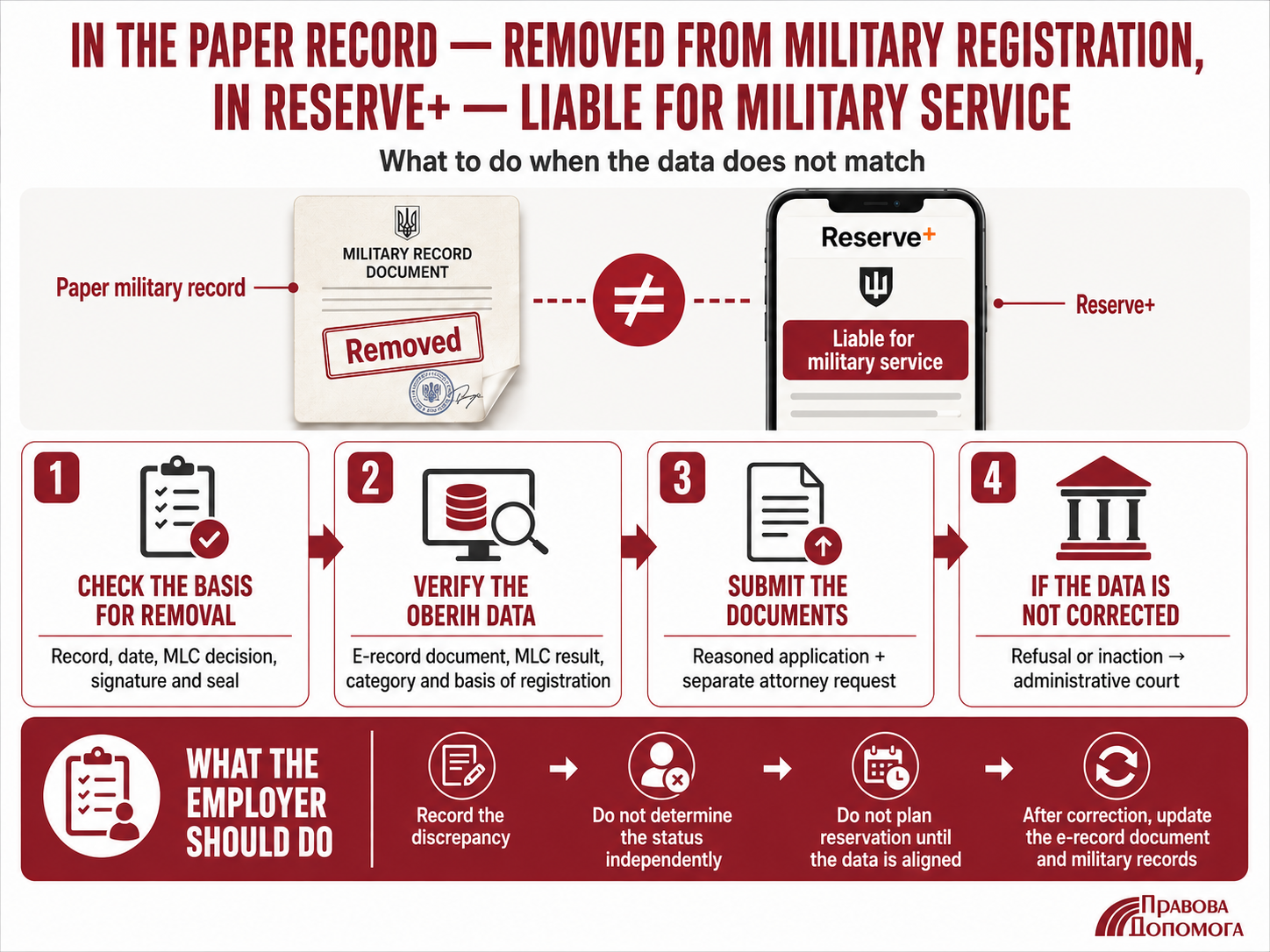
A paper military registration document may contain an entry confirming removal from the military register, while the current electronic military registration document (e-MRD) in “Reserve+” shows the same person as liable for military service. This discrepancy raises two immediate practical questions: how the person can have their data corrected, and which information an employer should rely on when maintaining personnel military registration records or preparing employees for reservation from mobilization.
An old entry alone does not prove that the Register is wrong. The first step is to reconstruct the legal history of the person's status: what decision was made, the grounds for removal, whether the original military medical commission (MMC) and territorial recruitment center (TCC) records exist, and whether a subsequent decision changed the earlier finding. The answers determine the next steps: correcting information in the Register, locating archived documents, or preparing an administrative case.
For a business, this conflict also has practical implications. An individual employee's status determines how they should be reflected in personnel military registration records and whether the employee reservation procedure can properly begin. However, an employer has no authority to choose one of two conflicting entries on its own and declare it accurate.
Below, we explain how to verify the grounds for an earlier removal, which documents to request, how to initiate corrections in the Oberih register, when court proceedings become necessary, and how a business should document the problem until it is resolved.
Why Your Military ID Says “Removed from the Register” but “Reserve+” Shows You as Liable for Military Service
We are handling a case in which a temporary certificate of a person liable for military service issued in 2022 records both an MMC ruling of unfitness and a separate entry confirming removal from the military register. The entry includes a date, legal grounds, an official's signature, and an official seal bearing the coat of arms.
However, an electronic military registration document generated in 2026 presents a different picture: the person has the status of a person liable for military service and is registered. The extended Oberih data contains no MMC examination date, MMC ruling, or grounds for removal.
We deliberately do not present this case as completed or won: the administrative procedure still lies ahead, followed by court proceedings if necessary. Yet one fundamental point is already clear: simply arguing that “my paper document says I was removed from the military register” is insufficient. The TCC and, potentially, the court need a chain of evidence establishing who made the decision and what it said, whether that authority had the necessary powers, how the decision was documented, whether it was implemented, and why its outcome is missing from the Register.
Why Filing an Administrative Claim Is Not the First Step in Correcting Your Status
Before submitting demands to the TCC or drafting an administrative claim, we analyze the entire military registration document, rather than just the page containing the relevant entry. The exact wording in different sections, military rank, MMC examination date, the version of Regulation No. 402 in effect on that date, and the availability of original records at the TCC may all matter.
The audit must establish:
- whether the document specifically states “removed from the military register,” rather than merely “deregistered” or “unfit in peacetime, of limited fitness in wartime”;
- the date, grounds, and number of the MMC ruling, as well as the seal and signature;
- whether the person belonged to enlisted, NCO, or officer personnel, since the procedure for documenting findings may have differed;
- whether an MMC certificate, certificate of illness, medical examination card, and minutes were prepared;
- whether a subsequent decision reviewed or revoked the ruling;
- exactly what the current electronic military registration document and extended Oberih data show.
This audit helps identify the proper defendant. One TCC may have issued the document, the personal file may later have been transferred to another, and a third authority may now maintain the Register entry. Bringing an administrative claim only against an authority that lacks the necessary documents or powers creates an unnecessary risk that the claim will be denied.
Is an Old Military ID Valid if Its Data Conflicts with “Reserve+” and Oberih?
There is an important but easily overlooked distinction here. A paper military ID or temporary certificate may confirm that a TCC previously made and documented a decision to remove the person from the military register. This is precisely why the document is needed to restore the entry, prepare an attorney's request, and pursue court proceedings.
However, paragraph 4 of the Procedure approved by Cabinet of Ministers of Ukraine Resolution No. 559 provides that if the information in a paper document does not match Oberih, the paper document itself is not amended and is considered invalid. Once the Register has been corrected, the person must generate an up-to-date electronic military registration document.
Thus, the paper document primarily serves as evidence in such a case. It does not entitle the person to simply ignore an incorrect status in “Reserve+” and use either of two conflicting documents as circumstances suit them.

How to Correct Data on Removal from the Military Register in “Reserve+” and Oberih
When correcting data, we distinguish between two documents because they serve different legal functions.
- The person's reasoned application. This must request corrections to specific Oberih fields: the MMC examination result and date, registration category, and date and grounds for removal from the military register. Article 9 of the Law on the Register expressly grants the right to request correction of inaccurate personal information.
- An attorney's request. It should not demand that the authority “correct the status,” since that is not a request for information. Its purpose is to obtain copies of the MMC ruling, minutes, registration card, documents concerning issuance of the certificate, the entry's change history, and the decisions that caused the person to appear as liable for military service again.
- Proof of submission. Retain the email with all attachments and the qualified electronic signature, the Portal receipt, or the postal inventory of enclosures and acknowledgment of receipt. For a future dispute, both the application and proof of exactly what the TCC received are important.
- A decision or documented inaction. A general informational letter that does not address the requests does not always conclude the administrative stage. A reasoned response addressing each request and the documents reviewed by the authority must be requested.
There is also no single deadline that applies in every situation. As a general rule, an attorney's request must be answered within five business days. If the search requires processing a substantial amount of information, that period may be extended to twenty business days.
Procedure No. 559 provides for amendments within five business days of registration of the special application. For an ordinary citizen's submission, the general response period may be up to one month. Thus, the approach of “always waiting 30 days” is legally inaccurate.
Challenging Data in an Administrative Court: Grounds and Case Law
Court proceedings become appropriate when the TCC refuses the request, fails to make a decision, or leaves inaccurate information unchanged after reviewing the application. Depending on the evidence, the relief sought may include declaring the inaction or decision unlawful, requiring reconsideration of the application, or directly ordering the entry of specific information into the Register.
The remedy matters. If the authority has not actually examined the documents, the court may limit its order to requiring reconsideration of the submission. The situation is different when all legally relevant circumstances have already been established and the authority has only one lawful course of action. There may then be grounds to seek an order requiring the direct entry of specific data.
Both approaches can already be seen in case law. On June 18, 2026, in case No. 440/15948/25, the Second Administrative Court of Appeal overturned the Poltava District Administrative Court's refusal to grant relief and directly ordered the entry of information about removal from the military register. In case No. 440/4534/25, on March 2, 2026, the same court of appeal declared the TCC's inaction unlawful but ordered it to reconsider the application rather than immediately change the entry.
There are also decisions against applicants. For example, on July 3, 2026, in case No. 160/3214/26, the Dnipropetrovsk District Administrative Court denied relief because it found that the old entries did not establish that the removal remained legally effective. This is only a first-instance decision and does not yet reflect any potential appellate position. Nevertheless, it demonstrates a significant risk: identical entries in paper documents do not mean identical evidentiary circumstances.
The key practical takeaway is this: the court assesses the origin and continuing legal validity of the decision itself, rather than an isolated entry in an old military registration document. Preparation should therefore begin with a document audit: reviewing MMC records, Oberih data, the history of file transfers, and identifying the authority responsible for the disputed entry.
The procedural course cannot be predicted using a standard template either. Some of these cases are considered in simplified written proceedings without hearings; in others, the court summons the parties or requests additional evidence. A fixed number of hearings or appeals cannot be promised in advance. The filing deadline also requires separate attention: for an individual, the general time limit for filing an administrative claim is six months from the date they learned or should have learned of the violation of their rights.
What Should an Employer Do if Paper and Electronic Military Registration Documents Contain Different Data?
For a business, this is more than an employee's personal problem. Paragraph 34 of the Procedure for Organizing Military Registration No. 1487 requires employers, when hiring, to check the military registration document and verify that its information matches the Register using an electronic military registration document generated no more than 72 hours before hiring.
If an employee presents an old paper document confirming removal from the military register, but their current e-MRD identifies them as liable for military service, the company's responsible staff member cannot independently decide which entry is “more correct” or amend Oberih. Nor should information from the paper document be transferred to internal lists as though the electronic discrepancy did not exist.
In practice, the employer should:
- record the date the electronic military registration document was checked and the discrepancy itself;
- refrain from destroying or altering the employee's paper document;
- ask the employee to initiate the official correction procedure and provide proof of submission;
- avoid promising employee reservation until the actual status and Register data are aligned;
- once the correction is made, generate a new e-MRD and update personnel military registration records and, if necessary, employee reservation documents.
A technical or archival discrepancy alone does not automatically mean that the employee has committed a violation. However, the employer is responsible for the completeness and accuracy of its own military registration records, as well as the accuracy of the lists used for employee reservation. HR therefore needs a documented procedure showing that the discrepancy is already being addressed officially, rather than the employee's verbal account.
Related reading: Military Registration After Employee Reservation: Business Mistakes
Can an Employee Be Reserved Before Their Status in Oberih Is Corrected?
If removal from the military register was lawful and remains effective, the person no longer has the status of a person liable for military service. The Supreme Court articulated this distinction in its ruling of May 21, 2025, in case No. 280/2880/24: a deregistered person retains the status of a person liable for military service, while a person removed from the military register does not.
We explain how people who have reached the maximum age are now removed from the register in our article Exclusion from Military Registration by Age: Age Limits and After 60.
Employee reservation is intended for people liable for military service. Procedure No. 76 separately provides that people who are not subject to call-up during mobilization under the law cannot be reserved. Thus, a legally effective removal from the military register should not be “replaced” with employee reservation.
However, while Oberih incorrectly shows a person as liable for military service, the company's electronic checks will use that entry. Submitting the person for employee reservation does not correct the original error and may distort the number of employees liable for military service, for which the company head is responsible. First, the correct status must be established and confirmed.
If the problem is discovered while preparing employee reservation applications or reviewing military registration records, it should be addressed alongside an audit of personnel lists and employee data.
Related reading: Employee Reservation: Who Is Eligible and How to Apply
What Results Can Pravova Dopomoga Deliver?
An individual needs more than a letter to the TCC. They need one of two verified outcomes: either a correct electronic military registration document showing removal from the military register, or a reasoned refusal and a complete set of evidence for court proceedings.
For an employer, the outcome is broader: a clear employee status, a documented basis for deciding how to maintain that employee's personnel military registration records, and, if the employee is indeed liable for military service, readiness to properly include them in the employee reservation procedure.
We can handle:
- an audit of every page of the military ID or temporary certificate, the MMC ruling, and current Oberih data;
- identification of the appropriate TCC, archive, or MMC and the evidence that is missing;
- preparation of a reasoned application to correct the Register and a separate attorney's request for documents;
- analysis of the TCC's response and formulation of claims supported by the evidence;
- representation in first-instance and appellate proceedings;
- for businesses, alignment of the corrected status with personnel military registration records and the employee reservation procedure.
For an initial audit, provide clear copies of all completed pages of the paper military registration document, a current e-MRD, extended Oberih data, available MMC documents, and the date the discrepancy was discovered. This allows us to make a sound assessment of whether to begin by recovering documents, request a technical correction, or prepare an administrative claim.
If you need a consultation, or your business needs comprehensive support with military registration, reservation of employees, or obtaining critical enterprise status, contact the lawyers at Pravova Dopomoga. Call our toll-free number or submit an online request on our website.
Learn more about our services here: critical enterprise status, military registration, and reservation of employees.
Answers to frequently asked questions
Is it enough to send an attorney’s request to the TCC?
No. An attorney’s request is designed to obtain existing information and copies of documents. A demand to correct Oberih data is better submitted as a separate reasoned application by the person or their duly authorized representative.
Can the application be submitted by email?
The Law on Citizens’ Appeals allows electronic appeals. To give the application evidentiary weight, it is advisable to sign the file with a qualified electronic signature and keep the complete electronic package. At the same time, paragraph 4 of Procedure No. 559 names the Portal or an in-person appeal, so if “Reserve+” does not offer this function, it is safer to also register the application in person or obtain the TCC’s written position on the submission channel.
Does the employer have to correct an employee’s data?
No. The employer checks the military registration document, keeps its own lists, and reports the changes required by law, but decisions on military status and Oberih entries fall within the competence of the authorities that maintain the Register. The company can arrange legal support for the employee and update its own records after the correction.
Does the entry “removed from the register” guarantee a win in court?
No. The court examines the legal grounds, the version of the rules in force on the relevant date, the competence of the MMC, the formalities of the documents, any later decisions, and whether the correct defendant has been named. That is why a thorough audit before filing a claim saves time and reduces the risk of choosing the wrong remedy.
Services on the topic of this material
Our publications on this matter


Our clients


We are ready to help you!
Contact us by mail [email protected] or by filling out the form:
Other publications by the author

A business does not have to build its own shelter if a suitable one nearby has free places and real access. How to find it, agree with its owner and prepare documents.

What TCC wanted status and the “Вас розшукує ТЦК” notice in Reserve+ mean, how to find the reason and six ways to remove the status, with pros, cons, timeframes and costs.

Cancellation of employee reservation ends the deferment of a reserved employee: who cancels it and when, the grounds under the Reservation Procedure, the steps in Diia, deadlines, what happens to the employee and the limit, and the employer's liability.

How to divorce a foreigner in Ukraine: when a joint application to the registry office is enough, when a court is needed, which court hears the case, what to do if the foreign spouse lives abroad, objects or cannot be found, and which documents to prepare.
Our other authors