
Medical Patient Transport in Ukraine: How to Set Up a Patient Transport Service
Cost of services:
Reviews of our Clients
…we can confidently recommend the lawyers of Law firm «Pravova dopomoga» as reliable legal partners on the matters of medical practice licensing and other procedures related to the Ministry of Health of Ukraine.
... Having used the services of the Law Firm "Pravova dopomoga", we managed to solve our problems, as well as found a qualified and reliable partner.
An entrepreneur approached our law firm with a clear business idea: purchase a specialized medical vehicle and establish regular cooperation with 3–5 private healthcare facilities, such as hospitals, hospices, or rehabilitation centers. The main objective was to transport patients for these facilities under contract and, when the vehicle was not being used for institutional work, provide private patient transport services directly to individuals.
The client did not understand how this business model should be structured legally. At first glance, the niche looked like ordinary passenger transportation, but in practice it raised a number of questions:
- How can contracted work with healthcare facilities be legally combined with private patient calls?
- Is a license required for this type of activity?
- Can the vehicle legally use special warning lights and a siren?
- Which KVED codes should be selected and what legal form should be used for the business?
- Which documents must be carried in the vehicle during each trip to avoid fines or suspension of operations?
Below we answer each of these questions and explain how to build a fully compliant patient transport service from the ground up, avoid critical mistakes, and turn a complex set of regulatory requirements into a clear and manageable business process.
You may also find this useful: Medical Marketing Without Fines—How to Manage Social Media Properly
Step 1: Build the Legal Foundation of the Business
We began by selecting the most appropriate legal form and the correct types of economic activity.
FOP or LLC for a Private Ambulance Service?
Because the business was planned on a medium scale, with one or two vehicles at launch, we selected the individual entrepreneur (FOP) model. This immediately raised an important asset issue: the ambulance vehicle belonged to another individual and was not registered directly to the FOP.
To use the specialized vehicle lawfully in the business, we recommended preparing and notarizing a vehicle lease agreement between the individual owner and the FOP. Based on that agreement, the Ministry of Internal Affairs Service Center issues a temporary registration certificate, allowing the FOP to operate the vehicle, register it for medical use, and obtain the required permits.
Which KVED Codes Should Be Selected for a Private Ambulance Service?
The second critical issue was selecting the correct KVED codes. The client initially assumed that ordinary freight or passenger-transport codes would be enough for patient transportation. This is one of the most common mistakes.
We prepared a clear list of activities for the FOP:
- 86.90 “Other human health activities”: the primary KVED code for transporting patients in specialized ambulance vehicles.
- 86.21 “General medical practice”: required to support the lawful work of medical personnel, such as physicians and paramedics, who accompany the patient during transportation and provide primary or urgent medical assistance en route.
- 86.10 “Hospital activities”: an additional KVED code covering a more integrated model in which the FOP works directly within the operational processes of partner healthcare facilities when transporting their patients between departments or to other clinics.
At this stage, the client’s business model was already taking clear shape. The decisive question was whether this model required a medical practice license. The answer was unequivocal: yes. Even if the service does not provide emergency resuscitation and only transports patients to clinics or fulfills private transport requests, the presence of medical personnel in the vehicle to accompany and monitor the patient is treated as medical practice under Ukrainian law.
The next task was to bring the vehicle into compliance with the medical standards required for licensing by the Ministry of Health.
Step 2: Prepare the Ambulance Vehicle and Medical Equipment
The client initially believed that any van fitted with a stretcher would be sufficient. Patient transportation, however, is a highly regulated activity in which the vehicle interior and its equipment must comply with strict national standards. We assisted with three key elements of preparation.
What Requirements Apply to the Ambulance Vehicle?
A vehicle used to transport patients must comply with DSTU EN 1789:2019 “Medical vehicles and their equipment—Road ambulances” (which replaced the previous DSTU 7032:2009).
For the client’s operating model, we selected a Type B vehicle: an ambulance designed for patient transport that requires the relevant conformity certification.
We explained the full vehicle-certification process to the client and the documents required to complete certification successfully through accredited conformity-assessment bodies.
Certification covers virtually every element of the vehicle, from stretcher anchoring and ventilation and heating systems to electrical safety in the patient compartment. A vehicle that does not comply with this standard cannot lawfully be put into service.
How Should the Ambulance Interior Be Equipped?
To reduce licensing risks during Ministry of Health inspections, we prepared the equipment list for the vehicle in accordance with Ministry of Health Order No. 739 dated October 31, 2011, which sets model equipment standards. Depending on the operating model, the vehicle may require, for example:
- Immobilization and transport equipment: a main wheeled stretcher with an adjustable angle and reliable fixation system, a folding transport chair for narrow corridors and stairs, and a cervical collar;
- Diagnostic and resuscitation equipment: a portable pulse oximeter, a blood pressure monitor with cuffs of different sizes, a glucometer, and an AMBU bag for manual ventilation with a set of masks;
- Oxygen support equipment: a fixed or portable oxygen cylinder fitted with a regulator and humidifier.
An emergency medical first-aid kit is also mandatory.
Step 3: Obtain a Medical Practice License
After establishing the legal foundation and assessing the vehicle equipment, we worked through the most important stage with the client: obtaining a medical practice license.
Business owners often assume: “If we only transport patients and do not perform complex procedures, this is purely a transport service.” That is a dangerous misconception.
Why this business cannot operate lawfully without a medical practice license:
- Lawful contracting: prospective partners such as private clinics and hospices should not contract for medical patient-transport services with a contractor that lacks the required medical practice license. For the healthcare facility, this creates its own regulatory risk.
- Prerequisite for special warning signals: Ministry of Internal Affairs Service Centers issue permits for special warning devices, including sirens and blue flashing lights, only to entities that meet the applicable medical licensing requirements.
- Protection against criminal and administrative liability: carrying out medical practice without the required license may result in fines, confiscation of equipment, and confiscation of income generated from the services.
For the selected FOP model, the appropriate licensing route was to obtain a medical practice license under the specialty “Emergency Medicine”. We handled the preparation of the licensing documents and the licensing procedure.
Only after the medical practice license is in place should the business proceed to the next stage: obtaining the Ministry of Internal Affairs authorization for special warning signals.
We have explained the staffing requirements and the process for obtaining a license for a private ambulance service in more detail here.

Step 4: Obtain Authorization for Special Warning Lights and a Siren
The client had the most questions about the right to use special light signals, or flashing lights, and an audible warning signal, or siren.
To obtain official authorization from the Ministry of Internal Affairs to install and use blue special warning signals under Ministry of Internal Affairs Order No. 1080 dated December 23, 2019, we guided the client through the required procedure.
Requirements for Special Warning Devices and Their Placement
All light and sound warning devices must comply with DSTU 3849:2024 and the Ukrainian Traffic Rules:
- Light signals (flashing beacons): only blue lights may be used. The beacon must be mounted on the vehicle roof so that the warning light is visible through 360 degrees around the vehicle.
- Audible warning signal (siren): the volume and frequency must produce the special alternating tone used by emergency services and be clearly audible in urban traffic.
Important: the siren and flashing lights are physically installed before the inspection at the Ministry of Internal Affairs Service Center, but using them on public roads is strictly prohibited until the official permit has been issued.
Applying the Required Color and Graphic Markings
Before attending the Ministry of Internal Affairs Service Center, the vehicle must also be marked in accordance with DSTU 3849:2024, including the required color scheme, identification markings, the wording “Emergency Medical Care,” and the 103/112 telephone number. The Territorial Service Center will not issue the permit if the required markings are not in place.
Submitting the Document Package to the Ministry of Internal Affairs Service Center
Once the medical and legal basis has been prepared and the vehicle itself is ready, the following documents are submitted to the Ministry of Internal Affairs Service Center:
- the prescribed application form and, where applicable, the representative’s power of attorney;
- a copy of the vehicle registration document and the temporary registration certificate, because the vehicle is used under a lease agreement;
- a certified copy of the administrative document confirming that the vehicle is used for operational assignments;
- a vehicle inspection report confirming compliance with DSTU 3849:2024, certified by the signature and seal of the authorized Service Center official;
- proof of payment for the service;
- a Ministry of Health document confirming the medical practice license under the specialty “Emergency Medicine.”
Only after this permit is issued does the FOP’s specialized vehicle obtain the official status required for lawful use of special warning signals during urgent calls.
Step 5: Prepare the Documents That Must Be Carried in the Ambulance
A medical practice license and authorization for special warning signals are only part of the compliance framework. A defined set of documents must be carried in the ambulance on every trip. The business also needs to organize recurring operational procedures as part of its day-to-day work.
Daily Pre-Trip Checks
The vehicle cannot simply be sent out without pre-trip controls. Under the joint Ministry of Health and Ministry of Internal Affairs Order No. 65/80 dated January 31, 2013 and Article 45 of the Law of Ukraine “On Road Traffic,” the entrepreneur must arrange pre-trip checks before every shiftLaw of Ukraine “On Road Traffic”nt out without pre-trip controls. Under the joint Ministry of Health and Ministry of Internal Affairs Order No. 65/80 dated January 31, 2013 and Article 45 of the Law of Ukraine “On Road Traffic,” the entrepreneur must arrange pre-trip checks before every shift:
- Driver medical examination: conducted by a healthcare professional before each shift, with the result recorded in the relevant log.
- Vehicle technical inspection: conducted by the responsible mechanic before the vehicle enters service to verify that all vehicle systems are functioning properly.
Checklist of Documents That Must Be Kept in the Ambulance
During an inspection by patrol police or Ministry of Health inspectors, the driver and medical team should be able to present the complete document package:
- Vehicle registration documents: the original vehicle registration certificate and the temporary registration certificate issued for the FOP.
- Right to use the vehicle: the notarized vehicle lease agreement between the individual owner and the FOP.
- Special warning devices: the original Ministry of Internal Affairs permit authorizing installation and use of special light and sound warning devices.
- Driver documents: a valid driver’s license of the appropriate category and a current mandatory vehicle technical inspection certificate.
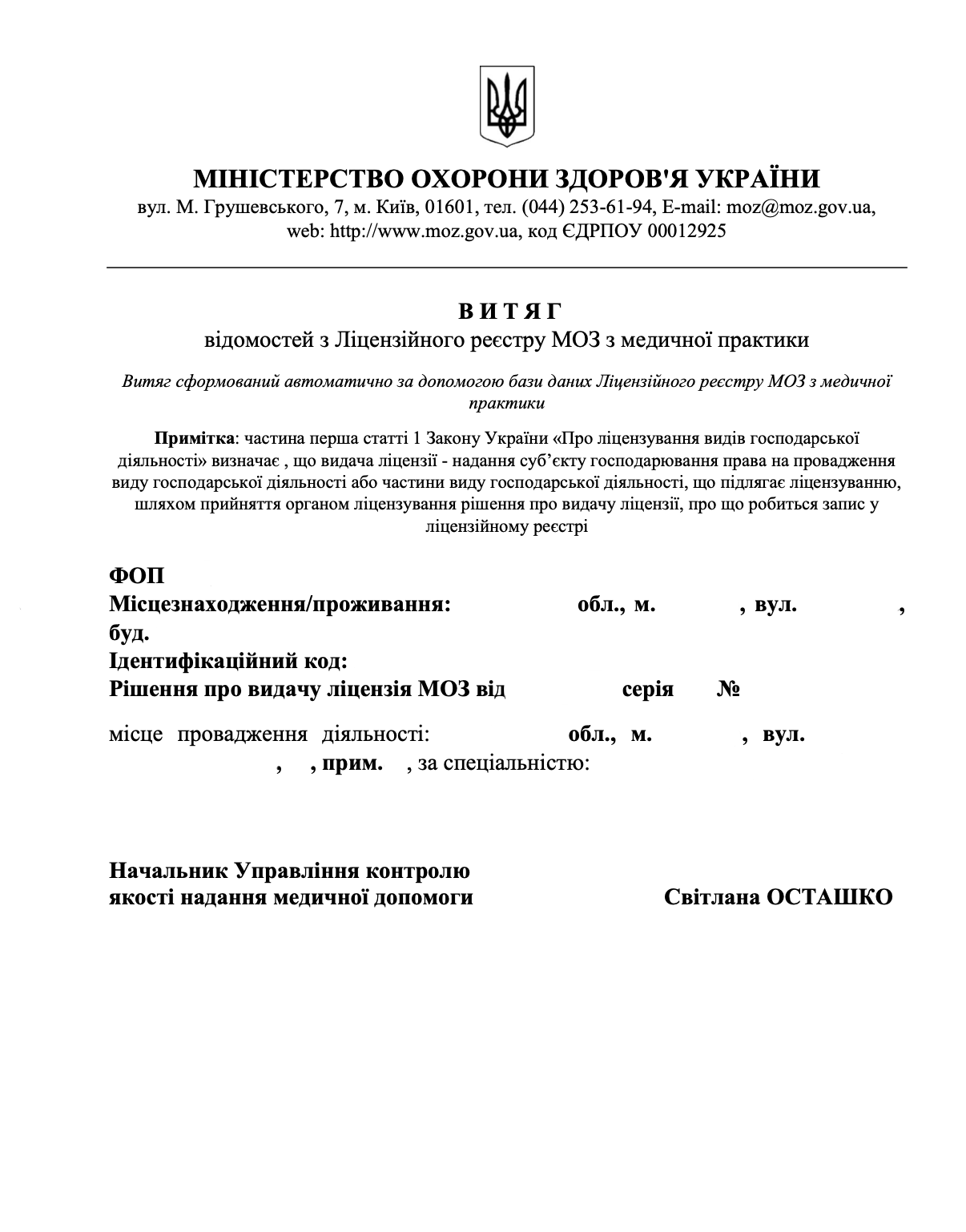
- Licensing documents: a certified copy of the extract from the Ministry of Health medical licensing register.
- Primary medical documentation: Ambulance Team Call Record forms (Form No. 110/0) and Patient Informed Voluntary Consent forms (Form No. 003-6/0).
Managing Critical Risks: Death of a Patient During Transport
If a patient dies during transportation, the medical team cannot act at its own discretion. The FOP should have an approved internal procedure governing how to call the investigative and operational police team, issue medical conclusions, and arrange transportation of the body in accordance with the applicable law.
Step 6: Prepare Ministry of Health Reporting Templates
Because the FOP operates under a Ministry of Health medical practice license, it must maintain and submit the required sector-specific and medical-statistical reports. New operators often overlook this obligation, which can lead to fines or create licensing risks during regulatory inspections.
For our client, we separated and documented two key annual reporting forms:
1. Form No. 47-health “Report on the Network and Activities of Healthcare Facilities”
- Report type: mandatory annual reporting.
- Legal basis: Ministry of Health Order No. 8 dated January 6, 2026 “On Approval of the Sectoral Statistical Reporting Form...”
Purpose: the FOP reports information on its available equipment and material resources, engaged medical personnel, number of specialized vehicles, and volume of medical services provided during the year.
2. Form No. 22 “Report of the Emergency Medical Care and Disaster Medicine Center”
- Report type: annual reporting that applies under specific conditions.
- Legal basis: Ministry of Health Order No. 999 dated November 17, 2010, as amended by Ministry of Health Order No. 278.
- When it applies: this form becomes mandatory where the specialized vehicle forms part of, or is engaged by, units of the emergency medical care system. It records operational indicators for calls and patient transportation performed within the disaster-medicine system.
A properly organized system for collecting primary data from ambulance call records allows these reports to be prepared and filed on time without hiring additional in-house analysts. We left the client with this information as a practical step-by-step guide for future operations.
Important for you: Registered Place of Business for a Mobile Medical Team—Ministry of Health Requirements
What Are Mandatory Vehicle Technical Inspection and Metrological Verification?
In addition to preparing the client to obtain a license for the ambulance service, we provided practical information that would matter during ongoing operations: mandatory vehicle technical inspection and metrological verification of medical equipment.
Under Cabinet of Ministers Resolution No. 137 dated January 30, 2012, mandatory vehicle technical inspection is a specialized inspection that checks the vehicle’s technical condition, braking system, steering, lighting, and overall road safety. An ordinary civilian vehicle check is not sufficient: specialized medical transport must undergo mandatory technical inspection every year.
To complete the inspection, the vehicle and registration document are presented to an accredited vehicle-inspection laboratory approved under the Ministry of Internal Affairs system. After the diagnostic inspection, an official inspection report is issued and the data is entered into the Unified State Register.
Another important requirement the client had not initially considered is metrological verification. This is an official accuracy check for measuring medical equipment installed in the vehicle, such as blood pressure monitors, pulse oximeters, defibrillators, and patient monitors. Under the Law of Ukraine “On Metrology and Metrological Activity,” this verification is performed once a year by specialized accredited laboratories.
How metrological verification is completed: the operator signs an agreement with an accredited metrology center, which checks the accuracy of each medical device either in the vehicle or at the laboratory and issues a verification certificate for each device.
How We Can Help
Our law firm can provide full end-to-end legal support so that you can focus on developing the business rather than navigating regulatory bureaucracy.
We can provide:
- Corporate structure and agreements: prepare the specialized-vehicle lease agreement between the individual owner and the FOP, arrange temporary registration certificates through the Ministry of Internal Affairs Service Center, and draft B2B service agreements with partner healthcare facilities.
- Medical practice licensing: prepare the licensing file under the specialty “Emergency Medicine” and support the procedure through registration in the medical licensing register.
- Special warning signal authorization through the Ministry of Internal Affairs Service Center: prepare and submit the full document package under Ministry of Internal Affairs Order No. 1080, including compliance with the DSTU 3849 vehicle markings and obtaining the vehicle inspection report, so the ambulance can receive official authorization for blue warning lights and a siren.
- Technical and medical documentation audit: review compliance of the vehicle with DSTU EN 1789:2019, mandatory technical inspection records, metrological verification certificates for medical equipment, and the required equipment schedules.
- Staffing and operational compliance: prepare job descriptions and internal procedures, including the response protocol for a patient death during transport, organize pre-trip driver medical checks and vehicle technical inspections for each shift, and provide the required primary medical documentation, including Forms No. 110/0 and No. 003-6/0.
- Protection against fines and challenges to traffic-enforcement decisions: build a legal-response system for challenging automated traffic violations through the Patrol Police Department where they arise during urgent calls.
Planning to launch your own specialized medical transport service for cooperation with clinics and private patient transport? Contact us for an initial consultation, and we will develop a step-by-step legal launch plan for your business.
Services on the topic of this material
Our publications on this matter


Our clients