
Opioid Agonist Therapy in a Private Clinic: Requirements for Launching a Program
Cost of services:
Reviews of our Clients
…we can confidently recommend the lawyers of Law firm «Pravova dopomoga» as reliable legal partners on the matters of medical practice licensing and other procedures related to the Ministry of Health of Ukraine.
... Having used the services of the Law Firm "Pravova dopomoga", we managed to solve our problems, as well as found a qualified and reliable partner.
Launching an opioid substitution therapy (OST) program in a private medical facility is much more than opening another medical service line.
An OST program is a project in which the medical practice license, the controlled-substances license, the National Police permit for the premises, internal medication accounting, work in the Ukrainian eHealth system, and, where relevant, NHSU requirements must all be aligned. If each issue is handled separately and sequentially, the risk of ending up with a legally incompatible structure increases significantly.
That is why a planning error can cost far more than proper legal preparation before launch. For example, a clinic may lease premises that cannot legally be used for OST, complete renovations without taking into account the requirements for storing controlled medicines, or obtain a medical practice license without including the required scope of operations in the controlled-substances license.
Redoing completed renovations or searching for new premises is far more expensive than checking these issues at the outset.
A medical practice license authorizes a clinic to treat patients, but it does not authorize the storage, use, or dispensing of OST medicines. These medicines are narcotic drugs subject to a separate state-control regime. This is a different procedure before a different authority, with its own requirements for premises, staff, and accounting.
A separate feature of 2026 is that regulation in this area continues to change.
This article provides a complete legal roadmap for launching an OST program: which licenses are required, where clinics most often make mistakes, and how to structure the process correctly from the beginning.
Can a Private Medical Facility Launch an OST Program?
Yes. It can, provided the facility meets the medical, licensing, staffing, and organizational requirements established by law.
For a private clinic owner, it is important to separate two issues:
- whether the facility is authorized to provide the relevant medical care;
- whether it is authorized to purchase, transport, store, use, dispense, and otherwise handle OST medicines.
A medical practice license alone does not resolve the second issue.
Medicines used in OST are subject to state control over narcotic drugs and psychotropic substances. Everything connected with them must therefore be arranged in parallel, but under separate regulatory procedures.
The First Question to Check: Can These Premises Be Used for OST at All?
Before signing a lease, the clinic owner should verify the legal status of the intended place of business.
The current Licensing Conditions for medical practice expressly provide that medical practice involving OST with narcotic drugs may not be conducted in apartment buildings. The legislation also specifically extends this restriction, among others, to individual entrepreneurs practicing medicine under the relevant physician specialty.
More information about premises is available here: Requirements for Premises Used to Store Precursors in Ukraine
Which Licenses Are Required for an OST Program?
The legal structure of an OST program is based on at least two separate licensing regimes.
Medical Practice License
The facility must hold a valid medical practice license and properly document its premises, staffing, and medical specialties.
The Licensing Conditions for medical practice were approved by Cabinet of Ministers Resolution No. 285. In 2026, they remain in force in an updated version.
If a medical facility already has a medical practice license, that does not mean an OST program can be launched simply by an internal order of the director. The clinic must verify:
- whether the current licensing model covers the actual place where care will be provided;
- whether the medical specialties are properly documented;
- whether staff qualifications correspond to the functions they will perform;
- whether current information on equipment, material resources, and staff has been filed;
- whether the premises comply with the specific restrictions applicable to OST.
License for Narcotic Drugs, Psychotropic Substances, and Precursors
It is critical to identify correctly which operations the facility will actually perform.
Depending on the clinic’s operating model, these may include:
- purchase;
- transportation;
- storage;
- use;
- dispensing where permitted by law;
- destruction.
The licensing file should not be prepared on the basis of “we will list the minimum now and figure out the rest later.” If the actual movement of medicines through the clinic exceeds the licensed activities, this is not merely a documentation issue—it may constitute a violation of the rules governing controlled substances.
Before filing, the clinic should therefore build a complete legal map of how the medicine will move through the facility:
supplier → receipt of the medicine → transportation → acceptance by the facility → storage location → transfer to the responsible person → use/dispensing to the patient → inventory accounting → return or destruction.
At every stage, it should be clear who is responsible for the medicine, the legal basis for the operation, and which document records it.
Is a Pharmacy License Required?
An OST program should not automatically be treated as pharmacy activity.
If a medical facility uses medicines as part of providing medical care under the special OST procedure, that is one legal model.
If the business plans to engage separately in retail sales of medicines through a pharmacy, a different licensing regime applies.
The question of a pharmacy license should therefore be answered based on the clinic’s actual business model, not “for OST in general.”
You may also find this useful: When Does a Medical Facility Need a New Accessibility Assessment When Expanding Its Practice?
Technical and Facility Security: National Police Requirements for Storage and Dispensing Areas
The principal regulatory documents in this area include:
- Cabinet of Ministers Resolution No. 469, which regulates permits for the use of the relevant facilities and premises;
- Order of the Ministry of Internal Affairs of Ukraine No. 52 dated January 29, 2018, which establishes specific requirements for such facilities and premises.
In May 2026, the permit procedure was additionally amended. In particular, its provisions were clarified for businesses engaged in controlled-substance activities.
What Is Checked in Practice
For a medical facility, documents proving the right to use the premises are only part of the review.
The entire physical-security system is assessed, including whether storage areas correspond to the nature and scale of the activity, protection against unauthorized access, physical reinforcement of the premises, and compliance with security-system requirements.
The exact technical requirements depend on which substances will be handled, in what quantities, and which operations will be carried out at the facility.
A universal recommendation such as “install a metal door, bars, and a safe” is therefore legally inadequate. The facility must be designed around the specific operating model.
National Police Permit
This stage must be completed before the clinic actually begins storing OST medicines on the premises.
For the business owner, this means the premises should ideally be assessed before renovation. Otherwise, the initial facility review may show that additional construction, installation, or security work is required.
In practice, we recommend dividing facility preparation into three stages:
- Legal audit of the premises.
Review the functional designation, title or lease documents, address, whether the property may be used for medical practice, and whether any restriction prevents OST from being provided there. - Technical audit against Ministry of Internal Affairs requirements.
Prepare a list of required measures before renovation and installation of security systems. - Preparation of the permit package.
The documents should correspond not to an abstract “OST room,” but to the actual configuration of the facility and the planned operations involving controlled medicines.
You may also find this useful: Medical Waste Disposal Agreement—How to Choose a Contractor and What to Check

How to Organize Patient Treatment Under an OST Program
Obtaining the licenses is only half the work. The second half is building a legally compliant model for providing medical care.
Enrolling a Patient in the Program
For adult patients, the procedure includes, among other things, a written request to begin OST and documented informed consent. A special procedure involving parents or legal representatives applies to persons under 18.
This means the medical facility needs more than a standard medical services agreement; it needs a dedicated OST patient pathway.
At a minimum, that pathway should answer the following questions:
- who performs the patient’s initial assessment;
- who establishes the relevant diagnosis;
- who decides to start OST;
- how the treatment plan is created;
- where and by whom the medicine is dispensed or administered;
- how receipt or administration of the medicine is documented;
- how monitoring is performed;
- when the patient may be allowed to take the medicine independently;
- how the clinic acts in the event of hospitalization, relocation, or the need to maintain continuity of treatment;
- how discontinuation or modification of therapy is documented.
Dispensing Medicines for Take-Home Use
Special attention should be paid to the model for providing medicines to patients for independent use.
This should not be an automatic option for every patient.
Procedure No. 200 requires the physician to make this decision individually. The conditions established by the Procedure include a sufficient period of participation in OST, compliance with program rules, and no use of other narcotic drugs except those prescribed by the physician, as monitored through the required testing.
Electronic Prescription
For OST, the e-prescription is linked to the relevant treatment plan entered into the Ukrainian eHealth system. The legislation also regulates when the next prescription may be issued for a medicine with the same international nonproprietary name.
Medical records, the eHealth system, and the actual dispensing of the medicine must therefore operate as one integrated system, not three separate processes.
You may also find this useful: VAT in a Medical Facility—How One Word on a Receipt Can Cost a Clinic 20% Tax
Accounting, Storage, Write-Offs, and Internal SOPs
Accounting for controlled medicines is one of the most sensitive elements of an OST program.
At any time, the clinic should be able to document the movement of every batch received: where it came from, who accepted it, where it was stored, how much was used, to whom it was dispensed, and what happened to the remaining stock.
The facility must clearly allocate responsibility for:
- ordering and receiving medicines;
- accepting deliveries;
- access to storage areas;
- maintaining the records required by law;
- actual dispensing and use;
- inventory control;
- identifying discrepancies;
- handling damaged, unusable, or expired medicines;
- documenting and carrying out destruction;
- retaining records;
- responding to loss, shortage, or another incident.
A specific responsible employee should be assigned to each function, and that person’s authority must correspond to the facility’s internal orders.
SOPs Are Not a Formality
For an OST program, internal standard operating procedures must be real working tools.
We recommend preparing separate SOPs at least for the following processes:
- receipt of medicines;
- access to the storage area;
- dispensing/use of medicines;
- daily accounting procedures;
- inventory control;
- patient take-home use;
- actions when the physical inventory and the documented balance do not match;
- actions in the event of loss of medicine;
- returns;
- write-off and destruction;
- actions in the event of an information-system failure;
- ensuring continuity of patient treatment.
Key principle: an SOP must not contradict the regulatory procedure or create a “simplified” internal process where the law establishes special rules.
For example, an internal order of the clinic director cannot replace the legally required accounting procedure with an ordinary Excel spreadsheet.
At the same time, a well-designed SOP helps employees understand exactly how to implement a regulatory requirement in their particular clinic.
This is especially important when staff change and during inspections: the regulator looks not only at the documents, but also at whether the established system actually works in practice.
Connection to eHealth, NHSU Programs, and e-Stock
These three information and financing frameworks are often mistakenly treated as one system. In reality, they must be separated.
Ukrainian eHealth System
The Ukrainian eHealth system is required for maintaining the relevant electronic medical records, creating treatment plans, and working with electronic prescriptions.
This is particularly important for OST because an electronic prescription for a narcotic medicine is linked to the patient’s treatment plan.
Before launch, the clinic should check not only its formal registration in eHealth, but also:
- registration of the facility and the place where services are provided;
- accuracy of healthcare professional data;
- functionality of the selected medical information system (MIS);
- staff access rights;
- the ability to create the required medical records;
- the workflow for treatment plans;
- issuing e-prescriptions;
- staff procedures in the event of technical errors.
Otherwise, a clinic may be fully licensed and have medicines in stock, but the physician may still be unable to document treatment properly in eHealth.
Is an NHSU Contract Mandatory?
No. An agreement with the National Health Service of Ukraine (NHSU) does not replace either the medical practice license or the controlled-substances license.
Contracting with the NHSU is a separate stage for a medical facility that wants to provide OST under the Program of Medical Guarantees and receive reimbursement from the NHSU.
To contract with the NHSU, the facility must meet the separate purchasing conditions for the relevant package, including staffing, organizational, licensing, and other requirements.
The launch strategy may therefore follow one of two models:
- Model 1: the clinic launches OST as a medical service under the general legal framework;
- Model 2: the clinic designs the OST service from the outset to meet the NHSU contracting requirements as well.
If the second model is the goal, NHSU requirements should be analyzed before filing the licensing documents and purchasing equipment. Retrofitting an already launched program to meet the Program of Medical Guarantees package is always more difficult.
What Is Happening With e-Stock?
In April 2026, Ministry of Health Order No. 545 established the e-Stock electronic system as a unified system consisting of the relevant software modules. At the same time, the Ministry of Health has stated that technical scaling and preparation of the components for full implementation are still underway.
Whether and to what extent a particular facility must work in e-Stock should be determined with regard to:
- the facility’s status in the system;
- the source from which medicines are supplied;
- participation in state-funded supply programs;
- NHSU contracting;
- the current implementation stage of the relevant modules.
Most importantly, e-Stock does not replace the special regulatory accounting required for narcotic drugs.
These are different layers of control. A digital inventory-management system should not be treated as a substitute for the special documentation requirements governing controlled medicines.
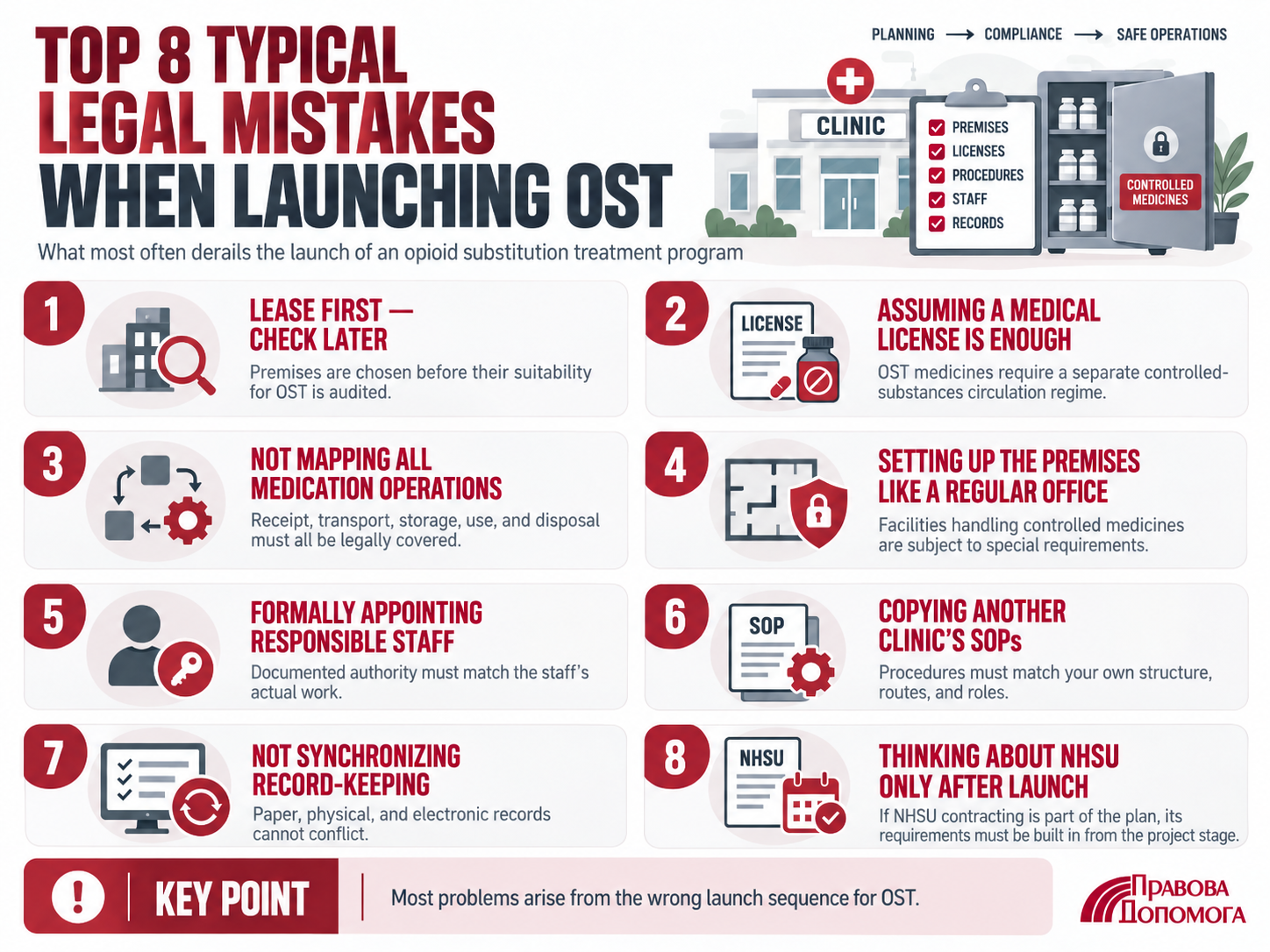
Top 8 Legal Mistakes When Launching an OST Program
In practice, most problems arise not because clinics do not want to comply with the law, but because the launch sequence is structured incorrectly.
Mistake No. 1. Leasing the Premises Before Checking Whether They Are Suitable
This is especially serious because OST involving narcotic drugs is expressly prohibited in apartment buildings. A legal audit of the property should be completed before signing a long-term lease.
Mistake No. 2. Assuming a Medical Practice License Is Enough
A medical practice license authorizes medical practice. It does not automatically authorize the storage or use of narcotic drugs. A separate licensing regime applies to those activities.
Mistake No. 3. Failing to Map Every Operation Involving the Medicine
The license and internal documents must reflect the actual process. If the facility receives, transports, stores, uses, and destroys medicines in practice, each operation must be legally covered.
Mistake No. 4. Preparing the Premises “Like an Ordinary Medical Office”
Facilities where narcotic drugs are handled are subject to special requirements. Ordinary clinic renovations do not guarantee compliance with Ministry of Internal Affairs requirements.
Mistake No. 5. Appointing Responsible Persons Only on Paper
An order appointing a responsible person is ineffective if other employees actually have access to the medicines, keys are not controlled, and operations are carried out by staff who do not understand the procedure. Formal authority and actual practice must match.
Mistake No. 6. Copying Another Clinic’s SOPs
Even a high-quality document from another medical facility may not fit your structure.
The SOP must take into account:
- the premises layout;
- the staffing model;
- suppliers;
- the specific MIS;
- the medicine-dispensing model;
- internal logistics;
- operating hours;
- allocation of functions among employees.
Mistake No. 7. Failing to Synchronize Paper, Physical, and Electronic Records
The most dangerous situation is when the physical medicine balance shows one figure, the accounting records another, and the information systems a third. For controlled medicines, such a discrepancy requires immediate investigation and documentation.
Mistake No. 8. Beginning NHSU Preparation Only After the Program Is Launched
If NHSU contracting is part of the business plan, the requirements of the relevant package should be built into the project from the outset. Otherwise, the clinic may obtain all required licenses but still fail to meet NHSU purchasing conditions.
How We Can Help
Launching an OST program requires the medical practice license, premises, National Police permit, controlled-substances license, internal documentation, eHealth workflows, and NHSU requirements to be aligned with one another.
If each issue is handled separately, the risk of ending up with a legally incompatible structure increases significantly.
Our team can support the OST launch from the initial premises review through to the facility’s actual readiness to treat patients.
We can:
- conduct a preliminary legal audit of the OST model;
- review the premises before lease or purchase;
- determine the required licenses and permits;
- review the current medical practice license and determine whether amendments are needed;
- prepare documents for medical practice licensing;
- prepare the licensing file for narcotic drugs, psychotropic substances, and precursors;
- provide legal support for preparing the premises to meet Ministry of Internal Affairs requirements;
- prepare documents for the permit to use the relevant facilities and premises;
- draft internal orders, policies, SOPs, and staff workflows;
- review procedures for accounting, storage, dispensing, write-offs, and destruction;
- prepare the patient-document package for the OST program;
- audit readiness to work in the Ukrainian eHealth system;
- assess compliance with NHSU contracting conditions;
- support preparation for contracting under the OST package;
- conduct a comprehensive pre-licensing or pre-inspection audit of the facility.
An OST launch should begin not with purchasing medicines, but with a properly designed legal architecture. That is what allows the clinic to complete licensing, work with controlled medicines, scale the program, and remain ready for regulatory oversight.
Planning to launch an OST program? Contact us so the project is structured correctly from the first attempt and without avoidable mistakes. We know the sequence that needs to work for your specific model.
Services on the topic of this material
Our publications on this matter


Our clients