

How to Open a Veterinary Inpatient Clinic: Step-by-Step Preparation
Reviews of our Clients
... our work on joint projects assured us of your high level of professionalism
Opening a veterinary inpatient facility is a logical and financially sound step in expanding any pet care business. Clients look for clinics where they can leave their pets under observation after complex surgery or for long-term treatment. However, while legal requirements for a standard veterinary office or outpatient clinic are relatively lenient, an inpatient facility involves an entirely different level of responsibility and regulatory oversight.
Animals receiving round-the-clock treatment require specialized conditions, which automatically attracts the attention of regulatory authorities. Choosing unsuitable premises, ignoring sanitary standards, or obtaining a license with errors can cost an entrepreneur fines or even lead to business closure before the first four-legged patient arrives.
Find out how to open an inpatient facility step by step without costly alterations or application refusals and start operating without fines. We will explain how to avoid conflicts with neighbours over barking and odours, and how to protect your business before it even opens.
Step 1: Start with Your Legal Status and License
Veterinary practice in Ukraine is regulated. Therefore, the entrepreneur’s first priority is to officially register the business and obtain a license for this activity. Here are the questions you will need to find answers to.
Should You Register as a Sole Proprietor or Establish an LLC to Open a Veterinary Inpatient Facility?
Your choice depends on the scale of the business and your plans for attracting partners in the future.
|
Business Structure |
Who It Is Suitable For |
Important Consideration |
|---|---|---|
|
Sole Proprietorship |
The simplest option for starting a business if you are the sole owner. |
The entrepreneur must personally have a relevant veterinary qualification. |
|
LLC |
A suitable choice if the business has several co-founders or investors. |
The LLC director does not need to have a veterinary qualification, but the company must employ qualified veterinary specialists with relevant diplomas. |
KVED Code for Registration: The main business activity for either business structure will be 75.00, “Veterinary Activities”.
What License Is Required to Operate a Veterinary Inpatient Facility?
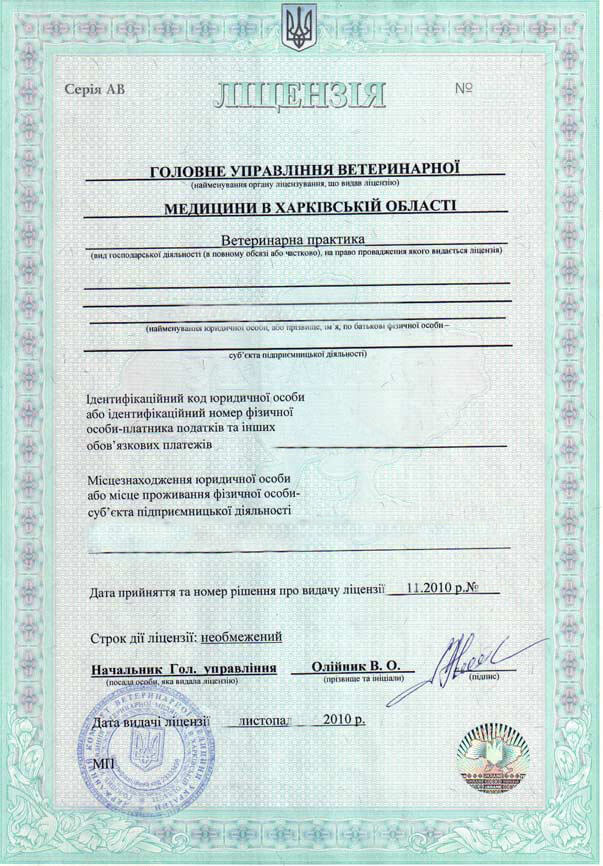
To operate a veterinary inpatient facility, you will need a veterinary practice license. It can be obtained from the State Production and Consumer Service of Ukraine (SSUFSCP).
To obtain the license, you must submit an application, information about your material and technical resources and staff, and relevant descriptions. The license is issued for an indefinite period, and a one-time fee, in the amount established by law, is payable for its issuance.
You might also like: Step-by-Step Guide to Completing the Documents for a Veterinary Practice License
Does a Veterinary Inpatient Facility Need a License for Narcotic Drugs and Psychotropic Substances?
Yes. Without this license, operating your facility may be practically impossible. Performing surgeries, providing intensive treatment, and ensuring adequate pain relief for inpatients may require the use of ketamine or other specialized medications.
Their use and storage at the clinic require a License for Activities Involving the Circulation of Narcotic Drugs, Psychotropic Substances, and Precursors, issued by the State Service of Ukraine on Medicines and Drugs Control.
This is one of the strictest types of licensing in Ukraine. Due to the stringent requirements, more than 80% of applicants who submit their documents independently receive a refusal. We take these risks off your hands and provide a turnkey licensing service, from inspecting your premises to obtaining a positive decision from the State Service of Ukraine on Medicines and Drugs Control.
Step 2: Prepare the Premises: State Building Standards and Sanitary Requirements
Choosing and fitting out premises for a veterinary inpatient facility is the stage at which entrepreneurs most often make critical mistakes. A facility where animals stay around the clock is subject to much stricter requirements for architecture, sound insulation, and ventilation than a standard outpatient veterinary clinic.
Any failure to comply with the State Building Standards (DBN) and sanitary and epidemiological regulations may result in a license application being refused. If such violations are discovered later, they may also lead to orders being issued by regulatory authorities. When selecting and preparing the premises, you will need to address the following issues.
Can You Open a Veterinary Inpatient Facility in a Residential Building?
No. Veterinary clinics that keep animals on their premises, including inpatient facilities, are prohibited from operating directly inside residential buildings. A veterinary inpatient facility must be located in a standalone building or in commercial premises designated for public use, with a separate entrance and compliance with the required distance from residential buildings.
Where Can a Veterinary Inpatient Facility Be Located?
Veterinary hospitals and inpatient facilities are subject to sanitary protection zone requirements:
- A standalone veterinary clinic building with an inpatient facility must maintain the required distance from the nearest residential building (usually at least 50 metres, depending on the number of animal beds and the specific nature of the facility).
- The local improvement regulations of the relevant settlement must also be taken into account, as they clearly establish the conditions for keeping animals for commercial purposes.
What Zones Should a Veterinary Inpatient Facility Be Divided Into?
An inpatient facility cannot simply be “a room with cages”. For both legal and functional purposes, the premises must be clearly divided into zones to prevent the spread of infections:
- Clean inpatient ward (therapeutic/surgical): For animals receiving routine treatment, recovering from surgery or injuries, and not suffering from infectious diseases.
- Infectious disease ward (isolation unit): A separate room with an isolated entrance and its own ventilation system is mandatory. Keeping infectious and non-infectious animals in the same room is a serious violation of sanitary standards.
- Exercise area (if provided): Must be fenced, have a hard surface that can be easily disinfected, and not be located directly next to the windows of residential buildings.
What Conditions Must the Veterinary Inpatient Facility Premises Meet?
In accordance with the State Building Standards (DBN) for heating, ventilation, and air conditioning, a veterinary inpatient facility must have an independent supply and exhaust ventilation system. Air from rooms where animals are kept, particularly the isolation unit, must not mix with air from the building’s general ventilation system, if the facility is part of a larger complex, or from administrative offices.
Sanitary regulations require all surfaces in the inpatient facility (floors, walls, and ceilings) to be suitable for regular wet cleaning and thorough disinfection using chemical agents and UV lamps.
How to Arrange Soundproofing and Noise Protection in a Veterinary Inpatient Facility
Barking by dogs that are stressed or recovering from anaesthesia is the main reason residents file complaints with the police and the State Production and Consumer Service of Ukraine.
Ukrainian regulations (State Sanitary Standards for Permissible Noise Levels) clearly establish permissible noise levels in residential areas, particularly at night (from 10:00 p.m. to 8:00 a.m.).
The walls, ceilings, and doors of the inpatient facility must have professional soundproofing, for example, using sound-absorbing panels, specialized doors with seals, and similar solutions. Noise generated inside the clinic must not exceed the established decibel limits outside your premises.
Related: Accessibility Report for People with Reduced Mobility

Step 3: Consider Waste Disposal and Environmental Safety
Operating a veterinary inpatient facility inevitably involves generating specific types of hazardous waste. Unlike an ordinary office or shop, you cannot simply throw used syringes, ampoules, or biological materials into a regular outdoor waste bin.
The types of waste generated by a veterinary inpatient facility include:
Household (non-hazardous) waste: Paper, cardboard medicine packaging, and office waste. This waste is collected and removed under a standard agreement with the local municipal waste management company.
Hazardous or specific waste (Group 18 02 under the National List of Waste):
- Biological waste and sharps requiring special conditions for disinfection and infection prevention (removed organs, tissue waste from surgical procedures, biological fluids, animal carcasses, as well as used needles, scalpels, and infusion sets).
- Pharmaceutical and chemical waste (expired medicines, vaccine residues, anaesthetic agents, and chemical reagents containing hazardous substances).
The law prohibits veterinary clinics from independently burning, burying, or disposing of hazardous waste. During an inspection or routine regulatory review, you may be required to provide official contracts with specialized licensed waste management companies.
What Waste Disposal Agreements Can You Enter Into?
- Agreement for the Management or Disposal of Medical/Veterinary Waste.
The contractor must be authorized to collect, transport, and dispose of sharps, used dressings, and ampoules. - Agreement for the Cremation or Disposal of Biological Waste.
The inpatient facility must have a clear procedure for cases involving the death of an animal. Burying animals within cities or forest park areas is strictly prohibited. The clinic enters into an agreement for the disposal of animal carcasses with a certified crematorium or a specialized facility, such as a private licensed animal cremation service.-
How Should Waste Be Collected at a Veterinary Inpatient Facility for Disposal?
Legal requirements oblige veterinary inpatient facilities to properly organize waste collection within their premises:
- Container labeling: Hazardous waste must be collected in special sealed bags or containers, usually yellow or red, clearly labeled “Danger: Veterinary Waste.”
- Collection of sharps: Needles and blades must be collected exclusively in puncture-resistant plastic containers with tight-fitting lids. Transferring them into bags is prohibited.
- Temporary storage: To store biological waste until collection, particularly during warmer months, the facility must be equipped with a separate dedicated refrigerator or freezer labeled “Biohazardous Waste.”
Step 4: Prepare Staff Documents and Internal Documentation
There are clear requirements for individuals authorized to provide veterinary care to animals at an inpatient facility:
- Specialist or master’s degree: All individuals who directly provide veterinary services and work at the facility, whether in a day-care or 24-hour inpatient setting, must have the relevant educational qualification in Veterinary Medicine.
- Proof of qualifications: Veterinary professionals must complete continuing professional development at least once every five years, as confirmed by the relevant certificate.
What If I Employ Assistants and Interns at My Veterinary Inpatient Facility?
Junior staff members (assistants and veterinary paramedics) are not required to hold a full veterinary degree. For example, they may still be students at veterinary faculties. They are authorized to perform procedures only under the supervision and at the direction of a qualified veterinarian. Leaving the inpatient facility in the care of an assistant without a responsible veterinarian present constitutes a serious legal violation.
How Should Staff Documentation Be Maintained at a Veterinary Inpatient Facility?
All facility employees must be formally employed under an employment agreement or contract.
Working at an inpatient facility involves increased occupational risks, so the clinic must develop and implement the following:
- Occupational Health and Safety Training Log: Working with aggressive or frightened animals and using X-ray machines or UV lamps require strict compliance with safety rules.
- Job Descriptions: Each employee, from the cleaner responsible for the infectious disease unit to the head of the inpatient facility, must have clearly defined duties, areas of responsibility, and procedures to follow in emergency situations.
- Medical Records (Health Books): Veterinary clinic staff must undergo regular medical examinations because of the risk of contracting zoonotic diseases, which can spread between animals and humans, such as rabies, leptospirosis, and dermatophytosis. Staff members must also be vaccinated against rabies.
What Internal Documentation Must a Veterinary Inpatient Facility Maintain?
To successfully pass inspections by the State Production and Consumer Service of Ukraine (SSUFSCP), a veterinary inpatient facility must maintain and retain the following records:
- Register of Sick Animals (Form No. 1-Vet): The primary patient record, containing the owner's details, medical history, diagnosis, and course of treatment.
- Register of Treatment and Preventive Measures: Records of all procedures, surgeries, and prescriptions.
- Register of Biological Products, Vaccines, and Disinfectants: The clinic must keep records of the use of every dose.
- Intensive Care Records (Inpatient Medical Charts): Internal records documenting hourly monitoring of vital signs, such as temperature and pulse, and the administration of medications.
Legal advice: You should have an approved internal protocol setting out how staff must respond to aggressive animal behavior. If a dog bites a veterinarian or assistant, signed safety training records and an established protocol can help protect the business owner against allegations of occupational health and safety violations.
You might also like: Requirements for Staff to Obtain a Veterinary Practice License
If You Do Not Want to Handle Everything Yourself
Opening a veterinary inpatient facility is a complex legal challenge in which every mistake in documentation or premises planning costs time and money. You do not have to navigate this process blindly or put your investment at risk.
Our company specializes in providing legal support to animal-related businesses and is ready to handle all regulatory matters on a turnkey basis:
- Premises audit before purchase or lease: We will check whether the property complies with State Building Standards (DBN) and sanitary protection zone requirements, and assess the risk of potential disputes with neighbors.
- Business Registration and KVED Code Selection: We will quickly register a sole proprietorship or LLC and select the most suitable tax system.
- Obtaining a veterinary practice license: We will prepare the complete set of documents and submit the application to the State Production and Consumer Service of Ukraine.
- Obtaining a license for activities involving narcotic drugs (State Service of Ukraine on Medicines and Drugs Control): We will help ensure that the premises and safe meet the requirements of the Ministry of Internal Affairs, obtain the necessary certificates, and secure police authorization for handling controlled substances.
- Preparation of internal documentation: We will create all necessary documents from scratch, including inpatient admission agreements, informed consent forms for animal owners, liability waiver forms, job descriptions, and record-keeping logs.
Call our free hotline or complete the inquiry form on our website to receive a personalized roadmap for launching your veterinary inpatient facility.
Services on the topic of this material
Our publications on this matter


Our clients
We are ready to help you!
Contact us by mail [email protected] or by filling out the form:
Other publications by the author
A medical license alone is not enough to launch opioid agonist therapy in a private clinic. The clinic must coordinate controlled-drug licensing, premises, police approval, medication records, eHealth, and NHSU requirements where applicable.

Adding a pediatrician to the service list is not enough. A pediatric service line changes licensing, physician qualification, consent, medical data, and front-desk procedures for working with minors.
A private clinic using supplied blood components for transfusion does not follow the same licensing route as a blood collection facility. It still needs a hospital blood bank, transfusion immunology testing, hemovigilance, and traceability.

School psychologists, speech therapists, rehabilitation specialists, and massage therapists do not always require medical licensing. The key issue is whether their actual work is educational or corrective, or amounts to medical care or rehabilitation.
Our other authors