
How to Expand a Veterinary Clinic Network: Own Locations or Franchise

Reviews of our Clients
... our work on joint projects assured us of your high level of professionalism
Choosing between opening your own veterinary clinic branches and launching a franchise is not simply a matter of marketing or investment size. From a legal perspective, these are two fundamentally different models of liability, veterinary practice licensing, and business control.
Own locations provide maximum control but also maximum legal responsibility. You remain the sole business entity. All new locations operate under your existing license, while the company itself remains responsible to the State Service of Ukraine on Food Safety and Consumer Protection (SSUFSCP) for any violation at any branch.
A franchise enables faster scaling while reducing direct licensing exposure. The franchisee is a separate business entity and must obtain its own veterinary practice license. Ukrainian law does not allow a franchisee to operate “under the franchisor’s license.” Under this model, you are not directly responsible to the state for the partner’s operational mistakes, but your brand reputation is at risk unless the agreement establishes strict legal standards for the network.
Which option is more advantageous and safer?
If your goal is complete control over service quality and personnel, opening your own locations is the better fit. If your priority is rapid expansion without direct responsibility for operational mistakes at individual locations, franchising may be more suitable.
This article explains the practical aspects of both models: how to register new locations correctly, how to avoid licensing mistakes with franchisees, and what the network’s legal standards must include before the first partner-operated veterinary clinic is launched.
Own Locations or a Franchise: How the Two Veterinary Network Expansion Models Differ
When Is It Better to Open Your Own Veterinary Clinics?
The own-location model generally works best when the business has resources not only for renovations and equipment, but also for centralized management of several clinics.
- You want to retain full control. Management sets the staffing policy, clinical protocols, service standards, and operating rules directly.
- You have sufficient capital to open new locations. The network owner bears all costs for premises, equipment, personnel, marketing, and launch.
- You have a strong operations team. As the number of locations grows, so does the workload related to management, HR, finance, procurement, and legal compliance.
- You are not ready to entrust the brand to an independent business. This is particularly important for veterinary clinics, where reputation is directly linked to the quality of medical care and the work of individual veterinarians.
When Should You Consider a Veterinary Clinic Franchise?
Franchising makes sense not when the owner simply wants to “sell the brand,” but when there is already a business model that another entrepreneur can reproduce under clear rules.
- The business model has already been tested. You understand the economics of a location, staffing requirements, the service mix, equipment needs, and operating processes.
- The processes can be standardized. You must be able to provide the partner with not only a logo, but also clear launch and day-to-day operating rules.
- You need faster geographic expansion. Partners finance their own locations and can develop the network in several cities at the same time.
- You are prepared to invest in franchisee oversight. A franchise requires regular audits, training, standards checks, contractual discipline, and trademark protection.
Can You Combine Company-Owned Veterinary Clinics and a Franchise?
Yes. A hybrid model is often practical for a veterinary network: flagship clinics, training sites, and the most complex medical areas remain under the owner’s direct management, while standardized regional locations are opened with partners. This structure makes it possible to retain control over the core of the brand while accelerating expansion.
However, a hybrid model requires a clear separation of legal and operational responsibilities: which standards apply across the entire network, who is responsible for licensing each location, who owns the rights to the brand and content, how quality control works, and what happens when a partner exits the network.
Related: How to Open a Veterinary Inpatient Facility: Step-by-Step Preparation
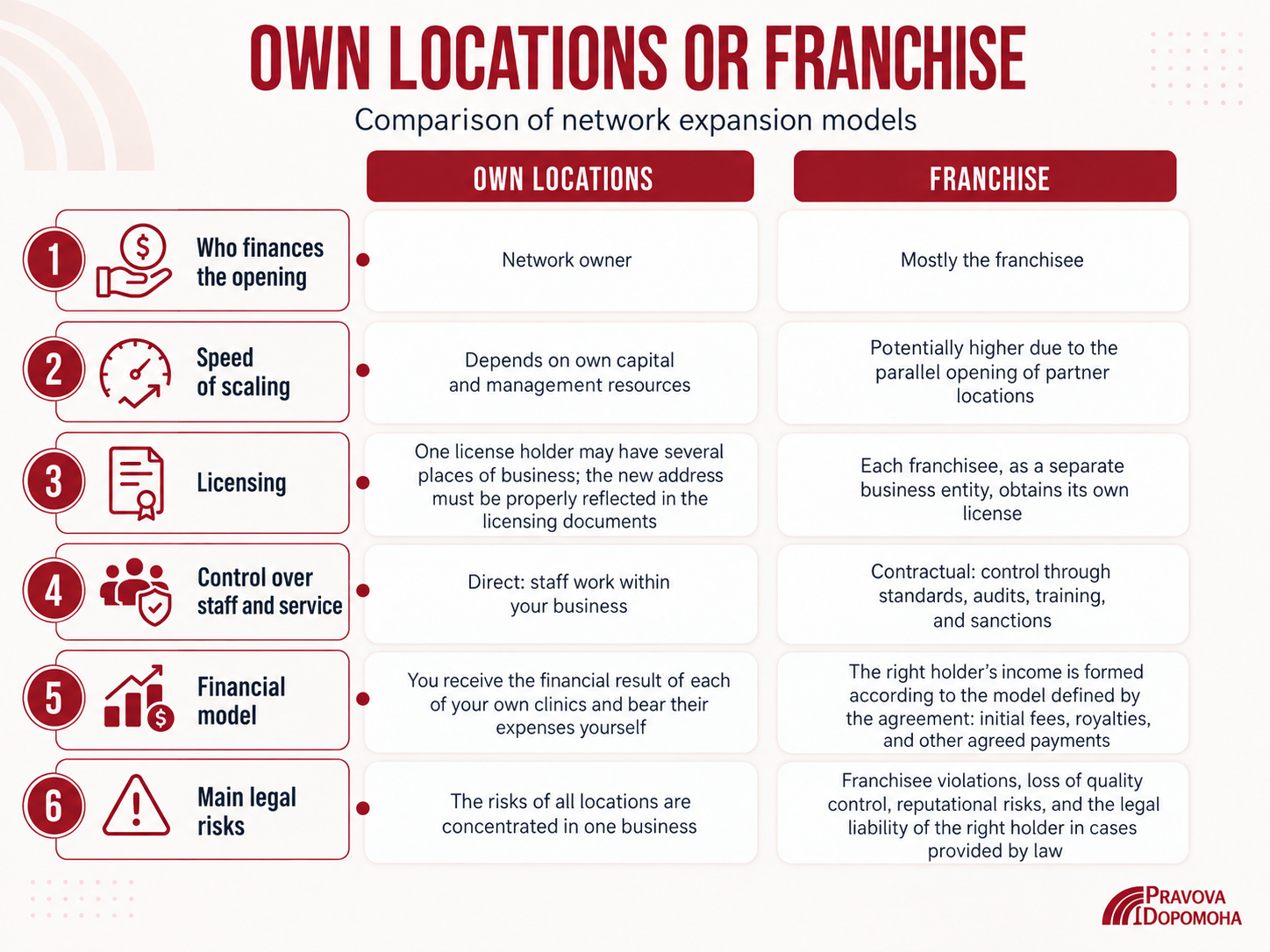
Legal Differences Between a Company-Owned Network and a Franchise
When deciding how to expand a veterinary network, marketing and capital investment are only part of the decision. The legal model determines who will hold the license, who will be responsible for personnel and premises, how directly you can control quality, and which risks will remain with your business.
From a legal perspective, the key difference between company-owned locations and a franchise is the identity of the business entity and the licensing model.
Company-Owned Locations: One Business Entity and Multiple Places of Business
When you open another clinic of your own—whether as a branch or an additional unit—the business remains within your existing legal entity (LLC) or individual entrepreneur structure.
- Business entity: The new location belongs to the same company. One legal entity operates the entire network of locations.
- Licensing model: You do not need to obtain a new veterinary practice license from scratch. You continue operating under the existing license, but must update the licensing file by notifying the SSUFSCP of the new place of business.
- Liability: You remain fully responsible for compliance with licensing conditions, sanitary requirements, and personnel requirements at the new location.
Franchising: A Separate Business Entity and the Franchisee’s Own License
The franchise model has a completely different legal architecture. The franchisee is an independent business entity (a separate LLC or individual entrepreneur) that acquires the right to operate under your brand and in accordance with your standards:
- Business entity: The franchisee is a separate legal entity. Under a commercial concession (franchise) agreement, the franchisor grants the franchisee the right to use intellectual property, including the trademark, operating specifications, and service standards.
- Licensing model: The franchisee cannot operate under the franchisor’s license. Because it is a separate business entity, the franchisee must independently complete the licensing process and obtain its own veterinary practice license for its legal entity or individual entrepreneur.
- Liability: The franchisee, as the license holder, bears full responsibility for compliance with licensing conditions, sanitary requirements, and interactions with regulatory authorities.
However, the franchisor may bear subsidiary liability to clients for the quality of veterinary services provided. This means that if a patient is harmed or treatment is substandard, the client may also bring claims against the brand owner. This is why quality control in a veterinary franchise is not merely a reputational issue—it is also a direct legal mechanism for protecting the franchisor against financial claims.
The fundamental distinction is therefore straightforward: a company-owned network has one license holder operating at multiple addresses, while a franchise network is an alliance of independent license holders operating under one brand. This distinction determines how documents are prepared, premises are set up, and legal risks are allocated.
For you, this means a different approach to risk management. In a company-owned network, control and liability are centralized within your business. In a franchise, operational responsibility is distributed among independent license holders, so reduced direct control must be offset by the agreement, network standards, audit rights, and rules for using the brand.
How to Open Another Veterinary Clinic Within an Existing Business
When scaling your own veterinary business, the first legal question is whether you need to register a new LLC or individual entrepreneur, or create a separate formal branch for each new location.
The short answer is no. This is not mandatory.
Legally, launching another location within the same business is simpler than creating a separate business entity. The new clinic remains part of your company or individual entrepreneur operation. From a licensing standpoint, however, you cannot simply lease premises, install a sign, and begin seeing patients.
An Additional Place of Business: What Does This Mean?
Veterinary practice licensing uses an important concept: the “place of business.” When your original license was issued, the SSUFSCP entered the address of your first clinic or office in the licensing register. Opening a second, third, or tenth location means that your company acquires additional places of business.
Key rule: You do not obtain a new license for every branch. Instead, you expand your existing licensing file by submitting information on the new places of business to the licensing authority.
The benefit is therefore not that lower requirements apply to the second or tenth location, but that you do not need to create a separate license holder. The location itself must still be prepared as an independent place of business.
How Do You Add a New Location to the Licensing File?
Launching a new location within the existing business involves updating the licensing register. The process can be summarized in three steps.
- Prepare the new location: Formalize rights to the premises (lease or ownership), provide the required facilities and equipment, and hire qualified veterinary personnel for that specific address.
- Submit notice of the changes: A package of documents for the new place of business is submitted to the SSUFSCP.
- Update the register: After reviewing the documents, the licensing authority makes a decision regarding the expansion of veterinary practice to the new address, which should be reflected in the licensing records and register.
What Requirements Must Each New Veterinary Network Location Meet?
A common mistake is to assume that obtaining a license for the first or “main” clinic automatically allows subsequent locations to open under a simplified procedure. For the regulatory authority, each place of business is a separate object of review.
Compliance of the main clinic with licensing conditions does not exempt the new location from separate preparation. Before spending money on rent, renovations, and equipment, you should verify the premises, facilities and equipment, and staffing model. Each new place of veterinary practice must independently meet the applicable regulatory requirements.
Premises
Even if the location is a small branch within your network, the premises must meet the basic standards.
- Format and floor area: Depending on the selected format (veterinary clinic, outpatient facility, or veterinary office), the premises must include the appropriate functional areas, such as reception, operating room, and waiting area.
- Title documents: The lease or ownership documents must be issued to the legal entity or individual entrepreneur that holds the license.
- Sanitary and construction requirements: Appropriate utilities and infrastructure must be available, including water supply, ventilation, and lighting, along with disinfectable surfaces and compliance with location requirements, including those related to residential buildings.
Facilities and Equipment
Equipment cannot simply be “shared” among several locations on paper. The licensing authority assesses the facilities and equipment for each address separately:
- Independent equipment set: The new location must have a complete set of equipment, instruments, and veterinary medicines required for the services it declares.
- Devices and verification: Measuring and diagnostic equipment, including scales, sterilizers, and X-ray equipment, must be properly documented, have the required technical documentation, and undergo applicable verification or calibration for the relevant location.
- Storage of veterinary medicines: Each location must have appropriate storage conditions for veterinary medicines, including dedicated cabinets and refrigeration equipment with temperature monitoring.
Personnel at the New Location
Personnel requirements under the licensing rules are tied to the specific place of business:
- Veterinarians working at the new location must have the appropriate higher education, valid continuing professional development or qualification documents, and formal employment arrangements.
- The information submitted to the SSUFSCP specifies the personnel assigned to each address. You cannot list the same veterinarian as the primary staffing resource for five different clinics simultaneously if this would conflict with working-time requirements.
Key takeaway: Each new network location is an autonomous site for which a separate set of information on facilities, equipment, and personnel must be prepared before the licensing file is updated.
If you plan to open locations on a recurring basis, it makes sense to standardize this preparation. A uniform legal checklist for premises, facilities and equipment, personnel, and licensing documents reduces the number of decisions that must be rebuilt from scratch each time.
If you need the complete process for preparing a separate new location—from choosing the legal form and premises to equipment, staffing, and licensing—we have explained separately how to open a veterinary clinic in Ukraine in 2026.

How Does a Veterinary Franchise Work From a Licensing Perspective?
Because the franchisee is a separate business entity and independent license holder, three matters must be clearly separated before launching a partner location: what the franchisor transfers under the agreement, what the franchisee is responsible for, and which quality-control mechanisms remain with the brand owner.
A franchise gives the partner the right to operate under the brand and network standards, but does not transfer the franchisor’s license. Each partner clinic must therefore be licensed in the name of the business entity that will actually provide the veterinary services.
Who Actually Provides the Services, and Who Must Hold the License?
The actual provider of veterinary services at a franchise location is the franchisee—a separate legal entity or individual entrepreneur. The franchisee enters into contracts with clients, receives payments, and employs veterinarians. Accordingly, the franchisee must be the license holder and must submit the licensing package to the SSUFSCP.
Can a Franchisee Operate “Under the Franchisor’s License”?
No. Under the Law of Ukraine “On Licensing of Types of Economic Activity,” a license is issued to a specific business entity and cannot be transferred to another person. Attempting to launch a franchise location and provide services under the brand owner’s license is treated as unlicensed business activity.
For the franchisee, this may result in sanctions under Article 164 of the Code of Ukraine on Administrative Offenses:
- A fine of UAH 17,000 to UAH 34,000.
- Confiscation of veterinary equipment, medicines, and all income received from the activity.
- For a repeated violation within one year—a fine of UAH 34,000 to UAH 85,000, with confiscation of facilities and equipment.
What CAN and CANNOT the Franchisor Transfer Under a Franchise Agreement?
A commercial concession (franchise) agreement provides for a clear allocation of assets. The following may be transferred under the agreement:
- the trademark, logo, and brand guidelines;
- service standards, clinical protocols, and operating procedures;
- software, CRM systems, and access to the knowledge base;
- technical specifications and operating guidelines for premises and equipment.
At the same time, a franchise does not replace documents that the franchisee must obtain or execute independently. In particular, the following are NOT transferred under the agreement:
- the veterinary practice license;
- employment agreements with personnel, since veterinarians are employed directly by the franchisee;
- title or lease documents for the premises and documents relating to facilities and equipment.
Who Is Responsible for Compliance of the Premises, Facilities, Equipment, and Personnel?
From the regulator’s perspective, the franchisee, as the independent license holder, bears full legal responsibility. If, during a scheduled or unscheduled inspection, the SSUFSCP identifies noncompliance of the premises with sanitary requirements, missing mandatory diagnostic equipment, or insufficient qualifications of veterinarians, the consequences fall directly on the franchisee.
Such violations may put the continued operation of the location at risk:
- Order to remedy violations: The license holder is given strict deadlines to correct the deficiencies.
- Suspension of the license: If the violations are not corrected on time, the regulator may suspend the license, effectively halting the clinic’s operations and preventing it from seeing patients.
- Revocation of the license: If the orders are not complied with, the licensing authority may ultimately revoke the license.
Important: For you as the brand owner, this does not mean there is no risk. A partner’s actions may affect the reputation of the entire network, so the agreement and network standards must include oversight and response mechanisms.
What Should the Franchisor Include in the Requirements for a Future Veterinary Clinic?
In a veterinary franchise, the agreement alone is not enough. To protect the brand from reputational and legal risks, the franchisor should develop a Network Legal Standard (Launch Standard). This internal policy document sets out the requirements for a partner location before it submits its licensing documents.
The franchisor’s requirements for a future clinic should cover six key areas:
1. Permitted type of veterinary facility. The franchisor should clearly define the format in which a partner location may operate, such as a veterinary office, veterinary clinic, or 24-hour center. The selected format determines the minimum service range the franchisee must provide and the scope of permitting documentation required.
2. Legal and technical requirements for the premises. The network standard should specify not only design requirements but also strict regulatory parameters:
- Zoning and floor area: Minimum areas for the consultation room, treatment room, operating room, and waiting area.
- Utilities and engineering systems: Requirements for independent ventilation, water supply to each work area, and electrical capacity, particularly for X-ray or ultrasound equipment.
- Legal requirements for the premises: The required lease term, for example at least 3–5 years, and the right to install facade signage and external equipment.
3. Mandatory equipment and facilities. The franchisor prepares a specification of the required facilities and equipment from which the franchisee may not deviate. This includes:
- a list of mandatory diagnostic and surgical equipment, including specified models or brands;
- requirements for certificates of conformity and verification or calibration of equipment before the licensing documents are submitted;
- rules for storing veterinary medicines, including dedicated refrigerators and secure cabinets for controlled medicines.
4. Requirements for veterinarians and personnel. The franchisor defines qualification criteria for personnel working under the brand:
- education and minimum professional experience requirements for the chief veterinarian and specialized personnel;
- mandatory valid continuing professional development or qualification certificates;
- completion of internal assessment or training at the franchisor’s main clinics before personnel are authorized to work.
5. Review of the licensing package. Although the franchisee obtains its own license for its own legal entity, the franchisor should reserve the right in the standard to review the information in advance. The franchisee must coordinate the package submitted to the SSUFSCP with the franchisor’s legal team to reduce the risk of refusals or licensing violations.
6. Who checks whether the location is ready to open, and how. The standard should establish a pre-opening audit procedure. The location does not open automatically once renovations are complete. The franchisor appoints a responsible person, such as a network inspector or auditor, to conduct an on-site or checklist-based review against criteria such as:
- full compliance of renovations and engineering systems with the brand guidelines and sanitary requirements;
- availability of all declared equipment in working condition;
- personnel readiness, including completed testing and training.
Related: Franchise Agreement: What to Check Before Buying a Franchise
Key Legal Risks of the Two Models
After choosing a scaling model, it is important to assess not only the licensing procedure, but also where the risks are concentrated and which tools can be used to control them.
Risks of a company-owned network:
- a violation at any location is a violation by the license holder itself, so problems at one site directly affect the entire business;
- as the number of clinics increases, so does the staffing, documentation, and management workload, increasing the risk of errors in licensing and operating documentation;
- poor choice of premises, inadequate equipment, or mistakes in staffing preparation may require additional expenditure even before the location opens;
- without a uniform opening standard, each new location must effectively be reviewed again against the same legal criteria.
Risks of a franchise network:
- a partner may formally comply with licensing requirements but deviate from internal network standards, affecting service quality and brand perception;
- a weak agreement or unclear standards make it harder to audit the partner location, apply contractual remedies, terminate the right to use the brand, and manage the franchisee’s exit from the network;
- if rights to the trademark and other intellectual property are not properly documented or protected, it becomes more difficult for the franchisor to control use of the brand after a dispute or termination of the relationship;
- under a commercial concession agreement, the rights holder may, in cases prescribed by law, bear liability for claims related to the quality of services provided by the user.
The legal risk therefore differs in nature between the two models. In a company-owned network, risk is concentrated within one business. In a franchise network, it depends to a significant extent on how precisely the rules for working with independent partners and the oversight mechanisms are documented.
Which Model Is Better for Scaling a Veterinary Clinic: Company-Owned Locations or a Franchise?
When comparing network expansion models, the amount of investment and royalties is only part of the decision. From a legal perspective, the key issue is the balance between control, speed of growth, and the risks that remain within your business or shift to partners.
To make the decision, compare the two models across the key legal criteria:
|
Company-Owned Locations (Expansion of Existing License) |
Franchising (Alliance of License Holders) |
|
|
Control over the license |
Direct and complete. You are the sole license holder. Any changes are made directly in your licensing file. |
Indirect. Each location has its own license. You do not directly manage the partner’s licensing file. |
|
Control over personnel |
Direct. Veterinarians and other personnel are your employees under employment agreements. You exercise full disciplinary and HR control. |
Limited. Personnel are hired by the franchisee. The franchisor can influence staffing only through network standards and contractual remedies. |
|
Legal liability |
Full. The company is responsible to the SSUFSCP and clients for violations at any branch. |
Allocated. The franchisee is independently responsible for compliance with licensing requirements and operation of its location. At the same time, the rights holder may incur forms of liability prescribed by law, as well as reputational risks. |
|
Speed of opening new locations |
Generally slower. Implementation depends on your own capital and management capacity. You must allocate internal time and resources to complete all licensing procedures and prepare the required information. |
Potentially faster. The franchisee prepares the premises and completes licensing in parallel using the franchisor’s established process. |
|
Compliance control |
Direct operational control. Regular internal monitoring and internal audits take place within one organization. |
Contractual control. Implemented through scheduled or surprise inspections, inspection reports, and the right to terminate the commercial concession agreement. |
After comparing the two models, the central question is not only which one makes it possible to open new locations faster or at lower cost, but also which system of control and responsibility you are prepared to maintain across a growing network.
How to Scale a Veterinary Network Without Licensing Risks: Legal Support
Whether you are opening a second, fifth, or twentieth location, the legal task is no longer limited to preparing licensing documents once. You need one consistent system: who holds the license at each location, how the premises and personnel are documented, which standards are mandatory, who owns the brand and know-how, and how partner locations are monitored.
At Pravova Dopomoga, you can obtain advice on a specific issue or comprehensive legal support for scaling a veterinary practice—from adding a new address under the existing licensing model to legally structuring a franchise and preparing network standards.
Depending on your needs, we can assist with the following:
- Legal scaling model. We compare the legal implications of company-owned locations, franchising, and a hybrid format, and help structure the selected model with due regard to licensing, control, and allocation of responsibility.
- Network licensing structure. We determine which addresses operate under the existing license holder, where a separate business entity is required, what information must be added to the licensing file, and in what sequence new locations should be prepared.
- Adding new places of business. We review premises and lease agreements, facilities and equipment, personnel, and prepare the information required for a new address.
- Preparing company-owned and partner locations for launch. We conduct a legal readiness review of the location, documentation, staffing model, and licensing package before submission to the licensing authority.
- Legal structuring of the franchise. We prepare the contractual model, brand-use rules, launch standard, mechanisms for auditing and controlling partner locations, and exit terms for franchisees.
From adding a new address to structuring the legal model for an entire network or franchise, contact us. Call our toll-free number or submit an online request on the website.
Learn more about our veterinary practice licensing service here.
Learn more about legal support for veterinary clinics here.
Services on the topic of this material
Our publications on this matter


Our clients