
How to Open a Private Clinic in Ukraine in 2026: From Registration to Medical Licensing
Cost of services:
Reviews of our Clients
…we can confidently recommend the lawyers of Law firm «Pravova dopomoga» as reliable legal partners on the matters of medical practice licensing and other procedures related to the Ministry of Health of Ukraine.
... Having used the services of the Law Firm "Pravova dopomoga", we managed to solve our problems, as well as found a qualified and reliable partner.
Opening a clinic is a demanding legal process in which every mistake is costly. Unsuitable premises, equipment without certificates, or a prospective medical director who lacks the required qualifications can stall a project at the licensing stage. The investor ends up paying months of rent while the business launch is postponed indefinitely.
We explain how to open a private clinic in Ukraine, covering the practical steps from registering a legal entity to obtaining a license from the Ministry of Health of Ukraine (MOH), and show you how to avoid the main regulatory pitfalls.
Related reading: Opening an Operating Suite: Requirements for Premises, Equipment, and Staff
Step 1: Business Registration and Choice of Legal Structure
The first step in setting up a medical business is choosing its legal structure. This choice determines the scale of the clinic's operations, its management structure, and its tax options.
In Ukraine, there are two main options for opening a medical practice: operating as a sole proprietor (FOP) or establishing a legal entity, most commonly a limited liability company (LLC). So, which should you choose: a sole proprietorship or an LLC?
Who Should Choose a Sole Proprietorship?
This is an ideal option for opening a private practice for a single doctor, such as a dentist, psychotherapist, cosmetologist, or gynecologist.
An important detail: Previously, the law required sole proprietors to have a medical degree to obtain a license. Now, a person without a medical degree can register as a sole proprietor and obtain a license to practice medicine, provided they hire qualified medical staff.
Limitations: Sole proprietors usually choose the simplified tax system, such as Group 2 or Group 3, which limits annual revenue and the number of employees (no more than 10 for Group 2). This significantly limits the potential to expand into a full-service multidisciplinary medical center.
Who Should Choose an LLC?
This is the right choice if you plan to launch a multidisciplinary clinic, a diagnostic center, or a network of healthcare facilities, or if the business will have several founding partners or foreign investors.
Advantages: There are no limits on the number of employees or default revenue limits under the general tax system. Anyone can be a founder, regardless of whether they have a medical degree, because a medical director is hired to manage clinical operations.
Liability: LLC founders are liable for the company's obligations only up to the value of their shares in its charter capital, unlike sole proprietors, who are liable with all their personal assets.
KVED Codes for a Medical Clinic: Which Codes to Choose in 2026
When registering a business, you must specify the correct KVED codes (Ukrainian classification of economic activities). Division 86 is the key division for healthcare. Depending on your clinic's services, you will need to select the following codes:
|
KVED Code |
Business Activity |
Who It Applies To |
|---|---|---|
|
86.21 |
General medical practice activities |
General practitioners (family doctors, internal medicine physicians, and pediatricians), including those working in outpatient clinics and private practices. |
|
86.22 |
Specialized medical practice activities |
Specialist consultations and specialized surgical procedures (gynecology, cardiology, dermatology and venereology, ophthalmology, etc.). |
|
86.23 |
Dental practice activities |
Dentists of all specialties, orthodontists, oral surgery, and operating rooms in dental clinics. |
|
86.90 |
Other human health activities |
Physiotherapists, nurses, midwives, laboratories, massage therapists, and other professionals without a higher medical degree. |
If your clinic offers several types of services or you plan to expand in the future, you can specify several KVED codes at once, designating one as the primary code.
Step 2: Clinic Premises Requirements Under DBN V.2.2-10:2022
Mistakes at this stage are the most expensive: if you invest in costly renovations of premises that do not comply with State Building Codes DBN V.2.2-10:2022 “Healthcare Facilities,” the MOH will simply refuse to issue a license.
If you are still looking for premises, our specialists will help refine your search and explain exactly what to look for. If you have already found your ideal premises, we can check them for compliance with MOH requirements.
Accessibility of the Premises
Ukrainian law requires healthcare facilities to be accessible to people with limited mobility. You cannot obtain a medical practice license without official confirmation of barrier-free access. This requires a special accessibility report (certificate) for the facility, issued by a certified architect or a building inspection expert.
The expert carefully assesses every inch of the space:
- Entrance area: A ramp with the correct slope and handrails on both sides, or a special lift at the entrance door.
- Doorways and thresholds: All doors along the patient's route, including those to consultation rooms and restrooms, must be at least 0.9 meters wide, and thresholds must be no higher than 2 cm.
- Interior areas: Any steps inside the premises must have an alternative route via a ramp or elevator.
- Accessible restroom: A spacious restroom is mandatory, equipped with support rails, fold-down fixtures, an assistance call button, and a sink at the correct height, with enough space for a wheelchair user to turn freely.
Obtaining an accessibility report for the premises is a complex engineering and legal process. Our company handles this entire stage for you. We arrange the accessibility certificate from start to finish, from an architect's initial assessment of your premises to the issuance of the official document, which will pass MOH review without objections.
Key Building Code Requirements for Medical Premises
When viewing potential premises to rent or buy, disregard real estate agents' assurances that they are “suitable for medical use” and check the following yourself:
- Ceiling height: The ceiling height in doctors' consultation rooms must be at least 2.6–2.8 meters, depending on the specialty and equipment. Ceilings that are too low prevent the installation of adequate ventilation and certain equipment.
- Utilities (water and sewerage): Every doctor's consultation room must have a sink with hot and cold running water.
- Ventilation and air conditioning: Operating rooms, treatment rooms, and certain specialist rooms require a separate mechanical supply and exhaust ventilation system with air filtration, which must not be connected to the building's general ventilation system.
- Finishing materials: Walls, ceilings, and floors in consultation and treatment rooms must have smooth surfaces that withstand regular washing and chemical disinfection.
- Basic Requirements for the Layout of a Healthcare Facility
You cannot open a clinic consisting solely of a doctor's consultation room. Even the smallest medical center must have a clearly defined layout:
- Entrance and reception areas: An entrance vestibule, a coatroom or space for patients' clothing, and a waiting/reception area.
- Restrooms: Separate restrooms for patients, with accessibility provisions, and for staff.
- Ancillary rooms: A staff break and dining room, a storage room for cleaning equipment, and an area or containers for temporary medical waste storage.
Calculating the Required Floor Area for Doctors' Rooms
As a general rule under the building codes, a doctor's room used for consultations must have a floor area of at least 12 sq m (10 sq m for reconstruction projects). This is the basic standard for most specialists, including internal medicine physicians, pediatricians, and family doctors.
However, these figures vary depending on the facility's activities and medical specialties, as the technical requirements for equipment play a significant role:
- Dental rooms: The minimum floor area for one dental chair is 16 sq m (14 sq m for reconstruction projects).
- Diagnostic equipment rooms: For ultrasound, ECG, endoscopy, or functional diagnostics rooms, the required area is calculated individually, taking into account the dimensions of the medical equipment and the space around it that the doctor needs to perform procedures. It generally starts at 20–25 sq m.
- Operating rooms: Rooms used for invasive procedures in surgery, gynecology, or urology require more space, starting at 30–42 sq m.
If several doctors will work in one room at the same time, such as a room with several dental chairs or workstations for two consulting physicians, the basic floor area is insufficient. It must increase proportionately for each additional doctor's workstation. In dentistry, for example, each additional dental unit requires another 7–10 sq m.
We will help calculate the required dimensions of your premises based on your plan and MOH requirements.
Step 3: Equipment Lists and Clinic Equipment Requirements
The facilities and equipment in each room are determined by regulations issued by the MOH, rather than at the clinic owner's discretion. The main document is the Model Equipment List for the specific medical care profile.
The equipment list is a detailed inventory of the mandatory medical equipment, devices, instruments, and even furniture that must be present in a room for a doctor of a particular specialty to see patients legally.
When completing the Statement on the Condition of the Facilities and Equipment and Available Staff (the Statement) for the MOH, you must itemize the equipment in each room, specifying manufacturers, models, and production dates. If the MOH finds that your treatment room lacks a defibrillator or a cabinet for sterile instruments required by the equipment list, your license application will be denied.
An important point: All measuring instruments, including blood pressure monitors, electrocardiographs, scales, thermometers, and laboratory analyzers, must have valid calibration (verification) certificates for legally regulated measuring instruments. This verification must be performed once a year.

Step 4: Medical Director and Clinic Staffing Requirements
The MOH sets requirements for both clinic staff, from doctors to junior staff, and management positions at these facilities. Here are the most common questions that arise when planning staffing for a private clinic, along with how to address them.
Who Can Manage a Clinic? The Two-Part Management Model
Ukraine has a clear division of management responsibilities in healthcare facilities. If you are opening a multidisciplinary clinic as an LLC, you must have two management positions:
CEO (general director): This senior executive is responsible for finance, marketing, business operations, and the company's overall development. The position may be held by an investor or a professional manager without a medical degree. A master's degree, for example in “Management and Administration” or “Law,” is sufficient for this position.
Medical director: This is the key person for licensing purposes, responsible exclusively for the quality of clinical care. The state imposes strict qualification requirements for this position:
- Higher medical education: a master's or specialist degree in “Medicine” is required.
- Specialization in “Healthcare Organization and Management”: the relevant certificate is required.
- A certificate awarding or confirming a qualification category (if applicable)
- If you register your medical business as a sole proprietor, you can manage your medical practice yourself. In this case, you do not need to establish CEO or medical director positions.
Requirements for Doctors and Nursing Staff
Every doctor you hire at the clinic must have a complete set of professional credentials in order. For the license application, you will need the following for each doctor:
- A diploma confirming higher medical education;
- A specialist physician certificate in the specific specialty for which you are licensing the room, such as “Ultrasound Diagnostics,” “Obstetrics and Gynecology,” or “Therapeutic Dentistry”;
- A certificate awarding or confirming a qualification category, if applicable;
- Evidence of continuing professional development (CPD): doctors must earn at least 50 CPD points each year through conferences, webinars, and courses.
Step 5: Obtaining a License from the MOH
An MOH license is the state's official authorization to start your medical practice. You should proceed to this stage only when you are confident that your premises and staff meet all MOH requirements.
What Documents Do You Need to Prepare?
License application: An official application in the prescribed form, specifying the company or sole proprietor's details, the medical specialties applied for, and the locations where services will be provided;
Statement on the Condition of the Facilities and Equipment and Available Staff: A detailed document in which you describe every aspect of your future clinic;
Inventories of documents in two copies.
The Statement must specify the following in detail:
- Details of the accessibility report (certificate) confirming that the premises are accessible to people with limited mobility;
- Details of the medical waste management contract;
- A list of all rooms, specifying their intended use and exact floor area in square meters;
- A complete list of medical equipment, including name, manufacturer, model, and year of manufacture;
- Information about the facility's structure and staff qualifications, including diplomas, certificates, qualification categories, and the medical director's work experience.
Submission Methods and Review Timelines
You can submit documents to the MOH in several ways:
- Electronically through the Electronic Services Portal (updated e-Licensing functionality).
- By mail with an inventory of enclosures.
- In person through the MOH Single Window.
By law, the licensing commission has 10 business days from the date the application is registered with the MOH to review it. In practice, allowing for the commission's meeting schedule, the process takes about 2–3 weeks.
Once approval is granted, information about the license is published in the electronic register on the MOH's official website. Paper licenses are no longer issued; the electronic entry in the license register is the valid record.
You must pay a state fee for the license, equal to one subsistence minimum for able-bodied persons.
Related reading: Medical Marketing Without Fines: How to Manage Social Media Properly
Step 6: Connecting to the Electronic Healthcare System of Ukraine (eHealth, ESOZ), Choosing an MIS, and Obtaining a QES
Under the Licensing Conditions, all healthcare facilities in Ukraine, from large LLCs to private doctors operating as sole proprietors, must use eHealth. Practicing medicine without it is prohibited, even if you operate exclusively in the private sector and do not plan to enter into contracts with the National Health Service of Ukraine (NHSU) to provide services free of charge to the public.
To connect to eHealth, you must complete the following steps:
- Choose an MIS (medical information system): eHealth is the central government database, and clinics connect to it through commercial interfaces known as MISs. Dozens of these systems are available in Ukraine, including Doctor Eleks, Health 24, Medics, and Helsi. Choose the one whose features best suit your business model.
- Obtain a QES (qualified electronic signature): Electronic signatures are required for the legal entity or sole proprietor, the medical director, and each individual doctor. Every action in the system, whether entering a diagnosis or issuing a prescription or referral, must be signed with the doctor's QES.
- Register the facility, its units, and staff: A record for your clinic is created in the MIS, all practice locations are registered, and doctors' profiles are entered and linked to their diplomas and the specialties covered by the license.
Once the facility has been successfully verified in eHealth, your doctors can maintain patients' electronic medical records and issue electronic prescriptions and referrals, bringing your operations into full legal compliance.
Learn more: Registering with eHealth: Benefits of Connecting to the Electronic Healthcare System
How We Can Help
Legal support for medical businesses is a core area of our practice. We go beyond advice and take full responsibility for achieving your desired outcome.
When you work with us, you receive comprehensive support at any stage of the launch:
- Expert assessment of premises before you sign a contract: Our specialists check the property's technical specifications against the building codes to protect you from investing in unsuitable premises.
- Accessibility certification from start to finish: We arrange a full building accessibility assessment by a certified expert and obtain an official accessibility report for people with limited mobility, which the MOH accepts without objections.
- Legal review of facilities, equipment, and staff: We check equipment documentation and staff credentials to identify hidden risks before you submit your application.
- Document preparation and guaranteed licensing: We prepare a complete, accurate application package, handle its processing with the MOH, and oversee the procedure until your clinic appears in the official electronic register of licensees.
Thanks to our in-depth expertise in medical law, we minimize the risk of denial, protect your investment from downtime, and guarantee that your business launches within a clearly defined timeframe.
With more than 15 years of experience in medical practice licensing, we know exactly what to do, even if not all your documents are in perfect order at the outset.
Request an initial consultation, and we will handle the legal requirements for opening your clinic.
Services on the topic of this material
Our publications on this matter


Our clients
We are ready to help you!
Contact us by mail [email protected] or by filling out the form:
Other publications by the author
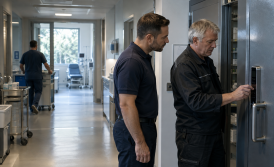
A medical license alone is not enough to launch opioid agonist therapy in a private clinic. The clinic must coordinate controlled-drug licensing, premises, police approval, medication records, eHealth, and NHSU requirements where applicable.

A private clinic using supplied blood components for transfusion does not follow the same licensing route as a blood collection facility. It still needs a hospital blood bank, transfusion immunology testing, hemovigilance, and traceability.

School psychologists, speech therapists, rehabilitation specialists, and massage therapists do not always require medical licensing. The key issue is whether their actual work is educational or corrective, or amounts to medical care or rehabilitation.

For companies with hazardous working conditions, employee medical examinations form part of occupational health management. An in-house occupational health office requires suitable premises, equipment, qualified staff, and medical licensing.
Our other authors