

License Obtained, but Not Ready to Operate: 7 Questions About Electricity Supply Readiness
Reviews of our Clients
... our work on joint projects assured us of your high level of professionalism
You have a valid NEURC electricity supply license in hand. Legally, everything looks fine: the company is authorized to supply electricity. Then the first potential customer calls, ready to sign a contract immediately.
But you cannot answer a simple question: can I actually start supplying this customer tomorrow?
A license confirms the right to operate, not operational readiness. Between those two points lies an entire layer of registrations, agreements, and processes that are often overlooked until there is a real need to onboard the first customer. An imbalance settlement agreement, market registration, a functioning website with up-to-date documents, and a prepared customer contract are what turn a license from a document in a folder into an operating business.
We do more than help clients obtain an electricity supply license or buy a ready-made company with an electricity supply license. We identify what a specific company is still missing, arrange the required registrations and agreements, and bring the supplier to the point where it can begin real operations with customers.
Before going into the details of each registration, test your company against seven simple questions. They will quickly show where the gap lies between “we have a license” and “we can start selling electricity today.”
You may also find this useful: Buying a Ready-Made Company With an Electricity Supply License and Operating History—When Does It Make Sense?
What Does It Mean in Practice for an Electricity Supplier to Be “Ready to Operate”?
Supplier readiness is not one document or one registration. It is the point at which the legal, market, and operational parts of the business work together.
In practice, this means the company:
- holds a valid license to supply electricity to consumers;
- has obtained the statuses, agreements, and registrations required for its chosen operating model;
- has arranged imbalance settlement;
- can purchase electricity on the market segments it needs;
- has the contractual arrangements required to serve customers within the territories of the relevant system operators;
- has completed any required registration as a wholesale energy market participant, where applicable to its activities;
- has customer agreements, commercial offers, and a clear procedure for working with consumers;
- has its website, reporting, document flow, invoicing, and internal control of regulatory obligations properly set up.
How much of this is already in place in your company? And how much are you prepared to arrange yourself if you buy a company?
Why an Electricity Supply License Alone Is Not Enough to Start Operating
An electricity supply license confirms that the company has the right to supply electricity to consumers. By itself, however, it does not provide access to every market mechanism required for actual operations.
The law expressly provides that one of the mandatory conditions for market participation is the settlement of imbalances with the transmission system operator.
That is why a buyer may acquire an LLC with a valid license and still be unable to start supplying customers the next day.
Before buying such a company, we recommend checking not only the license but also the supplier’s actual operational readiness: contracts, market statuses, registrations, website, reporting, and its history of compliance with licensing requirements.
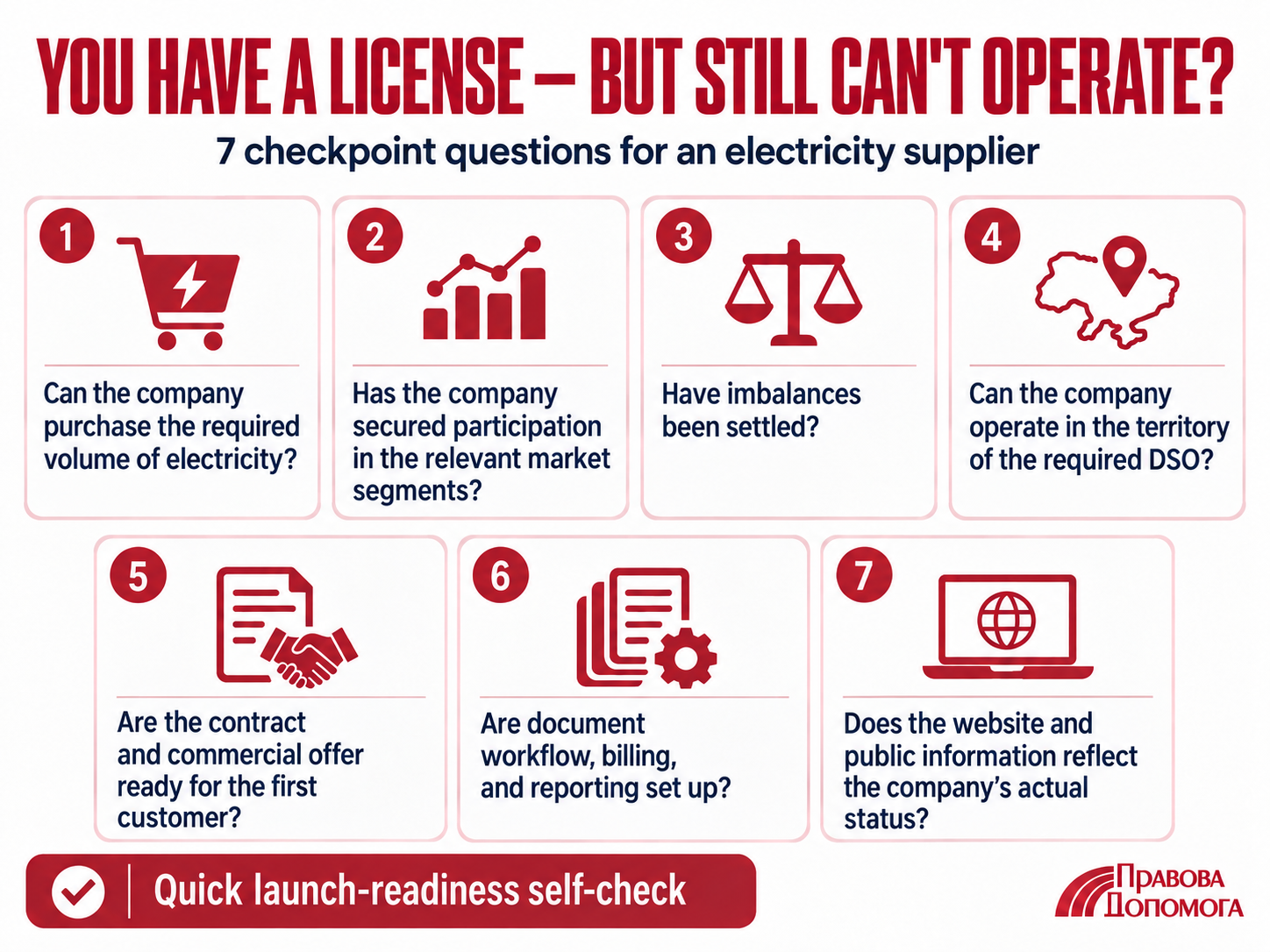
How to Check Whether a Company Is Actually Ready to Start Supplying Electricity: 7 Control Questions
We use a practical approach: we model the onboarding of the first customer.
We check the following.
Can the Company Purchase the Required Volume of Electricity?
Why it matters:
Having a license does not automatically mean the company can purchase electricity on the market segments required by its business model. The supplier must understand where it will source electricity and whether the necessary arrangements for those purchases are already in place.
If the answer is “no”:
The procurement model contemplated by the business plan must be defined, and the company must identify which registrations, agreements, or other organizational steps are still missing.
Is the Company Properly Set Up to Participate in the Relevant Market Segments?
Why it matters:
A supplier may plan to operate across several market segments, but each segment may require separate organizational steps. If those steps have not been completed, the company will not be able to operate under its intended model.
If the answer is “no”:
First determine which market segments the company actually plans to use, then arrange the necessary registrations and contractual relationships.
Have Imbalances Been Properly Settled?
Why it matters:
In electricity supply, actual consumption may differ from forecast volumes. For the supplier, this creates imbalances and corresponding settlement obligations. If the imbalance mechanism has not been arranged, the company is not ready for full-scale customer operations.
If the answer is “no”:
Review the status of the relevant agreements and arrange imbalance settlement in line with the company’s chosen operating model.
Can the Company Serve Customers in the Required DSO Territory?
Why it matters:
If prospective customers are located within the territory of a particular distribution system operator (DSO), the supplier must be ready to operate in that area. A license alone does not resolve the practical requirements for supplying a specific customer.
If the answer is “no”:
Check whether the necessary contractual relationships with the relevant distribution system operator are in place and arrange them if needed.
Are the Customer Contract and Commercial Offer Ready for the First Customer?
Why it matters:
Even if the company is technically ready to operate in the market, sales cannot be launched properly without a prepared contractual model. Each new customer should not require a completely new set of documents to be drafted from scratch.
If the answer is “no”:
Prepare the customer-facing document package and establish a clear procedure for contract execution, accession, and settlements.
Are Document Flow, Invoicing, and Reporting Set Up?
Why it matters:
Electricity supply is not a one-time contract signing. Once the first customer appears, regular settlements, document exchange, accounting, reporting, and other operational tasks begin. If these processes are not set up in advance, problems will arise immediately after operations start.
If the answer is “no”:
Assign responsible persons and set up document flow, accounting, invoicing, and control of regulatory obligations.
Does the Company’s Website and Public Information Reflect Its Actual Status?
Why it matters:
An electricity supplier’s website is part of how it works with consumers. Outdated information, missing mandatory documents, or public data that does not match the company’s actual status can create problems even before the first contract is signed.
If the answer is “no”:
Conduct a separate website compliance review, update the information, and publish the documents required for an electricity supplier.
A Company With a License but No Actual Electricity Supply History Requires a Separate Review
The absence of customers or business transactions does not necessarily mean the absence of regulatory obligations. The company may already have obligations relating to reporting, updating public information, website requirements, regulatory contributions, or other duties arising from its status as a licensee.
A “company with no activity” does not necessarily mean a “company with no history or risks.” Before launch or acquisition, it is advisable to review the entire period from the date the license was issued through the date of the audit.
You may also find this useful: Buying a Ready-Made Company With an Electricity Supply License—A Faster Route to Market
What Should Be Prepared Before Signing Customer Contracts?
Before acquiring the first customer, the supplier should have a complete document package ready for electricity sales.
This package may include:
- an electricity supply agreement with the consumer;
- an accession application, if that model is used;
- a commercial offer;
- the procedure for setting and changing the price;
- payment terms;
- the procedure for submitting meter readings and exchanging information;
- documents for electronic document flow;
- rules for handling customer applications, claims, and complaints.
A properly prepared package allows the sales team to work under an established process instead of sending every new customer to a lawyer for a completely new agreement.
The contractual package should be prepared for the supplier’s actual business model, not as an abstract template.
A supplier serving large industrial consumers and a supplier focused on small and medium-sized businesses may require very different commercial terms, settlement mechanisms, payment security, payment periods, and price-adjustment rules.
Before launching sales, the company should therefore define its target customer, how the price will be formed, and how the supplier intends to generate revenue.
You may also find this useful: How to Become an Electricity Supplier—The Bilateral Contracts Market

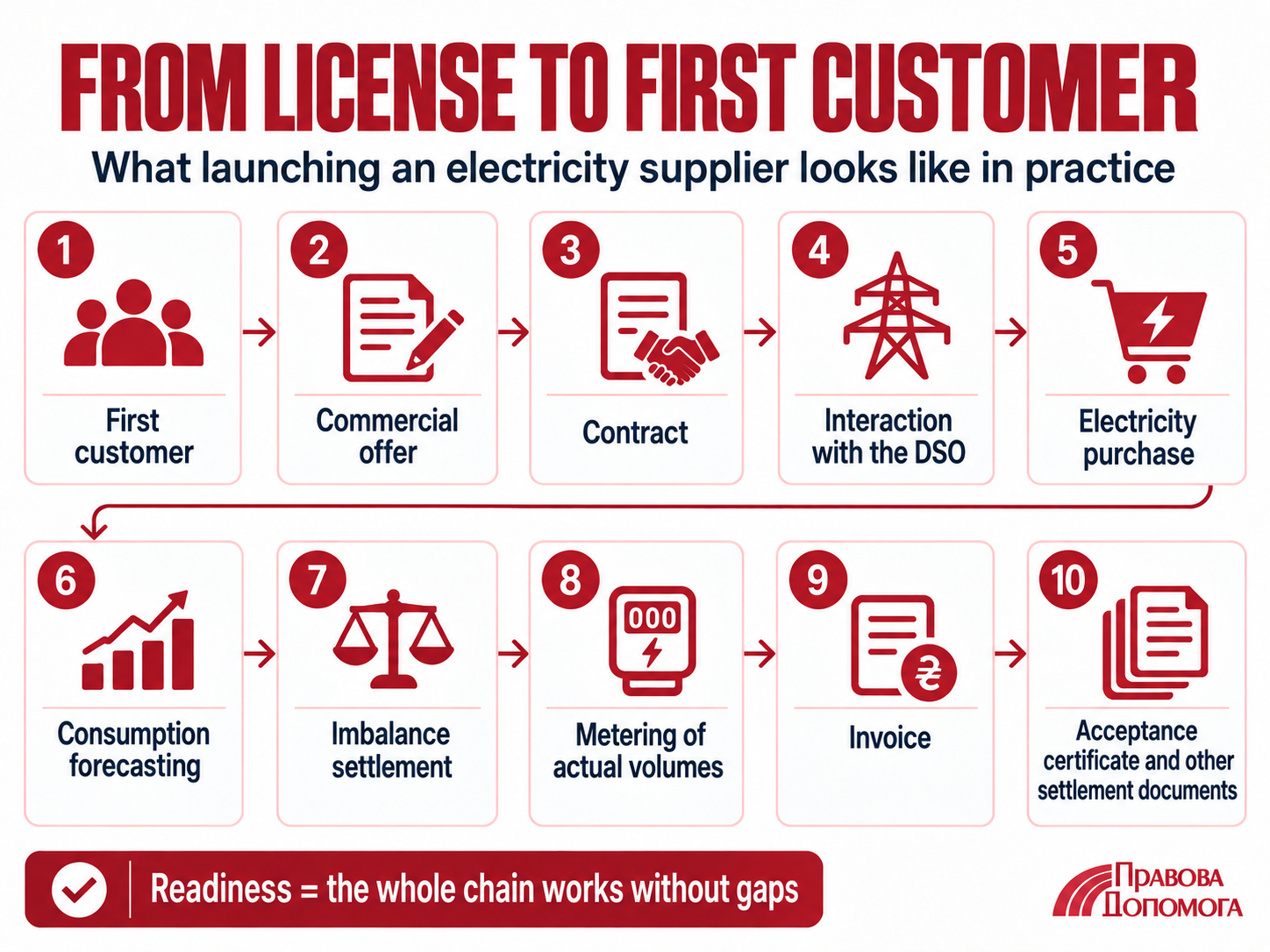
From License to First Customer: What an Electricity Supplier Launch Looks Like in Practice
The best way to test whether the company is ready is to go through the entire process as if the first customer had already been found and onboarding were scheduled to begin tomorrow.
Under this model, we review the entire chain:
first customer → commercial offer → contract → interaction with the relevant system operator → procurement of the required electricity volume → consumption forecasting → imbalance settlement → accounting for actual volumes → invoice → acceptance certificate and other settlement documents.
This test quickly reveals weak points that are not visible in a formal license review.
For example, a company may have all basic registrations but no established procedure for approving a price for a new customer. Or it may have agreements with market participants but no responsible person monitoring forecasts and actual consumption volumes. Or it may be legally ready for sales but lack a functioning process for invoicing and month-end closing.
Our objective when preparing a supplier is therefore not simply to obtain as many agreements and registrations as possible, but to build a repeatable operating model that can onboard not only the first customer but future customers without restarting the entire process each time.
Electricity Supplier Readiness Map
For a company that already holds a license, the first step should be an audit and a map of its actual market readiness.
The readiness map can separately record:
- what is already in place and can be used;
- which agreements or registrations are missing;
- which documents need to be updated;
- whether there are issues with previous reporting or compliance with licensing requirements;
- which market segments the company can already operate in;
- which DSOs the company is ready to work with;
- whether the customer-facing document package is ready;
- which actions are critical before the first supply starts;
- which processes can be set up in parallel after operations begin.
This approach avoids unnecessary “template” steps and allows a launch roadmap to be built for the specific company.
You may also find this useful: What Reports Must Be Filed With NEURC?
What Issues Are Most Commonly Found in “Ready-Made” Licensed Companies?
The most common mistake buyers make is checking only whether there is a NEURC resolution granting the electricity supply license.
In practice, a ready-made company may have:
- a license but no complete market registration;
- agreements that are missing or no longer up to date;
- no required REMIT registration;
- no customer supply agreements prepared;
- a website with outdated documents;
- missed reporting obligations or issues relating to regulatory contributions;
- changes to the director, address, owners, or contact details that were not properly reflected;
- a company that looks “ready on paper” but has no working process for onboarding the first customer.
At first glance, each of these issues may appear technical. In practice, however, any of them can delay the company’s launch.
For example, if the necessary market arrangements are missing, the company may hold a license but still be unable to carry out the intended operations. If customer documents are not ready, the first sale may have to be postponed until the legal package is completed. Outdated website information or inconsistencies in company data may also require additional remediation.
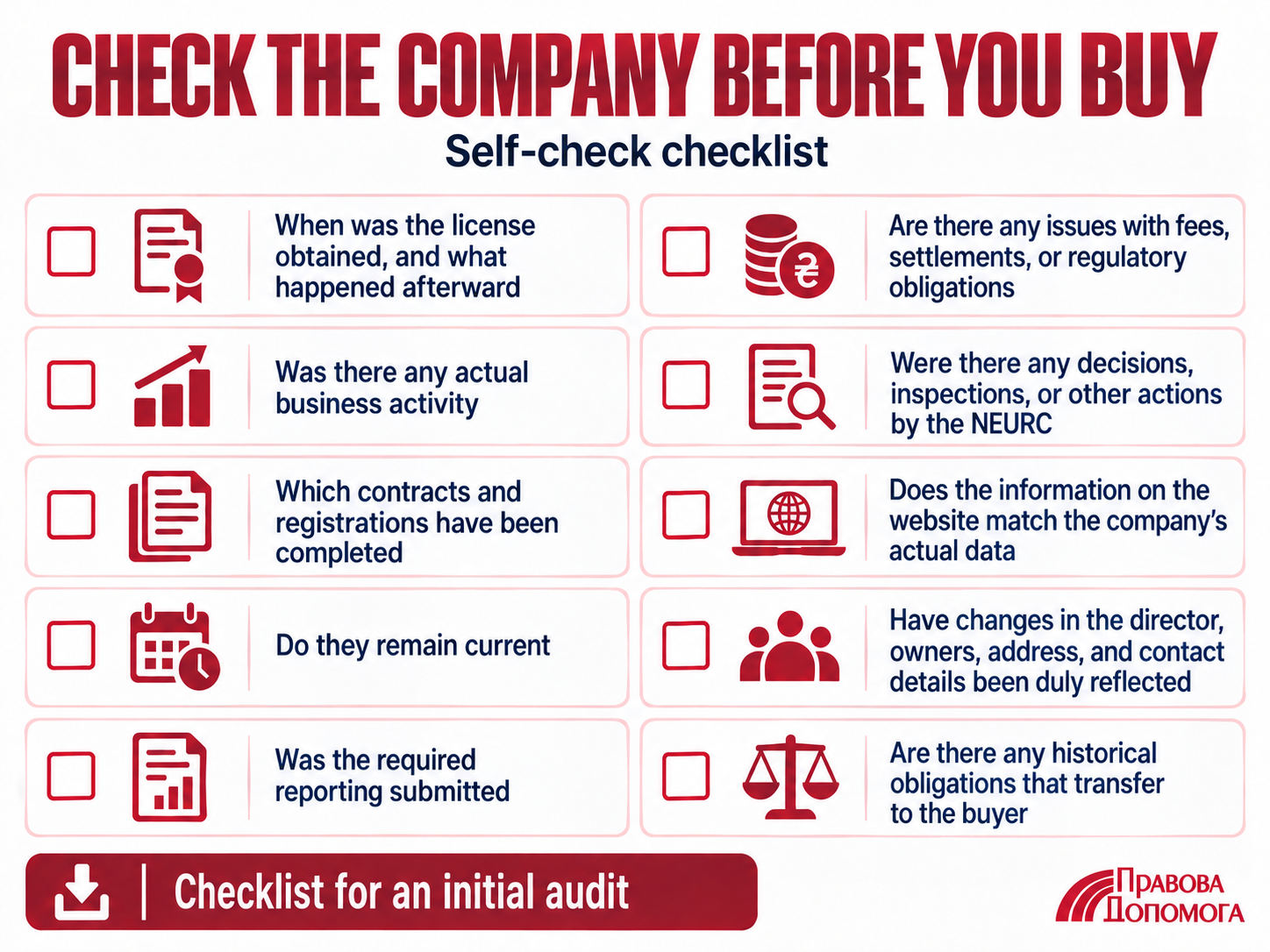
What to Check Before Buying the Company
- when the company obtained its license and what happened after that;
- whether it carried out actual business activity;
- which agreements and registrations were completed;
- whether they remain current;
- whether the required reporting was filed;
- whether there are unresolved issues relating to regulatory contributions, settlements, or other regulatory obligations;
- whether NEURC issued any decisions, conducted inspections, or took other measures in relation to the company;
- whether the information on the website matches the company’s actual data;
- whether changes to the director, owners, address, or contact details were properly reflected;
- whether there are agreements, obligations, or historical transactions that the buyer will effectively acquire together with the corporate rights.
Some deficiencies do not prevent the company from receiving a license, so the owner may not notice them until a real customer appears.
The problem becomes serious when the price has already been agreed, the supply start date has been set, and the customer expects to switch suppliers, but the company suddenly discovers that a required agreement, registration, access right, or document is missing.
At that point, a legal or organizational issue becomes a commercial problem: the company risks losing the customer, delaying the start of supply, or urgently rebuilding its processes around a specific transaction.
That is why it is more cost-effective to test market readiness before active sales begin, not after the first contract has already been agreed.
How We Can Help
We can step in at any stage:
- Sell you a ready-made company with a valid electricity supply license: after a preliminary review of its legal and licensing status.
- Bring the company onto the electricity market: identify the required registrations and agreements and organize their completion.
- Prepare the supplier to work with customers: customer agreements, commercial offers, website compliance, internal procedures, and document flow.
- Provide ongoing legal support to the electricity supplier: monitor regulatory requirements, changes, reporting, and day-to-day legal issues.
If you already own a licensed company or plan to buy one, we can audit its readiness and provide a specific list of what still needs to be completed before the first customer is connected.
For an initial assessment, it is enough to provide the company details and briefly describe the intended operating model: who you plan to supply, in which territories, and how you plan to procure electricity. We can then identify which launch elements are already in place and which still need to be arranged.
Our companies are created specifically for sale. They are clean, not publicly listed for sale, and the company code is disclosed only after prepayment. We also give you time to conduct your own due diligence through your preferred channels.
After acquisition, you can obtain all services for the future supplier in one place—from registrations and market entry through to filing reports with NEURC. The matter is handled by a team of lawyers, accountants, website developers, and electricity-market specialists.
Do you want to launch an electricity-market business safely and in compliance with the law? Contact us. We will make sure the company is fully prepared to start operating.
You can choose a ready-made company here.
Services on the topic of this material
Our publications on this matter

Our clients


We are ready to help you!
Contact us by mail [email protected] or by filling out the form:
Other publications

A valid electricity supply license does not mean the supplier is ready to serve its first customer. Market participation, imbalance arrangements, contracts, DSOs, website, reporting, and internal processes must also be checked.

The license is only the starting point. The new owner still needs to update company data, verify market registrations and contracts, and set up the website, balancing, and reporting before serving the first customer.

The owner and director do not need to return to Ukraine to liquidate an LLC. The process can be handled through a representative and liquidator if the power of attorney and foreign documents are prepared correctly.

A full teaching staff, library, and some facilities do not always need to be in place when the application is filed. The key is knowing what must be ready from the start and what can be completed later through written commitments.
Our other authors