

LLC Liquidation in Ukraine When the Owner and Director Are Abroad
Reviews of our Clients
... our work on joint projects assured us of your high level of professionalism
An owner’s or director’s move abroad does not mean that a Ukrainian limited liability company (LLC) has to be left in limbo. A “dormant” company does not disappear on its own. It continues to accumulate problems: tax debt you may not even know about, reporting requirements that no one fulfills, and a status that could at any time lead to claims against you personally as the director or owner.
A company can be liquidated even when its owner and director are physically outside Ukraine. Most legal steps can be arranged through a representative and a liquidator in Ukraine, while the necessary documents can be executed abroad.
The problem is usually not that this is impossible, but that documents prepared without proper guidance—with an incomplete list of powers or incorrect legalization—have to be redone, extending the process by months.
There is another question worth asking before you sign anything: do you actually need standard liquidation? If your goal is simply to stop looking after the company rather than formally terminate the legal entity, transferring corporate rights to a new owner may be a much faster and more practical solution.
The key is to structure the process correctly from the outset. You need to determine who will sign the documents, who will represent the company before the state registrar and the tax authorities, and whether there are debts, assets, employees, open bank accounts, or unfulfilled contracts.
We have been assisting with company liquidations for over 20 years, so we understand both the formal procedure and the problems that can delay an LLC’s termination for months. If the owner and director are abroad, we organize the process so that as many matters as possible can be handled remotely, without unnecessary trips to Ukraine.
Here, we explain which documents to prepare, how to legalize them, who can act in the director’s place in Ukraine, and how to choose between liquidation and an alternative way to exit the business.
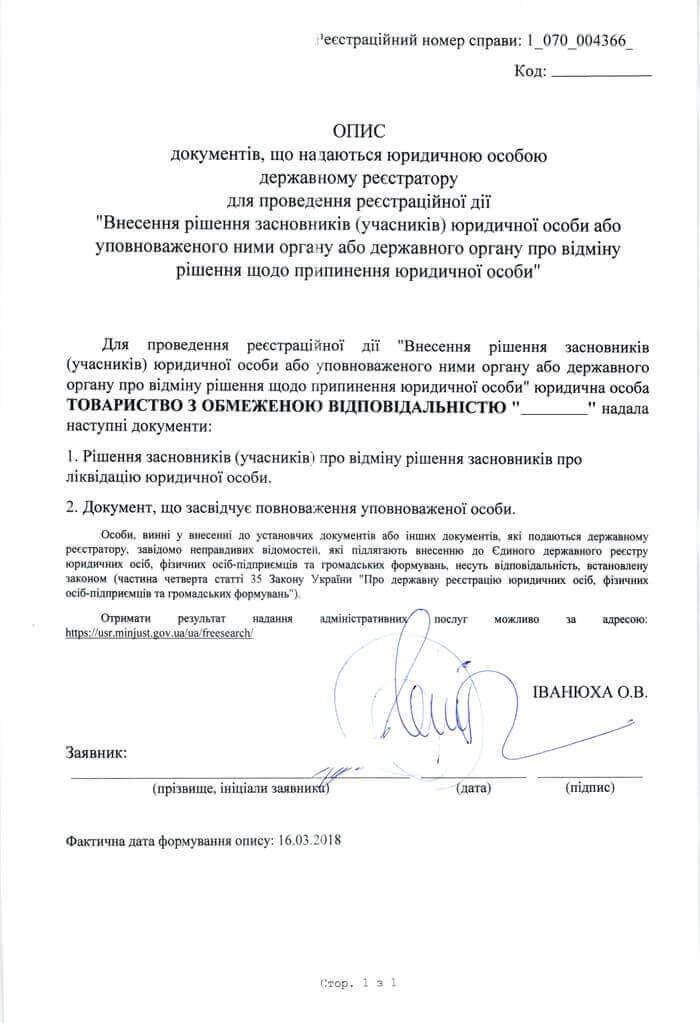
What the Owner Needs to Do: Power of Attorney, Liquidation Resolution, and Other Documents
The first step is to adopt a resolution to terminate the LLC.
If the company has one member, that member executes a written resolution. If it has several members, liquidation is decided at a general meeting. Under the general rule in the Law of Ukraine “On Limited and Additional Liability Companies,” a resolution on reorganization or liquidation requires three-quarters of the votes of all members entitled to vote, although the charter may set a different voting threshold permitted by law.
The resolution generally needs to:
- state the decision to liquidate the company;
- appoint a liquidator or liquidation commission;
- establish the procedure and the period for creditors to file claims.
The Civil Code of Ukraine provides that this period must be no less than two and no more than six months from the date the notice of termination is published.
If the owner is abroad, it is also advisable to execute a power of attorney for a representative in Ukraine. It should cover the full range of powers needed from the outset: participation in corporate procedures, submission and collection of documents, dealings with notaries and registrars, representation before government authorities, and any other actions required in the particular circumstances.
The law allows LLC members to participate in general meetings either personally or through representatives. The owner’s absence from Ukraine therefore does not, by itself, prevent liquidation from beginning.
In practice, we first review the charter and company information, and only then prepare the resolution and power of attorney.
Important: a general power of attorney “to represent interests” may be insufficient for a particular registration or notarial act. That is why we prepare the power of attorney around its specific purpose and the powers required, so that the representative can properly take the relevant actions on the principal’s behalf.
How to Execute Documents Abroad: Notary, Apostille/Legalization, and Translation
There are two main ways to execute documents while outside Ukraine.
The first is to contact a Ukrainian diplomatic or consular mission, if it offers the relevant notarial act. Ukrainian consuls are authorized to perform notarial acts, including notarizing powers of attorney and statements.
The second option is to execute the document before a local notary in the country where you are staying. In this case, you need to check which rules for recognizing documents apply between that country and Ukraine.
For countries that are parties to the 1961 Hague Convention, an apostille is generally used. If the relevant international agreement does not apply, consular legalization may be required. At the same time, certain international treaties to which Ukraine is a party allow some documents to be accepted without an apostille or legalization. The requirements must therefore be determined based on the country where the document is executed, rather than applying one rule to every country.
A document drawn up in a foreign language must also be properly translated into Ukrainian for use in Ukraine, in accordance with the requirements of the particular registration or notarial act.
This is often where unnecessary costs arise: the owner first executes a power of attorney using their own template, only to discover after sending it to Ukraine that a necessary power is missing or the document has been incorrectly legalized.
The best approach is therefore different: first, a Ukrainian lawyer prepares the document and instructions for executing it in the specific country, and only then does the owner visit a notary or consulate.
Related reading: “Dormant” LLCs in Ukraine: What Are the Risks?

Does the Director Have to Return to Ukraine?
In most cases, no.
After adopting a resolution to terminate the company, the owners appoint a liquidator or liquidation commission. Upon appointment, the liquidator assumes the powers to manage the legal entity’s affairs.
There is therefore no need to build the entire procedure around the current director. Another person who is in Ukraine can be appointed as liquidator and guide the company through every stage of termination.
This is especially convenient if the director lives abroad permanently and has no plans to visit Ukraine in the near future.
Before liquidation begins, it is essential to properly hand over documents and information about the company’s operations:
- accounting databases;
- primary documents;
- contracts;
- information on bank accounts, accounts receivable and payable, tax reporting, and other relevant matters.
That is why we recommend starting with a brief legal and tax audit of the LLC’s readiness for termination, and only then beginning the registration procedure. This identifies problems in advance that would otherwise emerge during liquidation.
Who Can Act as Liquidator and Represent the LLC in Ukraine?
The LLC’s members appoint the liquidator in the termination resolution. This can be the director, a member, or another person whom the owners trust to carry out the procedure, unless the law imposes special requirements for the particular company. Once appointed, the liquidator assumes the powers to manage the company’s affairs during the termination procedure.
This makes it possible to organize the process so that the owner and former director do not have to handle every matter in Ukraine personally.
The liquidator coordinates dealings with creditors and debtors, documents, reporting, company property, government authorities, and the final termination formalities.
However, one person does not necessarily have to perform every function. For example, an attorney or lawyer can provide legal support, an accountant can handle the accounting work, and a person appointed by the owner can exercise the liquidator’s formal powers.
For an owner abroad, this arrangement is usually much simpler than trying to coordinate the tax authorities, registrar, archive, and accounting work from another country.
How Remote LLC Liquidation Works: Key Stages
Standard voluntary liquidation involves a series of legal, accounting, and tax procedures, rather than a single registration action.
The process usually proceeds as follows:
- the owner or general meeting adopts a resolution to liquidate the company and appoint a liquidator;
- information about the termination resolution is entered in the Unified State Register;
- the prescribed period for creditors to file claims begins;
- the liquidator reviews assets, accounts receivable and payable, and makes settlements;
- outstanding obligations are fulfilled, and matters involving employees, contracts, accounts, and property are resolved;
- the required tax and other reports are filed, and settlements with the budget are completed;
- liquidation balance sheets and documents subject to archival retention are prepared;
- once the procedure is complete, documents are submitted for state registration of the LLC’s final termination.
We describe the full process and time frames in our article “How to Close an LLC in Ukraine and Key Features of the Updated Legislation After 2025.”
If the owner is abroad, their involvement can be concentrated on a few key steps: approving the approach, executing the necessary power of attorney and corporate documents, and providing company information. The liquidator and the team assisting with the procedure handle the main work in Ukraine.
What Problems Can Arise: Debts, Tax Authorities, and Missing QES or Documents
An LLC is easiest to liquidate if it is not actually operating, has orderly accounting records and up-to-date reporting, and has no employees, assets, litigation, or debts.
If the company has operated for many years, the situation may be more complicated.
One of the main problems is tax debt or reporting errors. The Main Department of the State Tax Service (STS) in Kyiv identifies tax debt, unfiled or late reports, open bank accounts, failure to carry out a prior reconciliation of settlements with the budget, and unresolved tax overpayments as common problems during the termination of legal entities. The tax authorities also note that a documentary tax audit is not conducted in every case of termination.
The second problem is missing documents. For example, accounting records may still be held by the former accountant, primary documents may have been lost, HR records may be missing, or the owner may not know which company contracts and obligations remain in effect.
The third is lack of access to electronic services and a qualified electronic signature (QES). If the director has been abroad for many years, their signing key may have expired, access to the electronic taxpayer account may have been lost, and the accountant who was granted electronic authorization may no longer work with the company. This does not mean liquidation is impossible, but these issues need to be resolved before the final reports are filed. Filing reports on paper is another option.
Companies with assets, substantial accounts receivable or payable, litigation, or creditor claims form a separate category. In these cases, the first step is to determine whether the LLC has sufficient property to meet its obligations and whether voluntary liquidation is an appropriate procedure at all.
That is why we begin by reviewing the company’s position, rather than submitting an application to the state registrar. Starting liquidation is straightforward. It is much more important to understand whether you can complete it without unforeseen problems.
How Long Does Liquidation of an LLC in Ukraine Take When the Owner and Director Are Abroad, and What Are the Alternatives?
Standard liquidation of an LLC cannot be completed in a few days.
The period for creditors to file claims alone must be at least two months. Additional time is needed to prepare liquidation documents, address accounting and tax obligations, settle with creditors, arrange archival storage, and complete final registration.
If the company has reporting problems, debts, or an incomplete set of documents, the procedure may take considerably longer. The STS also explicitly states that tax debt, unfiled reports, and other unresolved issues can significantly delay a company’s termination.
That is why, before starting standard liquidation, we always ask the client another question:
Do you specifically need to terminate the legal entity, or is your main goal to exit the business quickly and stop managing the company?
These are different objectives.
If the company must be fully terminated and removed from the Unified State Register, the standard liquidation procedure is required.
However, if the main goal of an owner who has lived abroad for a long time is to end their membership in the LLC, transfer the business to someone else, and stop dealing with its day-to-day operations, an alternative is worth considering: transferring corporate rights while replacing the member and director at the same time.
This arrangement is often informally called “alternative liquidation,” although legally it is not liquidation. The company is neither terminated nor removed from the Unified State Register. Instead, its owner, director, and, if necessary, address, contact information, and other details are changed.
This option can be much more practical if termination of the legal entity itself is unnecessary. It allows the owner to avoid a standard liquidation procedure lasting many months and transfer management of the company to a new owner.
However, “alternative liquidation” must not be used to conceal debts or evade liability. A change of owner and director does not, in itself, erase the LLC’s operating history, tax obligations, or the potential liability of individuals for violations committed while they managed the company.
We therefore review the LLC first and only then recommend one of two options:
- standard liquidation, if the company needs to be permanently terminated;
- or transfer of corporate rights and replacement of the director, if the main goal is to exit the business quickly and in a legally sound manner without completing the full liquidation procedure.
We can analyze the LLC’s position, identify the best way to exit the business, prepare the resolution and power of attorney for execution abroad, arrange representation and the liquidator’s work in Ukraine, assist with matters involving the registrar, accounting, and tax authorities, and guide the procedure through to the desired outcome.
We recommend assessing your options before automatically starting liquidation. First, review the company and compare standard liquidation with the alternative. In many situations, the second option may be faster and more practical for an owner who lives abroad permanently.
Contact us if you want a safe way to resolve matters involving a company in Ukraine that you no longer need.
Services on the topic of this material
Our publications on this matter


Our clients
We are ready to help you!
Contact us by mail [email protected] or by filling out the form:
Other publications by the author

A valid electricity supply license does not mean the supplier is ready to serve its first customer. Market participation, imbalance arrangements, contracts, DSOs, website, reporting, and internal processes must also be checked.

The license is only the starting point. The new owner still needs to update company data, verify market registrations and contracts, and set up the website, balancing, and reporting before serving the first customer.

A full teaching staff, library, and some facilities do not always need to be in place when the application is filed. The key is knowing what must be ready from the start and what can be completed later through written commitments.

How to launch a BESS project in Ukraine: when an energy storage license is mandatory, how to register as a market participant, execute key commercial agreements, and commence operations.
Our other authors