

Form No. 1-OP: How to Report Stock and Responsible Storage — Current Tax Service Guidance

Reviews of our Clients
... our work on joint projects assured us of your high level of professionalism
A company sells tobacco products wholesale: it purchases some in Ukraine, imports others, and stores some at a logistics provider’s warehouse. Its internal records track the usual figures — receipts, shipments, and inventory balances. But these aggregate figures are no longer sufficient for the Form No. 1-OP report.
The current Form No. 1-OP, approved by Ministry of Finance of Ukraine Order No. 641 dated December 22, 2025 (as amended), has applied starting with the February 2026 reporting period. Therefore, by fall 2026, the main question for a wholesaler is no longer how to “switch to the new form,” but how to reconcile its figures with source documents, warehouse records, customs declarations, and information about storage locations.
The practical importance of this issue is also confirmed by recent guidance from the State Tax Service of Ukraine (STS): in August and September 2026, the tax authority separately reiterated the rules for reporting counterparty information, filing a report when no sales occurred, and reporting inventory held in custodial storage.
Below, we examine who must file Form No. 1-OP, what data should be reconciled before each monthly filing, and where discrepancies arise most often.
Which Tobacco Wholesalers Must File Form No. 1-OP?
Form No. 1-OP is a monthly report. Under the Procedure approved by Order No. 641, it must be filed by businesses that engage in wholesale trade in tobacco products, raw tobacco materials, tobacco, industrial tobacco substitutes, liquids for electronic cigarettes, and/or import or export these goods, provided they are not the manufacturers of those goods. The same categories of filers are identified in the STS guidance.
Accordingly, a company that purchases finished tobacco products from a Ukrainian manufacturer or imports them for subsequent wholesale sale must file Form No. 1-OP. Importing goods does not, by itself, make that company a manufacturer.
If the enterprise also manufactures the relevant products, it is necessary to determine which reporting form it must file. The STS explains that manufacturers holding both manufacturing and wholesale licenses for the relevant goods file Form No. 1-VP.
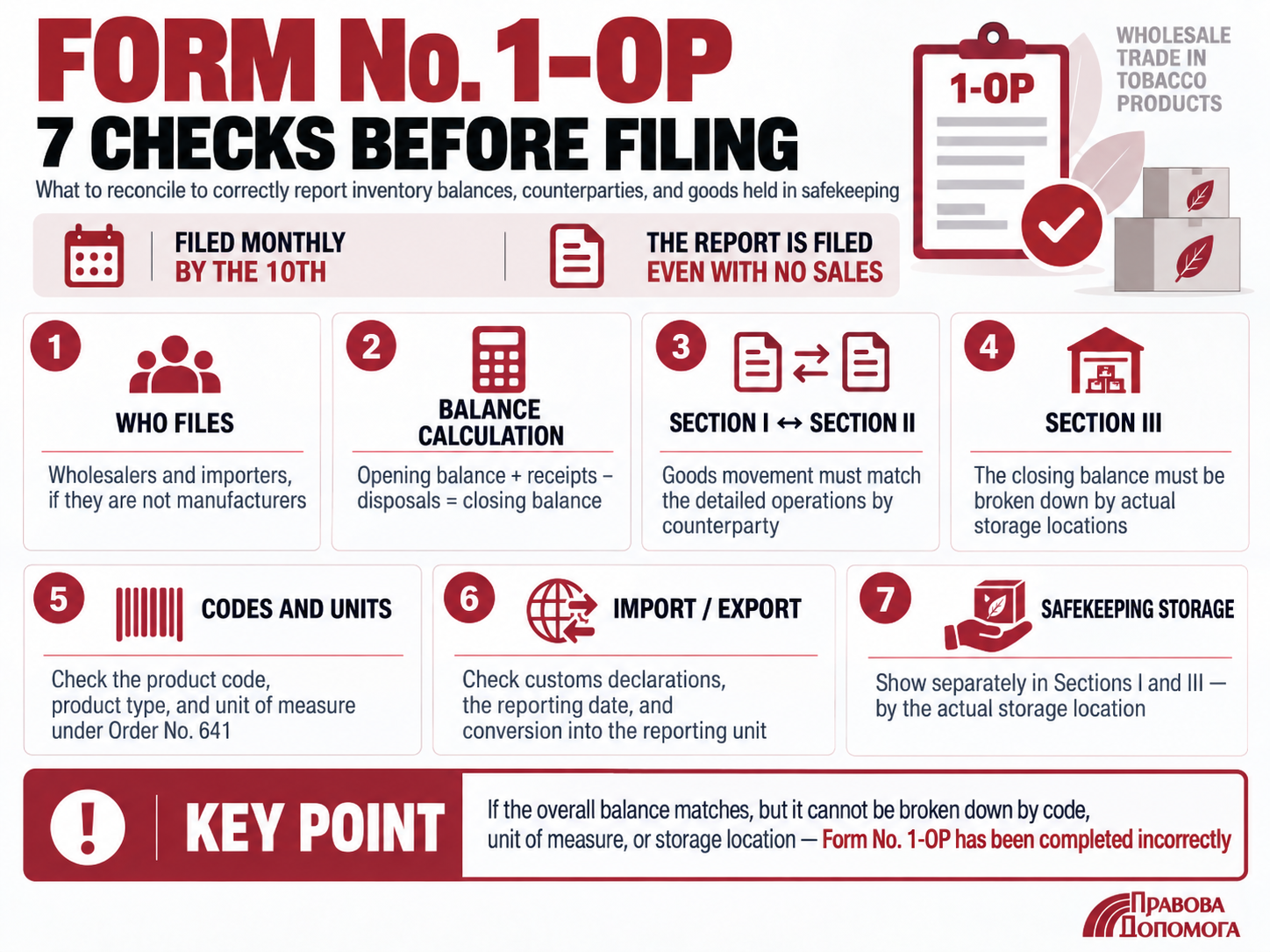
Form No. 1-OP must be filed monthly, no later than the 10th day of the month following the reporting month. The current form was first filed in March 2026 for February 2026.
Holding several wholesale licenses or dealing in several categories of goods does not, by itself, mean that a separate Form No. 1-OP report is required for each license. Details of the valid licenses are entered in the general section of the form.
Having no sales during a month does not eliminate the reporting obligation. In September 2026, the STS specifically reiterated that the report must be filed regardless of whether any activity took place during the reporting period or whether there is any remaining inventory. If there are no data for particular sections, the indicators prescribed by the form are used in the general section; where a specific numerical figure is absent, “0” is entered in accordance with the Procedure.
Example. Company A LLC holds a license for wholesale trade in tobacco products. It purchases cigarettes from a Ukrainian manufacturer and imports other tobacco products from the EU but manufactures nothing itself. The company files Form No. 1-OP and reports both domestic-market transactions and imports.
What to Check Before Each Form No. 1-OP Filing
Even after several months of working with the form, errors commonly arise because the same product batches are described differently in warehouse, accounting, customs, and licensing records.
To prepare Form No. 1-OP, the enterprise must reconcile three sets of data: product movements during the month, transactions with counterparties, and inventory balances at the end of the reporting period.
Section I of the form reports inventory balances, purchases or receipts of goods, and sales or transfers, including imports into Ukraine and exports from Ukraine. Transactions with counterparties are broken down in Section II, while end-of-period inventory balances by storage location are reported in Section III. The form and its completion rules are established by Order No. 641. These sections should be reconciled with one another and with internal records every month.
In practice, the following relationships should be checked at a minimum before filing:
- Opening inventory → receipts → outflows → closing inventory;
- Section I → counterparty-level transaction details in Section II;
- Closing inventory → actual storage locations in Section III;
- Warehouse unit of account → the unit of measure prescribed for the relevant product code under Order No. 641;
- Import and export transactions → customs declarations and the date on which the transaction is actually reflected in the report.
If the overall warehouse inventory balance reconciles but cannot be broken down by product code, unit of measure, or specific storage location, that is not sufficient for accurate completion of Form No. 1-OP.
Product Codes and Units of Measure: Where Technical Errors Occur
Goods must be reported using the product codes, product categories, and units of measure prescribed by the Order. If warehouse records are kept in packs or cartons, the quantity must be converted to the unit prescribed for that product category in the report, applying the established rounding rules.
Important! An additional check is required if the software still uses a reference directory configured for the previous Form No. 1-OP. An outdated code, an incorrect unit of measure, or automatic placement of a figure in the wrong section can produce a report that is formally completed but contains inaccurate information.
After conversion, the relationship between the opening inventory balance, receipts, outflows, and closing inventory balance should be checked. A discrepancy may indicate an error in the quantity, unit of measure, or reporting period to which the transaction was assigned.
Example: A wholesaler keeps cigarette inventory in packs. For Form No. 1-OP, the accountant first determines the number of individual products contained in those packs, then converts the quantity into the unit of measure prescribed for the relevant product code, and only then enters the figure in the report.
Practical Check
Before filing, it is advisable to check at least the following relationship:
Product code → product category → unit of measure under Order No. 641 → source documents → warehouse movements → month-end inventory. If the figures do not reconcile, the cause should be established before the report is filed.

How to Report Custodial Storage, Imports, Exports, and Reexports
The most questions arise when goods are stored somewhere other than the company’s own warehouse or pass through several stages of movement across the customs border. A general inventory turnover statement is usually insufficient for these transactions.
Custodial Storage
Custodial storage remains one of the most sensitive areas of Form No. 1-OP reporting because the legal owner of the goods and their physical location may differ.
Goods may belong to the wholesaler but be physically held at a logistics provider’s warehouse. Conversely, a company may be holding another company’s goods. The STS explains that products transferred to or received for custodial storage are reported in Sections I and III of Form No. 1-OP.
In Section III, inventory is broken down by storage location, including the individual registration number of the relevant location in the Unified Register of Storage Locations. For goods held by a custodian, information on their actual storage location is required. Inventory held in custodial storage is reported on separate lines in accordance with the STS guidance.
For each storage location, the company must have the correct identification details required by the form and reconcile them with the information about the actual warehouse. If the same batch moved between the company’s own warehouse and a custodian’s warehouse during the month, the internal movement register must make it possible to establish where that batch was located at the end of the reporting period.
In practical terms, before the monthly close, it is advisable to obtain confirmed inventory balances from the logistics provider broken down by product item, code, and batch, rather than only a total warehouse figure.
Imports
If a wholesaler imports tobacco products into Ukraine itself and is not their manufacturer, the import transactions must be reported in Form No. 1-OP. The figures in the report must be reconciled with customs declarations, product documentation, and warehouse records.
For each imported batch, it is advisable to check separately the product code and category under Order No. 641, the quantity converted into the reporting unit of measure, the date on which the transaction is reported, and the subsequent movement of the goods to their storage location.
Exports and Reexports
The export of tobacco products outside the customs territory of Ukraine is also covered by Form No. 1-OP. If goods were first purchased in Ukraine and later exported, their receipts, outflows, and inventory balances must be consistent in the report.
For reexported products, it is important to trace both stages of the transaction: initial import and subsequent export. For internal reconciliation, the documents can be assembled into one chain: import customs declaration → receipt into inventory → movement and storage → export customs declaration.
Units of measure should also be checked separately: customs, warehouse, and accounting documents may show different figures for the same batch. Information is transferred into Form No. 1-OP after reconciliation and conversion into the units prescribed by Order No. 641.
Companies that regularly import or export may also find our article “Foreign Trade Agreement: How to Draft an International Trade Contract That Protects Your Business” useful.
What to Do If There Were No Sales During the Reporting Month
Zero sales do not mean the form can be omitted. If the enterprise is required to report, Form No. 1-OP must be filed even for a month with no transactions. The Procedure separately governs situations in which data for a particular section are absent or an individual numerical indicator is zero.
This is also important for companies that temporarily made no sales but still held inventory at their own warehouse or at a third-party warehouse. That inventory must be correctly reported against the relevant storage location.
For unusual transactions where the reporting treatment remains disputed, it can be useful to establish the STS’s official position in advance. For details, see “Individual Tax Consultation: How to Document the Tax Authority’s Position.”
Useful tip: Before filing Form No. 1-OP, it is advisable to check the form itself, product codes, inventory balances, transactions, counterparties, storage locations, and the arithmetic relationships among the figures. To avoid missing anything, use our pre-filing Form No. 1-OP checklist.
How Can We Help?
Errors in Form No. 1-OP often arise when licensing information, customs documents, and warehouse records are maintained separately and are not reconciled before the report is filed. This is especially relevant to companies with several warehouses, goods in custodial storage, or foreign trade operations.
We can:
- determine whether your company is required to file Form No. 1-OP;
- check the categories of goods and transactions to be reported, product codes, and units of measure;
- reconcile inventory balances at company-owned and third-party warehouses;
- review imports, exports, and reexports;
- help correct errors in reports that have already been filed.
If a company is only preparing to begin wholesale trading in tobacco products, the process for collecting Form No. 1-OP data should be established before the first movement of goods. For companies already filing reports, it is useful to conduct a reconciliation check: does the current recordkeeping system allow each batch’s code, reporting unit of measure, counterparty, transaction, and actual storage location to be identified without manually reconstructing the data?
Need to review a Form No. 1-OP report or set up the reporting process without discrepancies in inventory, codes, and storage locations? Submit a request on our website or call the phone number provided.
Services on the topic of this material
Our publications on this matter
Our clients


We are ready to help you!
Contact us by mail [email protected] or by filling out the form:
Our other authors