

NHSU Contract: How to Conclude It—A Step-by-Step Guide for Medical Facilities and Sole Proprietors
Cost of services:
Reviews of our Clients
…we can confidently recommend the lawyers of Law firm «Pravova dopomoga» as reliable legal partners on the matters of medical practice licensing and other procedures related to the Ministry of Health of Ukraine.
... Having used the services of the Law Firm "Pravova dopomoga", we managed to solve our problems, as well as found a qualified and reliable partner.
Concluding a contract with the National Health Service of Ukraine (NHSU) is one of the key stages for a medical business that plans to work under the Program of Medical Guarantees and receive state funding for the services it provides. In 2026, the contracting procedure remains technically and legally complex. In addition to the standard document review, the NHSU actively monitors staffing, the compliance of premises, work in eHealth, and the actual provision of services.
In practice, medical facilities are often refused because of errors in the electronic system, noncompliance with service packages, or problems with staff employment paperwork. This is especially true of newly established clinics, dental practices, and doctors registered as sole proprietors (FOP doctors) who are going through the contracting procedure for the first time.
In this article, we will look at who can conclude a contract with the NHSU, what requirements apply in 2026, how the contract signing procedure works, and which mistakes most often lead to a refusal.
What Is a Contract with the NHSU
A contract with the NHSU is a contract for medical care of the population under the Program of Medical Guarantees between the National Health Service of Ukraine and a healthcare facility or a FOP doctor holding a license for medical practice: the facility provides patients with services under the Program of Medical Guarantees, and the NHSU pays for them at the tariff rate. The procedure for concluding, amending, and terminating it is established by Cabinet of Ministers of Ukraine Resolution No. 410 of 25.04.2018. As a rule, the contract is concluded for no longer than one calendar year; for up to three years, it is concluded only with providers of primary and emergency medical care, as well as with cluster, supra-cluster, and general facilities of the capable network. For the facility, the contract means payment for services under the packages included in the contract; for the patient, it means these services are free of charge.
You can find out whether a facility has a contract with the NHSU on the official NHSU website, where concluded contracts are published within five business days, or in the NHSU dataset “Concluded Contracts for Medical Care of the Population under the Program of Medical Guarantees” on the data.gov.ua portal.
Who Can Conclude a Contract with the NHSU: Requirements for Clinics and Sole Proprietors
Under Ukrainian law, the NHSU concludes contracts for medical care of the population under the Program of Medical Guarantees with healthcare facilities regardless of their form of ownership. The key legal requirement is a valid license to conduct business activities in medical practice, as established by part one of Article 8 of the Law of Ukraine “On State Financial Guarantees of Medical Care for the Population”. A FOP doctor with a license for medical practice can also conclude a contract on the same terms as a clinic; whether a package is suitable is determined by its procurement conditions.
A contract with the NHSU can be concluded by medical service providers that meet the basic requirements set out in Cabinet of Ministers of Ukraine Resolution No. 391 of 28.03.2018 “On Approval of the Requirements for a Provider of Medical Care Services to the Population with Which Chief Budget Fund Managers Conclude Contracts for Medical Care of the Population”. We covered in detail which requirements apply and which documents to prepare in our article on NHSU requirements and documents for the contract.
Basic Conditions for Medical Service Providers to Conclude a Contract with the NHSU in 2026
In 2026, the NHSU significantly tightened the requirements for medical facilities that plan to conclude or renew contracts under the Program of Medical Guarantees (PMG). Cabinet of Ministers Resolution No. 1808 as amended on 08.09.2026 provides for not only a review of documents but also an assessment of the facility’s actual readiness to provide medical services in line with the conditions of the specific package.
The basic contracting conditions consist of several blocks.
Connecting to eHealth (ESOZ) and Keeping Medical Records
Holding a valid license for medical practice and being connected to the electronic healthcare system eHealth (ESOZ) are only the technical starting point. The National Health Service of Ukraine closely monitors whether medical records are entered into the electronic system correctly, because eHealth data are the basis for paying for medical services.
If your doctor provided a medical service but made a mistake in coding the diagnosis under ICD-10 or closed an electronic referral incorrectly, the system will automatically reject that case when the payment report is generated.
Related reading: Registering a Medical Facility and a FOP Doctor in eHealth
Facilities, Equipment, and Staffing
In addition to the basic conditions, the requirements of each NHSU package contain specific criteria regarding:
- the number of medical staff;
- doctors’ qualifications;
- working hours;
- available equipment;
- premises and accessibility for people with limited mobility (paragraph 3 of the Requirements approved by Cabinet of Ministers Resolution No. 391);
- related medical services.
For example, for surgical packages, the NHSU checks for an operating room, anesthesia support, and round-the-clock patient monitoring. For rehabilitation packages, it checks for a multidisciplinary team and appropriate equipment. For dental packages, it checks that urgent care is provided and infection control requirements are met.
Strict Monitoring of Free Care and Financial Sanctions
The NHSU actively tracks cases where private or municipal facilities make patients pay for services that are already covered by the state under the Program of Medical Guarantees. If a patient received care at your clinic under an NHSU package, you have no right to charge them for consumables, anesthesia, or additional examinations included in that package.
If such facts are discovered through patient complaints or during scheduled monitoring, the NHSU applies tough measures:
- demands that funds be returned to the budget;
- stops payment for the package;
- terminates the contract with the facility;
- passes the information on to supervisory authorities.
The “Budget Neutrality” Risk
Under the law, the principle of “budget neutrality” also applies. This means that even when the number of services provided increases, adjustment coefficients may be applied and payment may be reduced if the actual volume of services claimed exceeds the budget of the Program of Medical Guarantees. For medical facilities, this creates an additional risk of financial instability and the need to constantly monitor the volume of care provided.

How to Conclude a Contract with the NHSU: A Step-by-Step Procedure
NHSU contracting takes place through the electronic system and consists of several consecutive stages. Skipping or carelessly completing even one of them completely ruins the chances of receiving state funding.
Step 1. Obtaining a License for Medical Practice
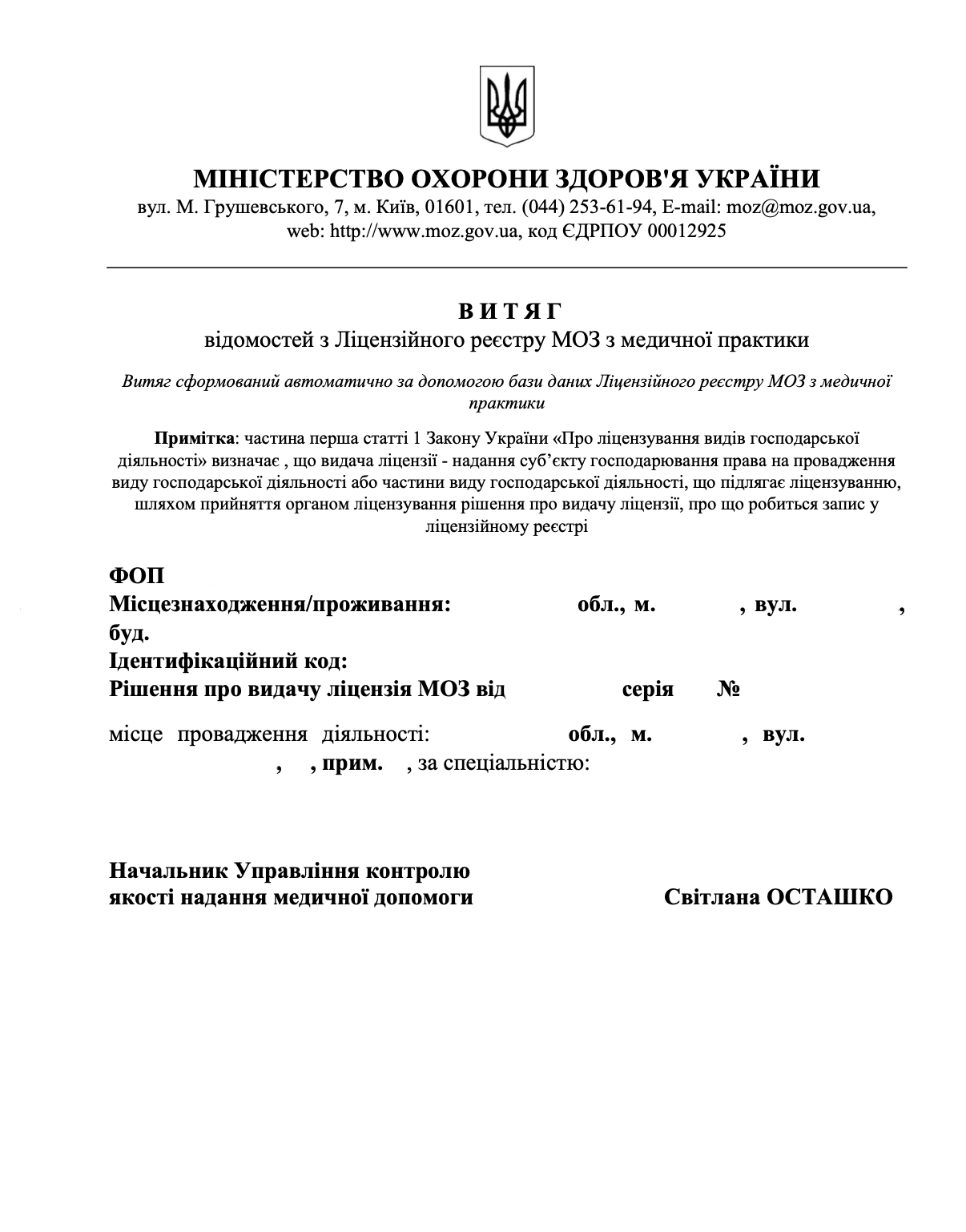
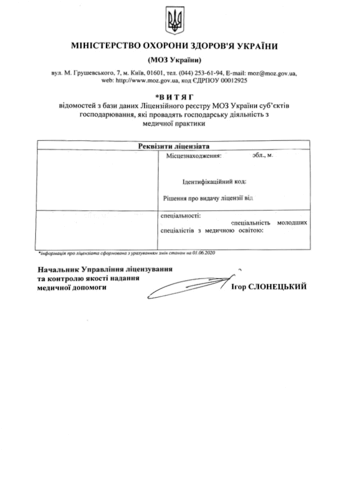
Without a valid license from the Ministry of Health of Ukraine (MoH), a medical facility or a FOP cannot count on medical contracts with the NHSU. So the first thing to do is to license your medical activities. If you already have a license, you should check that it matches the actual situation at the clinic. If necessary, amend the license, taking into account both the updated legal requirements and the NHSU criteria.
The specialties of medical staff, the addresses where activities are carried out, the material and technical resources, and the list of services in the license must meet the requirements of the chosen Program of Medical Guarantees package.
Step 2. Registering the Facility in eHealth (ESOZ)
After obtaining a license, the facility connects to the electronic healthcare system eHealth (ESOZ) through a Medical Information System (MIS). At this stage, the following are registered:
- the facility itself (a legal entity or a FOP);
- places where services are provided;
- doctors;
- junior medical staff;
- available medical equipment and structural units.
If some services will be performed by a subcontractor, such as a laboratory, information about the subcontractor must also be in eHealth before the proposal is submitted, and the subcontractor itself must be registered in the system and have its own license.
Authorized persons and medical workers who will conclude or perform the contract must use a qualified electronic signature (QES) or an advanced signature based on a qualified certificate that contains the facility’s details in addition to the person’s details.
Step 3. Analyzing the Requirements of the Specific PMG Package
The NHSU publishes the requirements for each service package on its official website. Before submitting a proposal, you must carry out a detailed internal audit of the facility for compliance with these criteria. For example:
- the number of doctors on staff;
- the required work experience and certificates;
- the floor area of the premises;
- the list of medical equipment;
- accessibility for people with limited mobility;
- agreements with laboratories or other facilities.
For instance, if you are applying for a specific PMG package, you must carefully check:
- whether your doctors have certificates and diplomas in the relevant specialty;
- whether a contract has been concluded for the disposal of medical waste of the relevant class;
- whether your ventilation system meets infection control requirements.
If you miss even one technical or staffing detail, your application will be rejected. To be on the safe side, we recommend ordering a professional legal audit of a medical facility before contracting begins.
Step 4. Submitting a Proposal to the NHSU
A proposal can be submitted only after the NHSU publishes an announcement on concluding contracts on its official website. The announcement sets out the procurement conditions and package specifications, what to state in the application and in the system, which documents to attach, the deadline and method of submission, and the review period. The NHSU does not consider proposals submitted after the deadline set in the announcement.
Proposals are submitted electronically in the way specified in the NHSU announcement: the Procedure for Concluding, Amending, and Terminating the Contract (Cabinet of Ministers Resolution No. 410) does not fix a submission channel. For example, under the announcement of May 12, 2026, proposals were accepted through the SmartTender platform.
Procedure No. 410 names only three attachments as mandatory for everyone:
- a document confirming the representative’s authority, if it is not in the Unified State Register;
- the facility’s confirmation of the accessibility of all places where services are provided and of translation into Ukrainian Sign Language (since 01.12.2025, a scan of the accessibility document is not submitted);
- documents on the implementation of a plan to eliminate violations, if there was one.
The rest of the document set and its form are determined by the announcement; for example, for an application in eHealth, the system asks for the charter. The license, places where services are provided, equipment, employees, authorized persons, and subcontractors are data in eHealth that must match the facility’s documents. Documents are submitted electronically, and scanned copies are submitted in the format specified in the announcement.
We have separately covered the full list of documents for concluding a contract with the NHSU and what to check in each of them.
Step 5. NHSU Review and Monitoring
After the documents are submitted, NHSU specialists analyze them. In recent years, the focus has shifted to detecting hidden abuses and technical inconsistencies. In some cases, additional explanations may be requested or monitoring measures may be carried out regarding the facility’s actual activities. Particularly close attention will be paid to:
- the actual number of patients;
- the substantiation of medical records;
- whether the services provided match the package;
- compliance with the principle of free care.
The application goes through several statuses in the system, and based on the results of the review, the NHSU makes one of three decisions. We explained what each of them means in our article on NHSU requirements and documents for the contract.
Step 6. Concluding the Contract and Further Control
If the proposal meets the conditions of the announcement, the NHSU prepares a draft contract, signs it, and sends it to the facility through the electronic system. The head or an authorized person of the facility must sign the contract with their qualified electronic signature within 10 calendar days; otherwise, the contract will be deemed not concluded. By signing, the facility confirms that it meets the procurement conditions. The contract enters into force on the date it is signed by both parties, and the NHSU publishes it on its website within five business days.
After the contract is concluded, the facility reports to the NHSU every month through the electronic system on the services provided, and the NHSU pays for them on the basis of the reports and an invoice. The data on the facility, places where services are provided, doctors, equipment, and subcontractors in eHealth must be kept up to date, because the NHSU checks reports against the system and demands repayment of overpaid amounts if there are discrepancies. For a new period, the facility, as a rule, submits a new proposal under a new announcement.
However, even after the contract is signed, a medical facility remains under constant NHSU monitoring. For violations it detects, the NHSU may stop payment, demand the return of funds received, or terminate the contract.
Mistakes and Reasons for Refusals in NHSU Contracting
Over years of supporting medical businesses, we have compiled a ranking of the worst mistakes that cost clinics and FOPs their NHSU contracts.
Staffing noncompliance and staff overload
One of the most common reasons for refusal is failure to meet staffing requirements. The NHSU checks not only whether there are doctors on staff but also:
- the validity of certificates;
- whether specialties match;
- official employment;
- the actual workload of staff;
- doctors’ work schedules.
Inadequate material and technical resources
Another common problem is that the material and technical resources do not meet the package requirements. Many clinics buy used medical equipment abroad without proper technical documentation, which often ends up causing problems with NHSU contracting.
It is important that all equipment listed in the package specifications has been properly put into operation and has valid metrological verification certificates (for measuring instruments such as ultrasound machines and electrocardiographs).
You should understand that if, for example, the verification expired even one day before the application was submitted, the package will be rejected.
So it is very common for a medical facility to formally have the required equipment, but that equipment:
- has not been put into operation;
- is not at the place where services are provided;
- does not meet the NHSU technical requirements;
- does not ensure round-the-clock operation of the package.
Related reading: Registration and Accounting of Medical Equipment in eHealth
Technical eHealth failures and organizational defects
A separate category of risk is errors in eHealth. Incorrectly entered data about the facility, doctors, care addresses, or equipment often lead to technical refusals when a proposal is reviewed. Today, the NHSU actively uses the electronic system to automatically check whether medical service providers meet procurement conditions.
In addition, grounds for refusal may include:
- lack of the required related packages;
- failure to comply with inclusiveness and barrier-free requirements;
- inconsistency with the patient pathway;
- lack of agreements with laboratories or other partners;
- discovery of false information in the submitted documents.
Particularly risky are cases where the NHSU finds signs that requirements are met only formally, “on paper,” without the actual ability to provide services. In such situations, the facility may not only be refused a contract but also become subject to further monitoring or inspections.
Legal Support for Concluding a Contract with the NHSU from Pravova Dopomoga
NHSU contracting is a rigorous state audit of your medical business. If you try to go through it on your own, you risk losing valuable time, being refused funding, or, even worse, facing sanctions and lawsuits because of unintentional errors in preparing your documents.
Pravova Dopomoga provides comprehensive support throughout the contracting process, minimizing any risks for your business. First of all, our lawyer specializing in medical law analyzes:
- licensing documents;
- staffing;
- the facility’s structure;
- compliance of the premises;
- medical equipment;
- data in eHealth;
- internal documentation.
Special attention should be paid specifically to compliance with the conditions of the particular NHSU package. In practice, many medical facilities mistakenly focus only on the general requirements without taking into account the special criteria of individual packages, and as a result they are refused after the documents have already been submitted. As part of legal support for NHSU contracts, we also check:
- employment relationships with medical staff;
- whether the required orders and internal regulations are in place;
- premises lease agreements;
- equipment documents;
- whether work schedules comply with NHSU requirements;
- whether registration in eHealth is correct.
In addition to preparing documents, we also help minimize risks after the contract has been concluded. Properly structuring internal processes at a medical facility is no less important than signing the contract itself. That is why it is important for medical facilities not only to formally meet NHSU requirements but also to properly organize internal processes, HR documentation, and work in the electronic healthcare system.
Protect your medical business from financial losses and bureaucratic traps. Get legal support for NHSU contracting from leaders in the medical law market: book a consultation with our specialized lawyers today.
Services on the topic of this material
Our publications on this matter

Our clients
We are ready to help you!
Contact us by mail [email protected] or by filling out the form:
Other publications by the author

Stock balances in Form No. 1-OP should be reconciled not only with warehouse records but also with storage locations, product codes, and source documents. Specific rules apply to responsible storage, imports, and exports.

A foreign company may still trigger CFC reporting even if it had no operations or income. The key factors are Ukrainian tax residency, ownership or actual control, while CFC notices and annual reports follow different filing rules.

A tax authority may interpret a transaction differently only when an audit begins, after the exposure has accumulated for years. An individual tax consultation allows a business to obtain an official position in advance for its specific transaction model.

Returning to Ukraine is not required for divorce in most cases. Depending on whether the spouses have minor children and both agree to divorce, the process may go through Diia, the civil registry, or court, while child and alimony issues can be handled separately.
Our other authors